


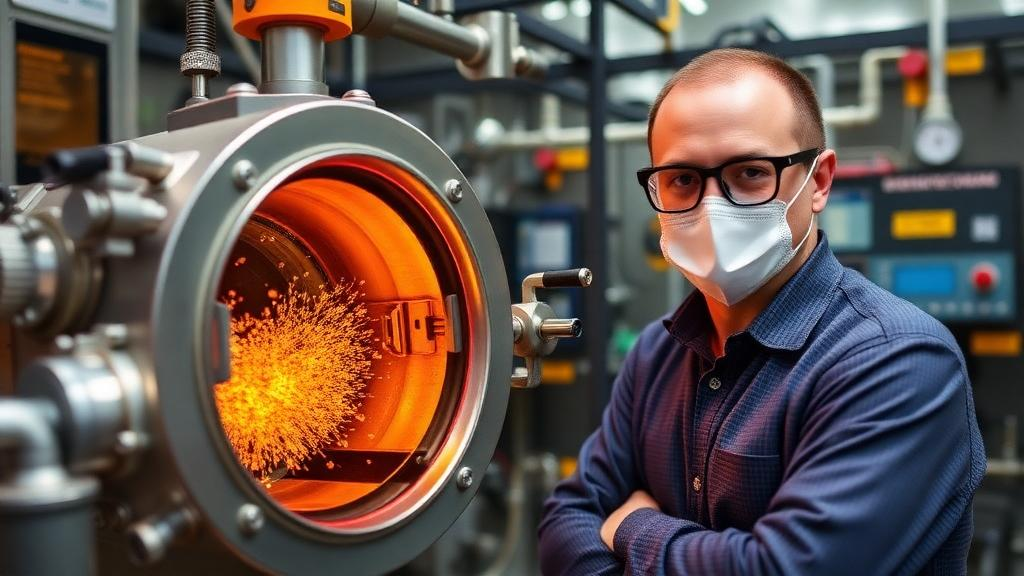
Inside every industrial reactor that promises to store heat in chemical bonds, there is a hidden world that no one has ever directly measured. Thousands of metal oxide particles tumble, collide, jam and flow through vessels heated to temperatures that would melt many metals, carrying energy in and out of reversible reactions. Yet the physics of how those particles actually move has remained largely invisible to engineers. A researcher at the University of Central Florida now intends to pull back that curtain. Like Li, an associate professor in UCF’s Department of Mechanical and Aerospace Engineering, has received a $400,000 grant from the U.S. National Science Foundation to characterize, for the first time, the mechanical and flow properties of particles inside thermochemical energy storage reactors operating at temperatures of up to 1,500 degrees Celsius.
The technology at the heart of the project is thermochemical energy storage, or TCES, a method of preserving energy through reversible chemical reactions rather than through sensible heat in water, molten salt or rock. In a TCES system, heat drives an endothermic reaction in a solid material, storing energy in the chemical products; later, the reverse reaction releases that energy as high-temperature heat. The approach offers several advantages that conventional storage technologies struggle to match. Chemical storage can hold heat for long periods with relatively low standby losses, it can operate continuously, and it can deliver heat at the high temperatures demanded by advanced manufacturing processes. For industries that need a low-cost, large-scale storage solution, those qualities make TCES an increasingly attractive candidate.
The obstacle, Li explains, is that almost nothing is known about the granular flow inside these reactors. Engineers can measure how much material enters and leaves the vessel, but the motion of particles within the bed itself has been extraordinarily difficult to observe. Optical techniques are generally restricted to surfaces or to reactors with transparent walls, which are impractical at extreme temperatures. Interior-probing methods such as X-ray tomography or magnetic resonance imaging can penetrate the bed, but they are complex, expensive and limited in resolution. At higher temperatures the problem compounds further, because particle properties shift under the combined influence of gas flow, heat transfer and chemical reactions. The result is a field that has advanced with very little experimental data to guide it.
To close that gap, Li and his team in UCF’s Thermal Energy Storage Development Lab will build a high-temperature test rig designed to measure particle mechanical and flow properties under reactor-relevant conditions. The rig will allow the researchers to quantify how metal oxide particles behave as they are heated, fluidized and cycled through reaction states at temperatures approaching 1,500 degrees Celsius. Those measurements will then feed into computational models, giving simulations an experimental anchor they have never had. With validated models, the team can examine the gas-particle, interparticle and particle-wall interactions that experiments alone cannot easily resolve, effectively reconstructing the invisible interior of a working reactor on a computer.
The simulation campaign is central to the project’s strategy. Li plans to use the models to evaluate different reactor designs and operating conditions, identify undesirable flow behavior before it causes problems, and develop new strategies for controlling how particles move through the system. The most promising of those particle-flow control strategies will then be tested experimentally on the rig to determine whether they genuinely improve overall reactor performance. This iterative loop between measurement and modeling is what distinguishes the effort from previous work in the field: rather than inferring particle behavior from indirect signals, the team intends to measure it directly and then design around what they learn.
The material focus of the experiments is metal oxide chemistry, particularly magnesium-manganese-oxide. Compounds in this family can repeatedly store and release energy through reversible reactions, functioning much like a battery that charges and discharges, except that the stored quantity is heat rather than electricity. Cycling stability matters enormously for a storage medium that may undergo thousands of charge-discharge cycles over a plant’s lifetime, and magnesium-manganese oxides have emerged as promising candidates for high-temperature thermochemical cycles. Understanding how these specific particles flow, abrade, agglomerate and interact with reactor walls at temperature is essential to translating laboratory chemistry into dependable industrial hardware.
The implications extend well beyond energy storage alone. Li points out that biofuel production, food processing and pharmaceutical manufacturing, despite producing very different products, share a critical common feature: large quantities of particles or granular materials must move through processing equipment while simultaneously exchanging heat and mass. A better understanding and control of granular flow could improve reactor uniformity and efficiency in biofuel processing, achieve more consistent heating and drying in food production, and enhance particle handling and process consistency in pharmaceutical manufacturing. In other words, the fundamental data generated by this project could ripple across multiple sectors of the economy that have long managed granular flows largely by empirical trial and error.
Timing, Li argues, is another reason the work matters now. The rapid growth of artificial intelligence has created an enormous appetite for electricity, and data centers increasingly strain grids that are simultaneously absorbing variable renewable generation. TCES could address part of that challenge by providing long-duration energy storage that helps integrate renewable electricity and improve grid flexibility. In such a scheme, electricity would be converted into high-temperature stored energy, retained for long periods with relatively low standby losses, and then discharged as heat or power when demand peaks. That ability to time-shift large quantities of energy across hours or days is precisely what many grid planners identify as a missing piece of the decarbonized energy system.
The NSF award also carries an educational mission through the UCF Thermal Energy Storage Ambassadors, or TESA, initiative. Through TESA, UCF students and researchers will bring energy storage concepts to K-12 students, community colleges and local communities using accessible demonstrations and hands-on activities. Li’s stated goal is not only to teach students about energy storage but to show them how the fundamental subjects they learn in school, including physics, chemistry, mathematics and engineering, can be applied to solve real-world energy challenges. Building a pipeline of curious students, the project suggests, is as much a part of the energy transition as building better reactors.
Li brings substantial experience to the effort. He serves as a core faculty member of UCF’s Center for Advanced Turbomachinery and Energy Research and is principal investigator on more than $4.6 million in research funding from federal agencies and industry, including the National Science Foundation and the U.S. Department of Energy. He previously received a $3.8 million DOE grant to develop an integrated particle-based thermochemical energy storage system for concentrating solar power, and he has collaborated with the Florida High Tech Corridor and Duke Energy on advancing electrically heated thermochemical storage systems for long-duration energy storage. With the new NSF-supported rig, that accumulated expertise will be directed at a question that has stubbornly resisted measurement: what actually happens to a particle inside a reactor too hot, too opaque and too complex to see into. The answer could help determine whether thermochemical storage fulfills its promise as a backbone technology for industrial heat and a stabilizer for a renewable-powered grid.
Subject of Research: Experimental characterization of particle flow and mechanical properties in high-temperature thermochemical energy storage reactors
Article Title: UCF researcher to characterize particle properties in thermochemical energy storage reactors for first time
Article References: UCF researcher to characterize particle properties in thermochemical energy storage reactors for first time. (n.d.). Original publication
Image Credits: AI Generated
DOI: Not provided
Keywords: thermochemical energy storage, granular flow, metal oxide particles, magnesium-manganese-oxide, high-temperature reactors, energy storage, renewable energy integration, long-duration storage, computational modeling, National Science Foundation, University of Central Florida, data center energy demand
Cite Scienmag News
Faith Mcneil. (October 1, 2026). UCF engineer to measure particle behavior inside thermochemical energy storage reactors for the first time. Scienmag. https://scienmag.com/ucf-engineer-to-measure-particle-behavior-inside-thermochemical-energy-storage-reactors-for-the-first-time/
Faith Mcneil. "UCF engineer to measure particle behavior inside thermochemical energy storage reactors for the first time." Scienmag, 1 October 2026, https://scienmag.com/ucf-engineer-to-measure-particle-behavior-inside-thermochemical-energy-storage-reactors-for-the-first-time/. Accessed 1 October 2026.
Faith Mcneil. "UCF engineer to measure particle behavior inside thermochemical energy storage reactors for the first time." Scienmag. October 1, 2026. https://scienmag.com/ucf-engineer-to-measure-particle-behavior-inside-thermochemical-energy-storage-reactors-for-the-first-time/


