


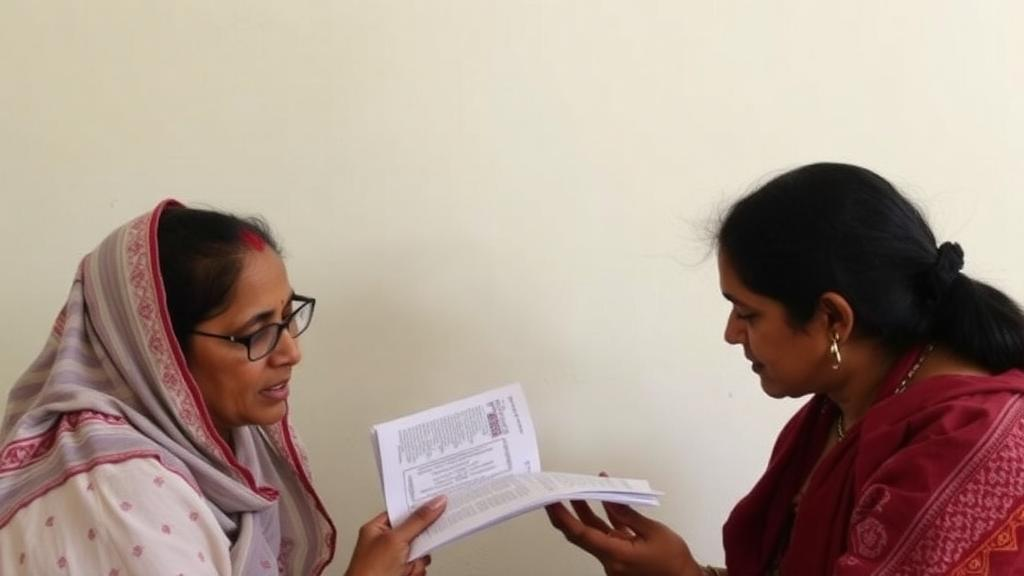
A widely used ten-question checklist for postpartum depression may be asking rural Indian women questions they do not hear in the way clinicians intend. A new qualitative study from western Maharashtra, published in BMC Psychology, has found that most of the women interviewed struggled to understand the Marathi version of the Edinburgh Postnatal Depression Scale (EPDS), even though the questionnaire had already been carefully translated. Instead of reading the items as discrete psychological symptoms, the women filtered each question through the concrete realities of their lives: a newborn’s first smile, the arrival of relatives, the pressure of breastfeeding, the disappointment of a second daughter, sleepless nights, family quarrels, and household money worries. The findings suggest that a screening tool can pass rigorous translation and statistical validation and still fail, quietly, at the most basic level of comprehension.
The EPDS is one of the most trusted instruments in perinatal mental health. Developed originally in English, it is not a diagnostic test but a screening questionnaire designed to flag mothers who may need further evaluation for depression during pregnancy or after childbirth. Over the decades it has been rendered into more than sixty languages, and its brevity and sensitivity have made it a fixture of maternity services worldwide. Yet researchers have long warned that translation alone does not guarantee cultural fit. A word-for-word equivalent of “I have felt sad or miserable” may carry different emotional weight, or no recognizable weight at all, in a community where sadness is described through circumstances rather than inner states. The new study set out to test exactly this gap, using a method that goes beneath the surface of questionnaire responses.
The technique, known as cognitive interviewing, treats the questionnaire itself as the object of investigation. Rather than simply administering the scale and recording answers, researchers ask participants to think aloud as they interpret each item, probing what a question means to them, how they recall relevant experiences, and how they decide on a response. In this study, a team led by Manisha Gore of Symbiosis International (Deemed University), together with Vaidehi Kaplay and Isha Kshirsagar, conducted cognitive interviews with thirty postpartum women drawn from thirty villages in western Maharashtra. The work formed part of a larger research project on postpartum depression and was carried out under the university’s community outreach initiative, with support from community health workers and a multidisciplinary team. The study received ethical approval from the university’s Independent Ethics Committee in January 2024, and all participants gave written informed consent, with thumb impressions accepted for women unable to read or write.
The participants themselves illustrate the population the scale is meant to serve. The women ranged in age from eighteen to thirty-eight years. Most had secondary education, but others had only primary schooling or were illiterate. Their occupations spanned housework, farming, tailoring, and salon work, while their husbands’ livelihoods ranged from manual labour to small-scale entrepreneurship. Monthly household incomes varied dramatically, from about 5,000 rupees to 100,000 rupees, roughly sixty to twelve hundred US dollars. This heterogeneity matters, because a screening question that assumes familiarity with psychological vocabulary may work very differently for a college-educated urban mother than for a farmer’s wife with limited schooling, even when both are interviewed in the same regional language.
What the interviews revealed was systematic rather than random. The majority of participants faced significant difficulty comprehending the scale items in Marathi, and interviewers had to deploy additional probing and explanatory support to elicit meaningful answers. The researchers identified four distinct types of comprehension problems. Semantic barriers arose when the words themselves did not communicate the intended meaning. Conceptual non-equivalence occurred when an entire construct, such as self-blame as a psychological symptom, had no natural counterpart in the woman’s frame of reference. Contextual reframing described the tendency to reinterpret a question about feelings as a question about circumstances. Finally, ambiguous emotional terminology left women uncertain which specific emotion an item was asking about, because the translated terms could map onto several different experiences.
The concrete examples are striking. When asked about happiness, women did not report an internal mood state; they pointed to their newborn’s activities or to visits from family members. Self-blame was understood not as pathological guilt but as the culturally loaded experience of having given birth to a second daughter, a circumstance that in some communities carries social stigma and perceived failure. Anxiety was anchored to breastfeeding and the weight of maternal responsibility rather than to a free-floating worry. Distress was attributed to family conflict, lack of support, sleep deprivation, and financial or social pressures. In each case, the women answered honestly and coherently, but the answers measured their lived situations rather than the psychological constructs the scale was designed to quantify. A clinician scoring such responses could easily overestimate or underestimate depressive symptoms without ever knowing the instrument had slipped.
This is not merely a technical quibble about questionnaire wording. Screening tools are the front line of perinatal mental health care, especially in low-resource settings where specialist psychiatrists are scarce and community health workers rely on brief instruments to decide who needs referral. If items are systematically misread, the resulting scores are not simply noisy; they are biased in ways that correlate with culture, education, and social position. A woman who interprets a question about self-blame as a question about the sex of her child may answer affirmatively for reasons that have nothing to do with depression, or she may deny depressive feelings because the concept of feeling sad without a visible cause seems nonsensical or even shameful. The study’s authors argue that evaluating cultural comprehensibility is therefore essential to ensure the appropriate use of mental health screening instruments in diverse populations, and that cognitive interviewing catches problems that translation and psychometric validation alone cannot detect.
The methodological lesson extends well beyond India. Psychometric validation typically checks whether a translated scale produces internally consistent scores and correlates with other measures as expected. But those statistical checks can be satisfied even when individual items mean different things to different respondents, a phenomenon measurement specialists call differential item functioning. Cognitive interviews, by contrast, expose the interpretive process itself. In this study they revealed that participants often understood the items through sociocultural experiences rather than as discrete emotional states, which means the scale’s assumed measurement model was breaking down at the item level. Similar concerns have been raised for translated instruments across many languages and health domains, but the Maharashtra findings provide unusually vivid documentation of how local social realities, including son preference, joint-family dynamics, and the economics of rural households, can infiltrate a clinical questionnaire.
For practitioners, the study points toward a practical pathway. Before deploying a translated screening tool in a new community, researchers and health services can conduct cognitive interviews with a purposive sample of local women, identify the semantic and conceptual fault lines, and revise the wording or add culturally anchored examples and interviewer probes. The authors emphasize that the EPDS is effective in detecting symptoms during pregnancy and postpartum when it is properly understood, and that it remains a valuable tool for identifying individuals who need further evaluation. The goal is not to discard the instrument but to adapt it so that a question asked in Marathi actually asks, in the listener’s world, what it asks in English. Community health workers, who already mediate between formal health systems and village households, are well placed to support this kind of culturally calibrated administration.
The broader significance of the work lies in its challenge to a quiet assumption of global mental health: that emotional vocabulary travels cleanly across languages and cultures. The thirty women of western Maharashtra showed that feelings in their communities are often narrated as events, relationships, and duties rather than as internal states, and that a questionnaire built on the premise of discrete emotions must earn its validity anew in every cultural setting. As perinatal depression gains recognition as a major public health concern, with consequences for mothers, infants, and families, ensuring that screening instruments are not just translated but truly comprehensible becomes a matter of clinical equity. The study, published open access with a permanent DOI, offers both a warning and a method: measure twice, interview once, and never assume that a score reflects what the respondent actually understood.
Subject of Research: Cultural comprehensibility of the translated Marathi Edinburgh Postnatal Depression Scale among rural postpartum women in western Maharashtra, India, assessed through cognitive interviews
Article Title: Understanding how rural Indian women interpret the Edinburgh postnatal depression scale: a cognitive interview study
Article References: Gore, M., Kaplay, V., & Kshirsagar, I. (2026). Understanding how rural Indian women interpret the Edinburgh postnatal depression scale: a cognitive interview study. BMC Psychology. https://doi.org/10.1186/s40359-026-05714-9
Image Credits: AI Generated
DOI: 10.1186/s40359-026-05714-9
Keywords: Edinburgh Postnatal Depression Scale, postpartum depression, cognitive interviewing, rural India, Maharashtra, cross-cultural psychology, mental health screening, Marathi translation, perinatal mental health, content validity, qualitative research, cultural adaptation
Cite Scienmag News
Glenn Wilkins. (October 1, 2026). When a Depression Questionnaire Gets Lost in Translation: Rural Indian Women Read the EPDS Through Daily Life. Scienmag. https://scienmag.com/when-a-depression-questionnaire-gets-lost-in-translation-rural-indian-women-read-the-epds-through-daily-life/
Glenn Wilkins. "When a Depression Questionnaire Gets Lost in Translation: Rural Indian Women Read the EPDS Through Daily Life." Scienmag, 1 October 2026, https://scienmag.com/when-a-depression-questionnaire-gets-lost-in-translation-rural-indian-women-read-the-epds-through-daily-life/. Accessed 1 October 2026.
Glenn Wilkins. "When a Depression Questionnaire Gets Lost in Translation: Rural Indian Women Read the EPDS Through Daily Life." Scienmag. October 1, 2026. https://scienmag.com/when-a-depression-questionnaire-gets-lost-in-translation-rural-indian-women-read-the-epds-through-daily-life/


