


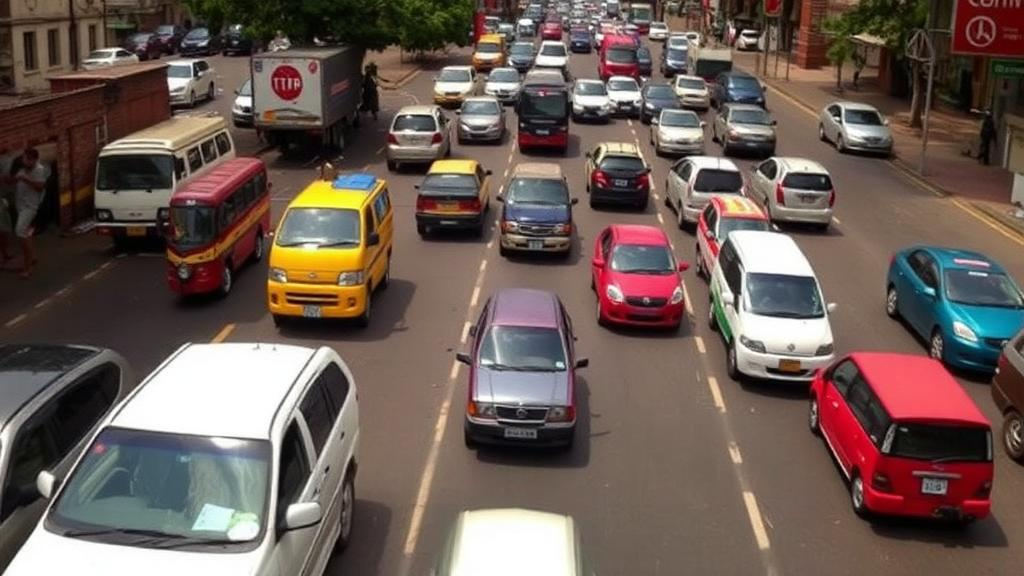
Harare’s legendary traffic jams are usually blamed on too many cars chasing too few roads, but a new study argues that the real story is far stranger: the Zimbabwean capital is suffering from an acute shortage of economic space, not merely asphalt. In a perspective published in Discover Cities, geographer Knowledge Murenje of the University of the Free State and Innocent Chirisa of Zimbabwe Ezekiel Guti University deploy a decades-old project management tool, the logical framework or log-frame, to dissect why the city’s decongestion efforts have repeatedly fallen short. Their central claim is provocative: roughly 70 percent of Harare’s formal jobs, banks, government offices and wholesale markets are packed into the central business district and the Willowvale industrial area, all funneling workers, customers and supply chains onto less than 5 percent of the city’s land.
The log-frame approach, developed for USAID in the 1960s and since adopted by development agencies worldwide, is essentially a structured matrix that forces planners to answer four questions at every stage of a project: what are you trying to achieve, how will you know, where is the evidence, and what must hold true. Murenje and Chirisa apply this discipline to Harare’s congestion problem by building a problem tree, in which the core problem stands as the trunk, root causes spread below and cascading effects branch above. The roots they identify include rural-urban migration, natural population growth, deregulation policies of the 1990s and relaxed vehicle import rules. The branches include parking shortages, pedestrian crushes, rising crime and public health pressures.
The historical layer of the analysis is revealing. Tight zoning regulations dating from the mid-1950s made it nearly impossible in the early 1980s to secure land for expanding the CBD or creating decentralised centres, and a cumbersome planning mechanism imposed long lead times on any development. Before rezoning in the late 1980s and early 1990s, the land market was thin and dominated by life assurance societies and pension funds that were reluctant to sell their properties or partner with developers, aggravating the shortage of office and retail space. The authors cite a striking figure: the 13,900 square metres of office accommodation created in January 1996 fell far below half of what was in demand at the time.
The 1990s economic liberalisation and the Structural Adjustment Programme pushed thousands of formally employed people into the informal sector, many of whom chose Harare’s CBD for self-employment. Local Development Plan 22, the city’s response, introduced mixed land uses and a densification model, and residential buildings were converted into offices. The authors trace the paradoxical consequences through their solution tree: partitioning offices created more workspace but also more workers with cars; relaxed car importation brought more than 300,000 vehicles into the CBD on each working day, according to a 2015 City of Harare count; and vending activity swelled sidewalk densities, pollution and disease risks.
Perhaps the study’s most counterintuitive finding is that solutions can become problems. One-way streets, introduced as a quick fix, ended up concentrating logjams, with Chinhoyi Street now among the most congested in the city during peak hours. Increasing the bulk factor, meaning more multi-storey construction, eases office shortages but multiplies the working population per hectare and therefore the demand for parking. Even the celebrated Eastgate Mall, whose biomimetic passive cooling system consumes 90 percent less energy for air conditioning than comparable buildings, is part of a gentrification story: the adjacent Eastgate Market was created to relocate street vendors into a planned space, easing the CBD while reshaping it.
Suburbanisation emerged as the escape valve. Property developers and companies fled high rents and congestion for the urban fringe, and suburban shopping centres proliferated from the mid-1990s. By 2017, demand for prime suburban retail space at 25 US dollars per square metre per month had outpaced CBD demand at 20 dollars, and occupancy rates in new suburban malls exceeded 80 percent, driven largely by informal traders, according to a Knight Frank report cited in the study. Yet this dispersal created its own congestion, as commuters from Goromonzi, Chitungwiza, Norton, Mazowe and even cities 100 kilometres away such as Marondera and Bindura clogged the arterial roads daily.
The heart of the paper is a worked log-frame for Domboshava, a polycentric suburban node in Goromonzi District. The model proposes dualising the road, rezoning 200 hectares for industrial development, and coordinating utilities and bus rapid transit so that 15 percent of Harare’s jobs shift locally. The target indicators are explicit: a 20 percent reduction in CBD congestion by 2030, and a rebalancing of the 70-percent-jobs-on-5-percent-land ratio to 55 percent on 15 percent. Crucially, the authors insist the activities are interdependent: dualising the road without zoning the land, attracting industry and budgeting for transit would fail, because dormitory suburbs decongest nothing.
International precedents lend the approach credibility. The authors point to Bogota and Dar es Salaam, where bus rapid transit combined with dedicated lanes produced measurable cuts in travel times, and to Curitiba and Nairobi, where land-use rules around transit stations made the gains stick. Supporting studies cited include Texas A&M Transportation Institute findings that optimised traffic signal timing can reduce congestion by up to 20 percent, and National Centre for Traffic Research evidence that better public transport can lift ridership by 25 percent. What distinguishes the successful cases, the authors argue, is continuous monitoring against verifiable indicators, precisely what Harare’s past interventions lacked.
The solution tree also branches into softer infrastructure. The authors recommend expanding the ZUPCO bus fleet from roughly 500 vehicles to at least 1,500, reviving commuter rail links to Chitungwiza and Mabvuku-Tafara, and eventually introducing trams, which they note are quieter and cleaner than buses. They advocate congestion pricing on the model of Singapore, potentially along Borrowdale Road, cycling tracks, walkable new-urbanist suburbs, green roofs and walls that can cut building heat loads by up to 40 percent, and intelligent transport systems using cameras, sensors and real-time analytics for adaptive signal control. The long-abandoned Harare drive ring road, planned in 1957 but never completed, remains an unfinished piece of the puzzle across the city’s 5,500 kilometres of tarred roads.
The deeper lesson of the study is methodological as much as urban. Land speculation in the fringe, where a CBD stand can cost 40 US dollars per square metre against 5 dollars in Domboshava, an 80 percent discount, has artificially throttled the space available for commerce, while an estimated 100,000 vendors spill onto sidewalks for lack of affordable stalls. Piecemeal fixes, the authors conclude, cannot solve a problem whose causes are spatial, economic and historical all at once. Only a log-frame that links road upgrades, industrial zoning, transit investment, stakeholder participation and relentless monitoring, applied across the metropolitan region rather than the CBD alone, offers Harare a credible route from gridlock to a sustainable, polycentric city.
Subject of Research: Spatial analysis of traffic, land-use and human congestion in Harare using a log-frame evaluation approach
Article Title: Understanding the spatial complexity of traffic, land-use and human congestion in the City of Harare using a log-frame evaluation approach
Article References: Murenje, K., & Chirisa, I. (2026). Understanding the spatial complexity of traffic, land-use and human congestion in the City of Harare using a log-frame evaluation approach. Discover Cities, 3(1), Article 195. https://doi.org/10.1007/s44327-026-00313-0
Image Credits: AI Generated
DOI: 10.1007/s44327-026-00313-0
Keywords: Harare, traffic congestion, log-frame approach, urban planning, suburbanisation, land use, public transport, bus rapid transit, polycentric development, Zimbabwe, sustainable cities, economic space
Cite Scienmag News
Courtney Benton. (October 1, 2026). Harare’s Gridlock Is an Economic Squeeze, and a Planning Matrix May Untangle It. Scienmag. https://scienmag.com/harares-gridlock-is-an-economic-squeeze-and-a-planning-matrix-may-untangle-it/
Courtney Benton. "Harare’s Gridlock Is an Economic Squeeze, and a Planning Matrix May Untangle It." Scienmag, 1 October 2026, https://scienmag.com/harares-gridlock-is-an-economic-squeeze-and-a-planning-matrix-may-untangle-it/. Accessed 1 October 2026.
Courtney Benton. "Harare’s Gridlock Is an Economic Squeeze, and a Planning Matrix May Untangle It." Scienmag. October 1, 2026. https://scienmag.com/harares-gridlock-is-an-economic-squeeze-and-a-planning-matrix-may-untangle-it/


