


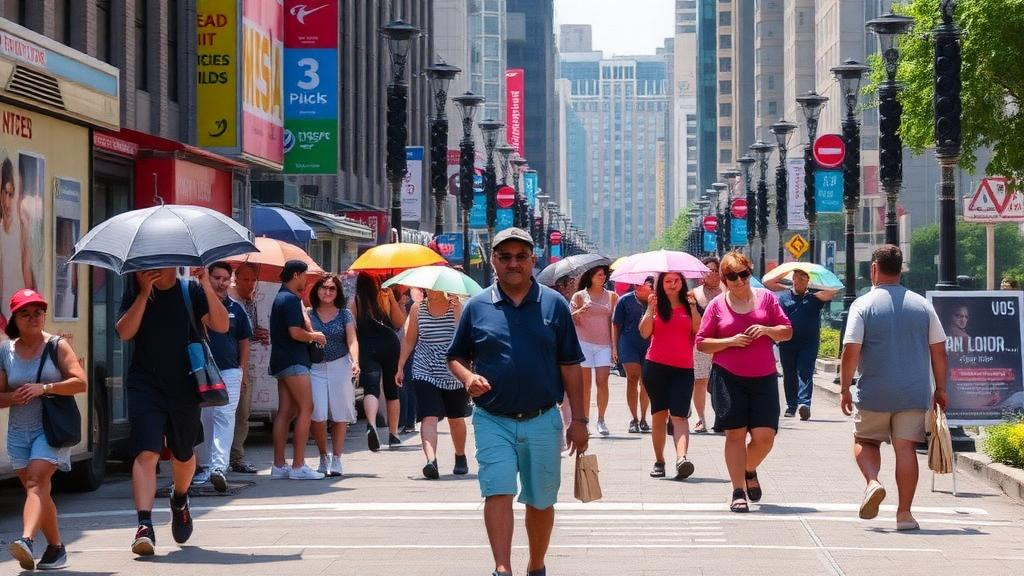
Urban heat has long been measured in degrees, mapped from satellites, and logged by weather stations scattered across city landscapes. Yet a growing body of research argues that these physical measurements capture only half of the story. Heat does not simply raise readings on a thermometer; it reshapes sleep, work, commuting, clothing, and even the sense of safety that people feel in public spaces. A new study led by an interdisciplinary team from the University of Würzburg, the German Aerospace Center (DLR), and Mendel University in Brno, Czechia, set out to capture this human dimension, using Mexico City in 2022 as its case study. Published in the IEEE Journal of Selected Topics in Applied Earth Observations and Remote Sensing, the research demonstrates how combining remote sensing, linguistics, digital humanities, and geography can move the science of urban heat from measured temperatures to lived experience.
The timing of the study could hardly be more relevant. Recent summers in Europe, and in Germany in particular, have shown how dramatic the consequences of heat waves can be, ranging from reduced quality of life and enormous economic damage to a high number of heat-related deaths. Conventional assessments of urban heat, however, often miss the everyday consequences that residents actually endure. Thermal maps can identify hotspots, and meteorological records can document record-breaking temperatures, but neither reveals whether a person spent a sleepless night, endured an unbearable commute, or was forced to choose between overheating and breathing polluted air. It is precisely this gap between physical measurement and human experience that the Würzburg-led team sought to close.
To do so, the researchers assembled an unusually rich multimodal dataset. Satellite observations provided a synoptic view of surface temperatures across the metropolitan area, while weather-station measurements offered ground-level readings of air temperature. Urban spatial structures and census data added context about how the city is built and who lives where. Crucially, the team then layered in geolocated social media posts, treating the digital traces left by residents as a sensor network of lived experience. This approach falls within the emerging field of Geolingual Studies, currently being developed at the University of Würzburg, which combines linguistic analysis with spatial data to understand how people talk about the places they inhabit.
One of the study’s clearest findings is a threshold effect. Lead author Dr. Richard Lemoine-Rodríguez explained that once air temperatures in Mexico City exceeded 25 degrees Celsius, heat-related social media posts increased exponentially, showing that heat becomes a matter of public concern above this level. In other words, residents do not respond linearly to rising temperatures; instead, discourse about heat erupts once a critical point is crossed. The spatial analysis added a second layer of insight: more heat-related posts were shared from hotter and more densely built parts of the city, confirming that the physical intensity of the urban environment shapes where people feel and talk about heat most acutely.
What people actually discussed online revealed the remarkable breadth of heat’s influence on daily life. The most common theme was health problems and heat stress, with users describing fatigue, insomnia, physical discomfort, and emotional distress. These firsthand accounts capture the physiological and psychological toll of sustained high temperatures in ways that no temperature map can. Working conditions and clothing emerged as another prominent concern. People described insufficient cooling infrastructure in workplaces and reported that they were not allowed to wear shorts despite extreme heat; in some cases, they argued that work should stop altogether under such conditions. The discussion showed that heat is not merely an environmental variable but a labor issue, a dress-code issue, and a question of workplace rights.
For women, the experience of adapting to heat carried additional burdens. The study found that women described unwanted attention and harassment when wearing lighter clothes to cope with high temperatures, turning what should be a simple adaptation strategy into a distressing experience. This finding underscores how vulnerability to heat is socially mediated: the same coping mechanism that offers physical relief to one group can expose another to social risk. Such nuances remain entirely invisible to satellite thermal imaging and station-based measurements, yet they are essential for designing adaptation strategies that work for all residents rather than only for some.
Public transport and urban infrastructure featured heavily in the online discussion as well. Users described delays, uncomfortable journeys, and insufficient ventilation or air conditioning on transit systems. Perhaps most strikingly, some posts described a dilemma in which riders had to decide which was the lesser of two evils: exposure to heat or exposure to air pollution. Opening a window to cool down meant simultaneously being forced to inhale polluted air, a trade-off that illustrates how multiple environmental stressors intersect in the daily routines of city dwellers. This coupling of heat and air quality is a well-known challenge in urban environmental management, but the social media record shows how concretely it plays out in individual decisions made on a crowded bus or train.
The conversation extended beyond human comfort to the wider urban ecosystem. Discussion included cooling areas and air conditioning, as well as concerns about birds, pets, and other animals needing water during hot periods. Some posts connected the heat to broader concerns about social inequality and climate change, situating personal discomfort within larger structural and planetary contexts. These observations suggest that public discourse about heat is not narrowly self-interested; it encompasses empathy for animals, awareness of who in the city suffers most, and an implicit understanding that extreme heat is a symptom of a changing climate. For policymakers, such discourse offers a window into public priorities and concerns that surveys alone may not capture.
Professor Hannes Taubenböck, one of the study’s senior authors, framed the central idea behind the research: satellites and weather stations can tell us where it is hot and how hot it is, but they cannot reveal whether people cannot sleep, struggle to work, feel unsafe, or suffer during their daily commute. Moving from measured to experienced heat, he argued, is the essential next step. By combining physical measurements with social media data, the authors identified not only where heat occurs but also the concrete problems it creates in people’s daily lives. This dual perspective transforms heat from an abstract environmental metric into a tangible social phenomenon with identifiable victims, locations, and consequences.
The study ultimately points toward a more human-centred approach to climate adaptation, in which temperature maps are complemented by information about people’s experiences and needs. As Taubenböck put it, to adapt cities to increasing heat, it is not enough to know how hot they are; we also need to understand what that heat means for people. The methodological lesson is equally significant. The combination of remote sensing, linguistics, digital humanities, and geography proved capable of producing a more spatially and thematically nuanced examination of urban heat than any single discipline could achieve alone. As heat waves intensify across the globe, the Würzburg team’s framework offers cities a way to listen to their residents at scale, turning millions of everyday complaints, worries, and observations into actionable knowledge for building cooler, fairer, and more livable urban environments.
Subject of Research: Experienced urban heat in Mexico City analyzed through satellite data and geolocated social media posts
Article Title: Beyond temperature: How people experience urban heat
Article References: Beyond temperature: How people experience urban heat. (n.d.). Original publication
Image Credits: AI Generated
DOI: Not provided
Keywords: urban heat, Mexico City, social media analysis, remote sensing, Geolingual Studies, climate adaptation, heat threshold, public health, urban form, air pollution, thermal comfort, interdisciplinary research
Cite Scienmag News
Sloane Callahan. (October 1, 2026). When 25°C Becomes Too Much: Social Media Reveals How City Dwellers Truly Feel Urban Heat. Scienmag. https://scienmag.com/when-25c-becomes-too-much-social-media-reveals-how-city-dwellers-truly-feel-urban-heat/
Sloane Callahan. "When 25°C Becomes Too Much: Social Media Reveals How City Dwellers Truly Feel Urban Heat." Scienmag, 1 October 2026, https://scienmag.com/when-25c-becomes-too-much-social-media-reveals-how-city-dwellers-truly-feel-urban-heat/. Accessed 1 October 2026.
Sloane Callahan. "When 25°C Becomes Too Much: Social Media Reveals How City Dwellers Truly Feel Urban Heat." Scienmag. October 1, 2026. https://scienmag.com/when-25c-becomes-too-much-social-media-reveals-how-city-dwellers-truly-feel-urban-heat/


