


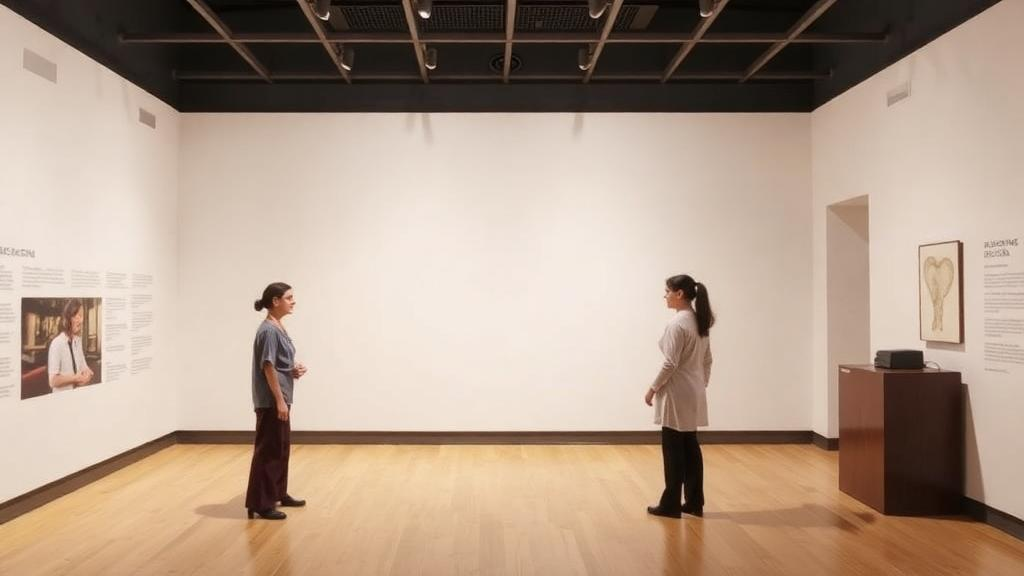
Medical education has spent the past decade searching for ways to train not just technically competent physicians, but reflective, emotionally attuned human beings. One of the more surprising answers has come from the art museum. At the Johns Hopkins University School of Medicine, a four-week, for-credit course places fourth-year medical students in a museum setting, where they engage with works of art as a way of developing observation, communication and self-awareness. A new study published in BMC Medical Education examines a distinctive pedagogical tool at the heart of that course: the processfolio, a curated collection of artefacts that documents students’ ongoing learning and reflections as it unfolds. The findings, based on the lived experiences of the students themselves, suggest that this arts-and-humanities-based approach can reshape how future doctors think about growth, emotion, communication and the troubled history of their profession.
The research, led by Sujal Manohar and Eden Noah Gelgoot with colleagues including Alex Walker, Nora McCarthy and Margaret S. Chisolm, set out to answer a question that has lingered around arts and humanities initiatives in medicine: how exactly do these activities enable learning and reflection? While the value of the arts and humanities in medical education has been increasingly recognized in recent years, with the potential to cultivate important clinical attributes, much of the literature has focused on outcomes rather than process. Less is known about how a processfolio actually functions as a vehicle for learning, and even less about the individual, lived experiences of the learners who create one. The Johns Hopkins team designed their study to close that gap, treating the students not as subjects to be measured but as narrators of their own educational journey.
Methodologically, the study took a deliberately qualitative approach. The researchers employed a cross-sectional design anchored in Interpretative Phenomenological Analysis, or IPA, a methodological framework that aims to uncover how individuals make sense of their personal and social world. IPA is well suited to questions of lived experience because it asks researchers to engage in a double hermeneutic: participants are interpreting their own experiences, and the researchers are then interpreting those interpretations. In this case, the data came from three sources. First, the researchers analyzed the completed processfolios themselves, the summative course artefacts in which students had assembled their work. Second, they examined the students’ final written reflections. Third, they conducted individual semi-structured interviews with each participant, allowing them to elaborate on what the processfolio had meant to them.
The sample was small but remarkably complete. All five fourth-year medical students who finished the museum-based course chose to participate in the research study. That total participation is significant in qualitative research of this kind, because it means the findings capture the full cohort rather than a self-selected fragment of it. It also reflects the voluntary, trust-based nature of the study, which was reviewed by the Johns Hopkins University Institutional Review Board and deemed exempt research under reference number IRB00365270. Because the study was classified as exempt, the institutional review board determined that it did not include informed consent procedures or fall under specific guidelines for research with human subjects. The exemption also signals the educational, non-interventional character of the work: the researchers were studying artefacts and reflections that already existed as part of the course.
From their analysis, the researchers distilled four Group Experiential Themes, the shared patterns of meaning that emerged across the five participants’ accounts. The first theme, contemplating the journey of reflection, growth and insight, speaks to the processfolio’s core function: it makes learning visible over time. Rather than submitting a single polished product at the end of a course, students accumulate artefacts that trace how their thinking evolved week by week. Looking back across that accumulation, participants could see their own intellectual and emotional trajectory in a way that conventional assessments rarely allow. The processfolio became, in effect, a mirror held up to the learning process itself, letting students contemplate not just what they had learned but how they had learned it.
The second theme, exploring personal and emotional growth, points to a dimension of medical training that is often squeezed out by the demands of scientific coursework. Medical students are routinely taught to compartmentalize emotion, yet the capacity to recognize and process one’s own emotional responses is increasingly understood as central to physician wellbeing and patient care. In the museum-based course, engagement with art opened a space where emotional responses were not only permitted but expected to be examined. The processfolio gave students a private, structured repository for that examination, and the act of assembling it encouraged them to connect their experiences in the gallery to their emerging identities as physicians. Participants reflected on their development as medical students and future physicians, a conclusion the authors highlight as central to the study’s purpose.
The third theme is perhaps the most clinically resonant: communicating in clinical contexts, with attention to the importance and complexity of both verbal and non-verbal communication. Art museums are, in a sense, laboratories of observation. Standing before a painting or sculpture, students must describe what they see, tolerate ambiguity, and recognize that others may perceive the same object differently. These are precisely the skills that translate to the bedside, where a physician’s reading of a patient’s posture, expression and silence can matter as much as any laboratory value. The processfolio documented this translation, capturing how students moved from describing artworks to thinking about how they describe patients, and how much of clinical communication happens without words at all.
The fourth theme, acknowledging the complex history of medicine and advocating for better practices, reveals a critical, even activist dimension of the experience. Museums and medicine share entangled histories, and engagement with artistic and historical material prompted students to confront uncomfortable truths about how their profession has treated patients, particularly those from marginalized communities. Rather than treating the arts and humanities as a decorative supplement to clinical training, this theme shows them functioning as a lens for professional critique. Students did not simply absorb the history of medicine; they interrogated it, and the processfolio preserved that interrogation as a record of their evolving ethical commitments. The authors frame this as learners advocating for better practices, a striking outcome for a course that takes place far from any hospital ward.
The study is candid about its limitations and about the fact that the processfolio is not a frictionless tool. Learners shared challenges related to its use, an acknowledgment that matters for educators considering adoption. A processfolio demands sustained reflective labor across a course, and students accustomed to the metrics of biomedical assessment may find the open-ended, self-documenting format unfamiliar or burdensome. The authors also emphasize that the research was conducted at a single institution with a small sample size, which constrains how far the findings can be generalized. Five students at one medical school cannot speak for all learners everywhere, and the authors explicitly call for future research in this area to test and extend what they observed.
Even with those caveats, the study offers a rare, granular look inside an arts and humanities intervention that is often praised in the abstract but seldom examined from the learner’s point of view. By combining analysis of the processfolios and written reflections with in-depth interviews, and by interpreting that material through the lens of Interpretative Phenomenological Analysis, the researchers have shown how a single pedagogical artefact can carry a student through contemplation of their own growth, exploration of their emotional life, refinement of their communicative instincts and confrontation with their profession’s history. The work was published open access on 1 October 2026, received on 11 April and accepted on 10 September of that year, with Manohar and Gelgoot serving as co-first authors. Chisolm’s contribution was supported through her direction of the Paul McHugh Program for Human Flourishing at Johns Hopkins. As medical schools worldwide continue to weave the arts and humanities into their curricula, this study suggests that the humble processfolio, a folder of artefacts and reflections assembled over four weeks in a museum, may be one of the most quietly powerful instruments for shaping the physicians of tomorrow.
Subject of Research: Use of processfolios in arts and humanities-based museum education for reflective learning in medical students
Article Title: Exploring the use of processfolios in a museum-based course for medical students
Article References: Manohar, S., Gelgoot, E. N., Walker, A., McCarthy, N., & Chisolm, M. S. (2026). Exploring the use of processfolios in a museum-based course for medical students. BMC Medical Education. https://doi.org/10.1186/s12909-026-10394-5
Image Credits: AI Generated
DOI: 10.1186/s12909-026-10394-5
Keywords: medical education, arts and humanities, processfolio, museum-based education, reflection, Interpretative Phenomenological Analysis, medical humanities, qualitative research, Johns Hopkins, experiential education, pedagogy, communication skills
Cite Scienmag News
Courtney Benton. (October 1, 2026). Museum Processfolios Help Medical Students Reflect on Growth, Communication and Medicine’s Past. Scienmag. https://scienmag.com/museum-processfolios-help-medical-students-reflect-on-growth-communication-and-medicines-past/
Courtney Benton. "Museum Processfolios Help Medical Students Reflect on Growth, Communication and Medicine’s Past." Scienmag, 1 October 2026, https://scienmag.com/museum-processfolios-help-medical-students-reflect-on-growth-communication-and-medicines-past/. Accessed 1 October 2026.
Courtney Benton. "Museum Processfolios Help Medical Students Reflect on Growth, Communication and Medicine’s Past." Scienmag. October 1, 2026. https://scienmag.com/museum-processfolios-help-medical-students-reflect-on-growth-communication-and-medicines-past/


