


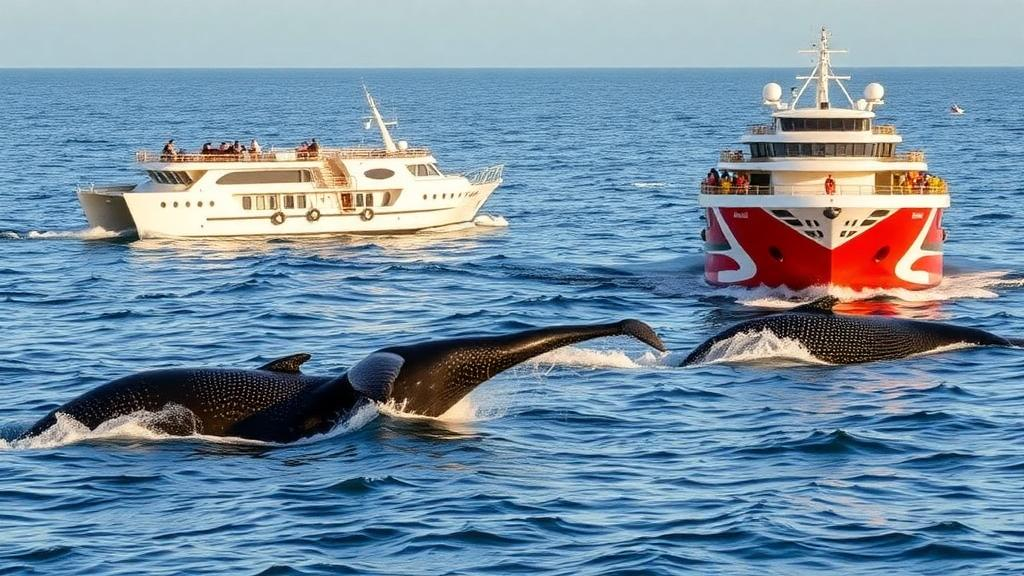
The Mediterranean Sea is home to some of the most remarkable marine animals on the planet, from the fin whale, the second-largest animal ever to have lived on Earth, to the deep-diving sperm whale and the acrobatic striped dolphin. Yet mapping where these giants actually are, and how quickly they move from one part of the basin to another, has long been one of the most stubborn challenges in marine conservation. A new set of results from the Synoptic Ferry Observation Network, known as SYNFONY, now offers an unusually detailed answer, and it comes from an unexpected platform: the commercial ferries that criss-cross the sea every day carrying tourists and freight. By turning scheduled ferry lines into scientific observation platforms, researchers have assembled a simultaneous, basin-wide snapshot of marine megafauna distribution that changes in a matter of weeks rather than years.
The findings, coordinated on the Barcelona–Tanger–Barcelona route by professors Odei Garcia-Garin and Manel Gazo of the Faculty of Biology and the Biodiversity Research Institute (IRBio) at the University of Barcelona, are striking in their scale and simplicity. Between June and July, three scientific campaigns recorded a total of 707 observations of marine megafauna along 19 fixed shipping routes in the western Mediterranean and the Adriatic. The species recorded were mainly the eight cetaceans commonly present in the Mediterranean: the fin whale (Balaenoptera physalus), the sperm whale (Physeter macrocephalus), Cuvier’s beaked whale (Ziphius cavirostris), the common dolphin (Delphinus delphis), the bottlenose dolphin (Tursiops truncatus), the striped dolphin (Stenella coeruleoalba), Risso’s dolphin (Grampus griseus) and the long-finned pilot whale (Globicephala melas). Two species of sea turtle were also documented: the loggerhead seaturtle (Caretta caretta) and the green seaturtle (Chelonia mydas).
What makes the SYNFONY approach technically powerful is its reliance on fixed routes sailed repeatedly and simultaneously across a wide geographic area. Because the ferries follow the same transects on every campaign, each survey functions like a repeated sampling grid laid over the sea. When all routes are surveyed within the same narrow time window, the resulting dataset provides a broad, simultaneous snapshot of where cetaceans and sea turtles are concentrated at that moment. This is a fundamental advantage over opportunistic sightings or single-vessel surveys, which tend to sample different areas at different times and therefore struggle to distinguish real shifts in animal distribution from simple differences in survey effort. In effect, the commercial ferries become genuine platforms for observing marine biodiversity, gathering data on the presence and distribution of species along the routes they regularly sail.
The human dimension of the project is equally notable. More than 20 volunteers have taken part in the campaigns, mainly students from the University of Barcelona’s degree programmes in Biology, Marine Sciences and Environmental Sciences. These trained observers stationed aboard the ferries carry out the systematic visual surveys that generate the data. The project is carried out with the support of ferry lines and shipping companies, whose cooperation transforms routine passenger services into a monitoring network of remarkable reach. Garcia-Garin and Gazo emphasized the importance of this collective effort, thanking all the volunteers who, as observers on board, made the campaigns possible, as well as the shipping companies and all the people and institutions who contributed to the development of the project, noting that their participation and commitment is key in continuing to expand knowledge of Mediterranean marine biodiversity and advancing its conservation.
Among the clearest results of the campaigns is evidence that distribution patterns can change dramatically between one survey and the next, over intervals of only a few weeks. The striped dolphin offers a vivid example. Garcia-Garin and Gazo, from the UB’s Department of Evolutionary Biology, Ecology and Environmental Sciences, explained that during the first campaign the species was observed more frequently and across a wider distribution area, whereas in the third campaign the sightings were much more spatially concentrated, especially on one of the routes in the Spanish corridor. Such rapid contraction and concentration of sightings suggests that these animals respond quickly to shifting environmental conditions, prey availability or other pressures, and that any static picture of their distribution is likely to be outdated within a season.
The fin whale, the Mediterranean’s only regularly occurring baleen whale and an emblem of the basin’s open waters, told a different story. The number of fin whale sightings remained relatively stable across the three campaigns, but the researchers found that the species’ distribution along the different routes underwent considerable changes. In other words, the overall abundance of observations stayed roughly constant while the locations where the whales were detected shifted substantially between campaigns. This decoupling of abundance from distribution is precisely the kind of pattern that only a synoptic, repeated-transect design can detect reliably, and it carries direct implications for conservation measures such as the placement of speed restrictions or the timing of protective measures in whale aggregation areas.
Sea turtles added further evidence of rapid spatial variability. The loggerhead turtle was the most frequently observed taxon across the entire monitoring period, underscoring its prominence in the Mediterranean’s surface waters. However, the experts noted that the number of observations decreased from the first campaign to the subsequent ones, while changes in its distribution within the network of monitored routes were also detected. Because loggerhead turtles are highly vulnerable to bycatch and vessel strikes, knowing when and where they concentrate, and how quickly those concentrations move, is essential information for fisheries managers and shipping operators alike.
SYNFONY does not operate in isolation. The project is being developed as part of the Fixed Line Transect Mediterranean Monitoring Network (FLT Med Net), coordinated by the Italian Institute for Environmental Protection and Research (ISPRA), of which IRBio-UB has been a member for almost 10 years. This broader initiative draws on more than two decades of experience in collaboration with shipping companies, meaning that the new campaigns rest on a long institutional foundation rather than a one-off effort. The integration of university researchers, national environmental agencies and private ferry operators represents a model of how large-scale marine monitoring can be achieved without dedicated research vessels, which are expensive to operate and limited in geographic coverage.
The practical motivation behind all this data collection is the growing overlap between maritime traffic and marine megafauna. Shipping is one of the pressures that may overlap spatially and temporally with the presence of cetaceans and turtles, whether through the physical risk of collision, underwater noise or other disturbances. The data obtained by SYNFONY can contribute to developing new dynamic risk assessment models that integrate the presence of the species, the intensity of maritime traffic and environmental conditions within a single framework. Unlike static maps that fix protection zones in place year after year, dynamic models can adjust predictions as animals move and as traffic patterns change, allowing management measures to follow the risk rather than lag behind it.
The researchers’ stated aim is to be able to identify more precisely which areas and which periods present a potential increased risk to marine megafauna and to advance towards a better understanding and management of the Mediterranean marine space. In a sea shared by dozens of nations, intense shipping lanes and a fragile community of long-lived, slow-reproducing species, that goal is ambitious. But the message from the 707 sightings gathered in just a few weeks of ferry-based observation is clear: the Mediterranean’s whales, dolphins and turtles are not stationary, and the tools used to protect them must be just as mobile as the animals themselves. With volunteers, universities, agencies and shipping companies pulling in the same direction, the region now has a working template for watching its giants in near real time.
Subject of Research: Ferry-based monitoring of cetacean and sea turtle distribution in the Mediterranean Sea
Article Title: Tracking the fin whale and the sperm whale in the Mediterranean
Article References: Tracking the fin whale and the sperm whale in the Mediterranean. (n.d.). Original publication
Image Credits: AI Generated
DOI: Not provided
Keywords: fin whale, sperm whale, striped dolphin, loggerhead turtle, Mediterranean Sea, marine megafauna, ferries, SYNFONY, University of Barcelona, maritime traffic, cetacean survey, dynamic risk assessment
Cite Scienmag News
Margaret Porter. (October 1, 2026). Ferries Turned Science Platforms Reveal Whales on the Move in the Mediterranean. Scienmag. https://scienmag.com/ferries-turned-science-platforms-reveal-whales-on-the-move-in-the-mediterranean/
Margaret Porter. "Ferries Turned Science Platforms Reveal Whales on the Move in the Mediterranean." Scienmag, 1 October 2026, https://scienmag.com/ferries-turned-science-platforms-reveal-whales-on-the-move-in-the-mediterranean/. Accessed 1 October 2026.
Margaret Porter. "Ferries Turned Science Platforms Reveal Whales on the Move in the Mediterranean." Scienmag. October 1, 2026. https://scienmag.com/ferries-turned-science-platforms-reveal-whales-on-the-move-in-the-mediterranean/


