


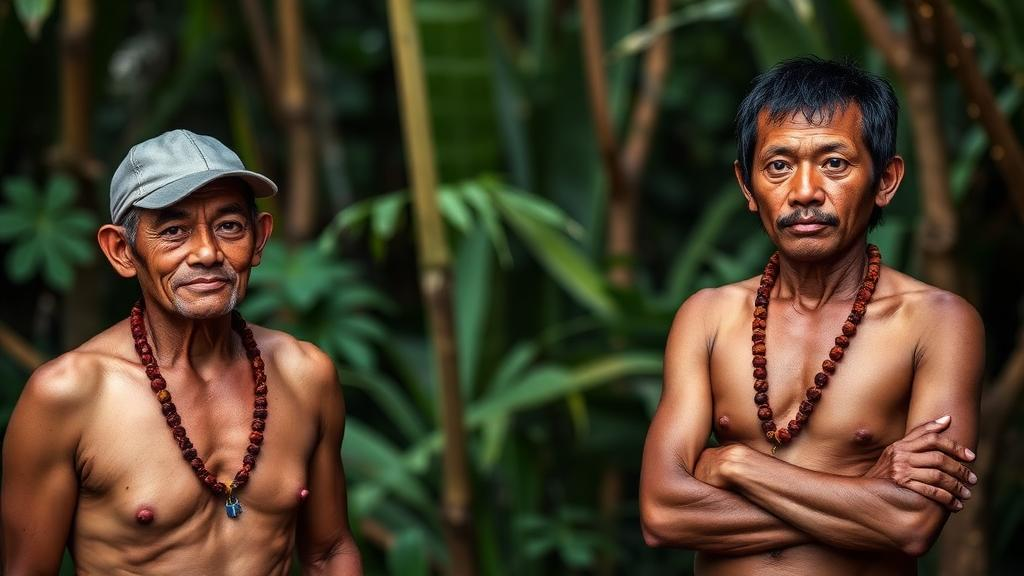
Deep in the rainforests and coastal villages of Malaysian Borneo, a quiet scientific milestone has been reached. Researchers have compiled the first detailed Y-chromosome genetic profiles of four indigenous population groups from Sabah and Sarawak, the two Malaysian states that share the island of Borneo. The study, published in the International Journal of Legal Medicine, analysed 257 male blood samples drawn from the Murut, Bajau, Kadazan-Dusun and Melanau communities, all of whom speak languages belonging to the vast Austronesian family. Using a commercial forensic kit that reads 27 short tandem repeat markers scattered across the Y chromosome, the team generated population datasets that can now be used to weigh DNA evidence in criminal investigations involving men from these communities. The work fills a conspicuous gap: while peninsular Malaysia’s populations have been studied extensively, the indigenous peoples of East Malaysia, separated from the rest of the country by the South China Sea, have remained largely invisible in forensic genetic databases.
The technology at the heart of the study is the Yfiler Plus PCR Amplification kit, a multiplex system that simultaneously amplifies 27 Y-chromosome short tandem repeats, or Y-STRs. These markers are repetitive stretches of DNA in which the number of repeating units varies from person to person. Because the Y chromosome is passed intact from father to son, a man’s Y-STR profile constitutes a haplotype, a signature of his paternal lineage. This makes Y-STR analysis uniquely powerful in sexual assault casework, where male DNA may be mixed with abundant female material, and in tracing male relatives, since paternal lineages share haplotypes. The trade-off is that the discriminating power of any Y-STR set depends entirely on knowing how frequently each haplotype occurs in the relevant population. A profile that is vanishingly rare in Europe may be commonplace in Borneo, and without local reference data, forensic statisticians cannot calculate meaningful match probabilities.
To supply that missing context, the researchers typed all 257 samples at the 27 loci and computed the standard forensic parameters for each of the four groups: haplotype diversity, discrimination capacity, and random match probability. These metrics collectively express how well the marker set distinguishes unrelated men within each community. The results, according to the authors, demonstrate the reliability of the tested Y-STR loci for forensic casework in these populations. In practical terms, when an investigator recovers a male DNA profile at a crime scene in Sabah or Sarawak, the new datasets allow an evidence weight to be assigned that reflects the actual genetic structure of local populations rather than a rough proxy drawn from unrelated groups thousands of kilometres away. The data also feed into international resources such as the Y Chromosome Haplotype Reference Database, which aggregates population haplotype frequencies worldwide for exactly this purpose.
Beyond the courtroom, the study offers a window into the deep history of Borneo’s peoples. The island occupies a pivotal position in the Austronesian expansion, one of the great demographic events of human prehistory, in which seafaring populations spread from Taiwan through Island Southeast Asia and out into the Pacific over several thousand years. Sabah and Sarawak are home to a striking diversity of indigenous Austronesian-speaking groups, each with distinct languages, customs and histories of migration and interaction. The Murut are traditionally an inland people of the interior highlands, the Bajau are famed as seafarers of the Sulu and Sulawesi seas, the Kadazan-Dusun form the largest indigenous group in Sabah, and the Melanau inhabit the coastal lowlands of central Sarawak. Whether their paternal lineages mirror these cultural and geographic distinctions was one of the questions the genetic data could address.
The answer, at first glance, is largely no. Using analysis of molecular variance, a standard technique that partitions genetic variation into within-population and between-population components, the team found that 89 percent of the Y-STR variation resided within populations, with only 11 percent separating the four groups from one another. In other words, two men from different communities in Borneo are, at the resolution of these markers, almost as similar to each other as two men from the same community. This pattern of high within-group diversity and low between-group differentiation is common in populations with shared ancestry, substantial gene flow, or both, and it underscores a recurring lesson of population genetics: cultural boundaries do not always map neatly onto genetic ones.
Principal coordinate analysis, a method that visualises genetic distances between populations in two dimensions, placed all four Bornean groups in a cluster together with other Austronesian-speaking populations of Southeast Asia, including Malays, Kedayan and Iban. Intriguingly, this Southeast Asian cluster sat slightly apart from indigenous Austronesian-speaking populations of Taiwan, such as the Paiwan and Puyuma, who are often considered descendants of the likely homeland of the Austronesian expansion. Had the Bornean groups descended directly and recently from Taiwanese ancestors, one might expect a closer genetic affinity. Instead, the Bornean and other Southeast Asian groups form their own cohesive cluster, hinting at the complex layering of migrations, admixtures and drift that has shaped the region’s paternal gene pool over millennia.
Yet the authors are careful to temper any grand historical conclusions. They suggest that the observed clustering patterns may stem from the limited resolution of the 27-locus Y-STR marker set rather than reflecting long-term demographic processes or the Austronesian expansion model inferred from linguistic and archaeological evidence. Y-STRs mutate relatively rapidly, but a panel of 27 markers can only capture so much of a lineage’s history, and haplotypes that appear similar may in fact be related only distantly, a phenomenon forensic scientists call homoplasy. Distinguishing genuine shared ancestry from marker-level coincidence requires either more markers, such as the rapidly mutating Y-STRs developed in recent years, or whole Y-chromosome sequencing, or the addition of genome-wide autosomal data that samples both maternal and paternal heritage.
This caution aligns with a broader shift in the field. Earlier generations of studies relied on small panels of 9, 12 or 17 Y-STR loci, and many of the published datasets for Malaysian populations, including work on Malays, Orang Asli groups, and the Iban, Bidayuh and Melanau of Sarawak, used these older kits. The 27-locus Yfiler Plus panel adds seven rapidly mutating markers that substantially increase the power to differentiate even close paternal relatives, a critical capability when a suspect’s brother or cousin may be the true source of crime scene DNA. The Bornean study thus brings the region’s forensic reference data up to the current international standard, and it complements recent genomic surveys that have revealed the native inhabitants of Peninsular Malaysia and North Borneo to carry a complex, layered population history that simple migration models fail to capture.
The authors are explicit about the limitations of the present dataset and the path forward. They call for larger sample sizes and for data from other genetically uncharacterised indigenous populations in Sabah and Sarawak to achieve accurate ancestry and forensic parameter estimations. Borneo hosts dozens of indigenous groups whose genetic profiles remain unsampled, and small sample sizes can bias frequency estimates, particularly for rare haplotypes whose true population frequencies are hard to pin down. Ethical engagement is equally important: the study obtained approval from the Human Ethical Committee of Universiti Sains Malaysia and written informed consent from every participant, following the tenets of the Declaration of Helsinki, a reminder that building forensic databases in indigenous communities must proceed with community trust and transparency.
For now, the study stands as both a practical tool and a scientific prompt. Practically, it gives forensic laboratories in Malaysia and the wider region the population-specific statistics they need to interpret Y-chromosome evidence from four of Borneo’s indigenous communities with confidence. Scientifically, it adds a piece to the puzzle of how the Austronesian-speaking world was peopled, while honestly acknowledging that the answer will require finer genetic resolution and broader sampling. As sequencing costs fall and interest in the genetic heritage of underrepresented populations grows, the men of Sabah and Sarawak whose DNA underpins this work may prove to be contributors not only to criminal justice in Malaysia but to a far richer understanding of humanity’s seafaring past.
Subject of Research: Forensic Y-chromosome STR population genetics of indigenous Austronesian-speaking groups in Sabah and Sarawak, Malaysia
Article Title: Population data of 27 Y-STR loci in indigenous populations from Sabah and Sarawak, Malaysia
Article References: Chan, X. Y., Kofi, A. E., Edinur, H. A., & Abd Rashid, N. H. (2026). Population data of 27 Y-STR loci in indigenous populations from Sabah and Sarawak, Malaysia. International Journal of Legal Medicine. https://doi.org/10.1007/s00414-026-04012-8
Image Credits: AI Generated
DOI: 10.1007/s00414-026-04012-8
Keywords: Y-STR, Yfiler Plus, forensic genetics, population genetics, Borneo, Sabah, Sarawak, indigenous populations, Austronesian, Murut, Bajau, Kadazan-Dusun
Cite Scienmag News
Juliet Wilcox. (October 1, 2026). Borneo’s Indigenous Men Yield New Genetic Map for Forensic Science. Scienmag. https://scienmag.com/borneos-indigenous-men-yield-new-genetic-map-for-forensic-science/
Juliet Wilcox. "Borneo’s Indigenous Men Yield New Genetic Map for Forensic Science." Scienmag, 1 October 2026, https://scienmag.com/borneos-indigenous-men-yield-new-genetic-map-for-forensic-science/. Accessed 1 October 2026.
Juliet Wilcox. "Borneo’s Indigenous Men Yield New Genetic Map for Forensic Science." Scienmag. October 1, 2026. https://scienmag.com/borneos-indigenous-men-yield-new-genetic-map-for-forensic-science/


