


Microplastics and nanoplastics have become one of the most stubborn pollution problems of the modern age. These particles, shed from packaging, textiles, and countless consumer products, drift through rivers, lakes, and oceans with a persistence that defies conventional cleanup. Now, a team of researchers at the University of Palermo has unveiled a solution with an almost poetic twist: a filter made from plastic waste that captures plastic waste, and then transforms the captured particles into a tool for removing yet another class of pollutants. The work, published in Advanced Composites and Hybrid Materials, describes a hybrid microfibrillar material the researchers call green fluff, and it may represent one of the most elegant examples of circular design in environmental remediation to date.
The research, led by Marta Balsamo, Maria Chiara Mistretta, and Roberto Scaffaro of the Department of Engineering at Palermo, began with a deceptively simple question. Most filtration materials designed to trap microplastics are themselves made from virgin polymers, which means the cure for plastic pollution requires manufacturing more plastic. The Palermo team instead turned to polypropylene and polyethylene terephthalate, two of the most abundant polymers in the post-consumer waste stream. Polypropylene, ubiquitous in bottle caps and food containers, and PET, the workhorse of beverage bottles, were selected precisely because they represent the kind of mixed plastic refuse that recycling facilities struggle to separate and reuse.
The technical heart of the study lies in how these two incompatible polymers were coaxed into a functional structure. When polypropylene and PET are melt blended together, they resist mixing, a property that usually spells disaster for material performance because phase separation weakens the final product. The researchers deliberately tuned the blend to achieve what they describe as poor self-compatibilization, a carefully balanced middle ground between miscibility and immiscibility. This balance proved crucial. It allowed the formation of a hybrid, hierarchical, microfibrillar architecture during subsequent processing, while still preserving the mechanical integrity of the individual fibers. Too much compatibility would have erased the fine structure; too little would have shattered it.
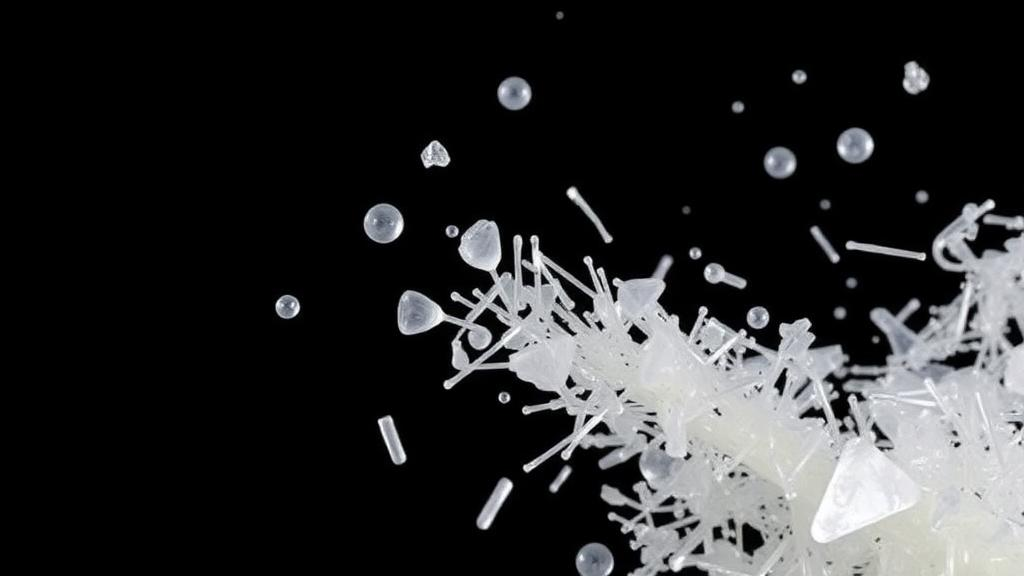
That processing step is where the material earns its whimsical name. The polymer blend was subjected to melt spinning, a technique borrowed from textile manufacturing in which molten polymer is extruded through fine openings to form fibers. In this case, the extruded material was directed into water through a vortex-assisted assembly process, where the swirling flow tore and folded the fiber mass into a spheroidal, porous puff of material. The resulting fluff is astonishingly airy: the team measured a porosity of 98.4 percent, meaning that less than two percent of the filter’s volume is solid material. This extreme openness gives the fluff an enormous internal surface area and a labyrinthine network of microfibrils, exactly the geometry needed to intercept particles suspended in flowing water.
A key innovation of the study is its insistence on testing against realistic pollutants rather than idealized laboratory standards. Many published filtration studies evaluate their materials using pristine, spherical polystyrene beads of uniform size, particles that bear little resemblance to the irregular, chemically weathered debris found in actual waterways. The Palermo researchers instead produced their test particles from post-consumer plastic products, subjecting them to environmental aging to mimic the degradation that plastics undergo in nature. These environmentally relevant microplastic and nanoplastic mixtures, with their rough surfaces, varied chemistries, and broad size distributions, present a far more demanding capture challenge, and it is against this realistic target that the fluff filters were judged.
The results were striking. The hybrid microfibrillar filters achieved a removal efficiency of 96.5 percent for the aged microplastic and nanoplastic mixtures, and they sustained this performance over multiple filtration cycles. The researchers attribute this effectiveness to two complementary mechanisms. The first is purely architectural: the hierarchical morphology of the fluff, with its dense thicket of microfibrils and high porosity, physically intercepts particles across a wide range of sizes, from micron-scale fragments down to nanoparticles that would slip through coarser media. The second is chemical: the polymeric matrix of the filter shares its composition with many of the captured particles, creating favourable physico-chemical interactions, including hydrophobic affinity and polymer-polymer adhesion, that hold particles in place once contact is made.
Reusability is where the design philosophy of circularity becomes explicit. A filter that saturates after a single use merely relocates the pollution problem, converting contaminated water into contaminated solid waste. The Palermo team demonstrated that their fluff filters could be regenerated and redeployed repeatedly while maintaining high removal efficiency, a property they link to the robustness of the microfibrillar network and the reversibility of the particle binding interactions. This cycle-ability transforms the material from a disposable sorbent into a durable piece of treatment infrastructure, dramatically improving its environmental and economic case.
Perhaps the most imaginative contribution of the study is what happens after the filter’s working life ends. Rather than treating the spent, plastic-laden filters as waste, the researchers explored a strategy they call post-use valorization, in which the captured microplastics and nanoplastics themselves are put to work. Because the trapped particles present a chemically active plastic surface, they can serve as sorbents for organic contaminants dissolved in water. Using paracetamol, a widely detected pharmaceutical pollutant, as a model compound, the team showed that the captured MNPs could remove 50.6 percent of the drug from solution in a recirculation strategy. In other words, the very particles that once threatened aquatic ecosystems become the active agents that pull pharmaceutical residues out of them.
This dual-function concept opens a genuinely new perspective on water treatment. Conventional remediation typically targets one contaminant class at a time, requiring sequential treatment stages for particles, dissolved organics, and other pollutants. A system in which a single material first concentrates plastic debris and then exploits that debris to strip dissolved pharmaceuticals could, in principle, address complex pollutant mixtures in a synergistic cascade. The researchers suggest that this approach offers new possibilities for the simultaneous management of the heterogeneous contamination that characterizes real wastewater and natural water bodies, where plastics, drugs, pesticides, and industrial chemicals coexist.
The broader significance of the work extends beyond the laboratory bench. The filters are built from the two most common plastic waste polymers, processed with scalable industrial techniques, and designed for multiple use cycles followed by productive reuse of their captured load. Funded in part by the SAMOTHRACE research innovation center and the EUROSTART2026 program, whose title, from threat to opportunity, recovery, reuse, and value creation, could serve as a summary of the study itself, the research points toward filtration technologies that do not merely shift plastic around but actively convert it into functional material. As microplastic contamination continues to infiltrate drinking water, food chains, and even human tissue, solutions that close the loop, turning the pollutant into the remedy, will only grow in importance. The Palermo team’s green fluff, light as a cloud and stubborn as a spiderweb, offers a compelling glimpse of what that closed loop might look like.
Subject of Research: Development of hybrid microfibrillar polymer filters from recycled polypropylene and PET for capturing microplastics and nanoplastics and valorizing captured particles for organic pollutant removal
Article Title: Hybrid microfibrillar green fluff for efficient capture of realistic micro/nanoplastics and post-use valorization
Article References: Balsamo, M., Mistretta, M. C., & Scaffaro, R. (2026). Hybrid microfibrillar green fluff for efficient capture of realistic micro/nanoplastics and post-use valorization. Advanced Composites and Hybrid Materials. https://doi.org/10.1007/s42114-026-02096-9
Image Credits: AI Generated
DOI: 10.1007/s42114-026-02096-9
Keywords: microplastics, nanoplastics, water remediation, polypropylene, PET, melt spinning, filtration, circular economy, paracetamol removal, recycled polymers, pollution, hierarchical materials
Cite Scienmag News
Neil Sanderson. (October 1, 2026). Plastic Fluff That Eats Plastic: Recycled Polymer Filters Snare Microplastics and Then Get a Second Job. Scienmag. https://scienmag.com/plastic-fluff-that-eats-plastic-recycled-polymer-filters-snare-microplastics-and-then-get-a-second-job/
Neil Sanderson. "Plastic Fluff That Eats Plastic: Recycled Polymer Filters Snare Microplastics and Then Get a Second Job." Scienmag, 1 October 2026, https://scienmag.com/plastic-fluff-that-eats-plastic-recycled-polymer-filters-snare-microplastics-and-then-get-a-second-job/. Accessed 1 October 2026.
Neil Sanderson. "Plastic Fluff That Eats Plastic: Recycled Polymer Filters Snare Microplastics and Then Get a Second Job." Scienmag. October 1, 2026. https://scienmag.com/plastic-fluff-that-eats-plastic-recycled-polymer-filters-snare-microplastics-and-then-get-a-second-job/


