


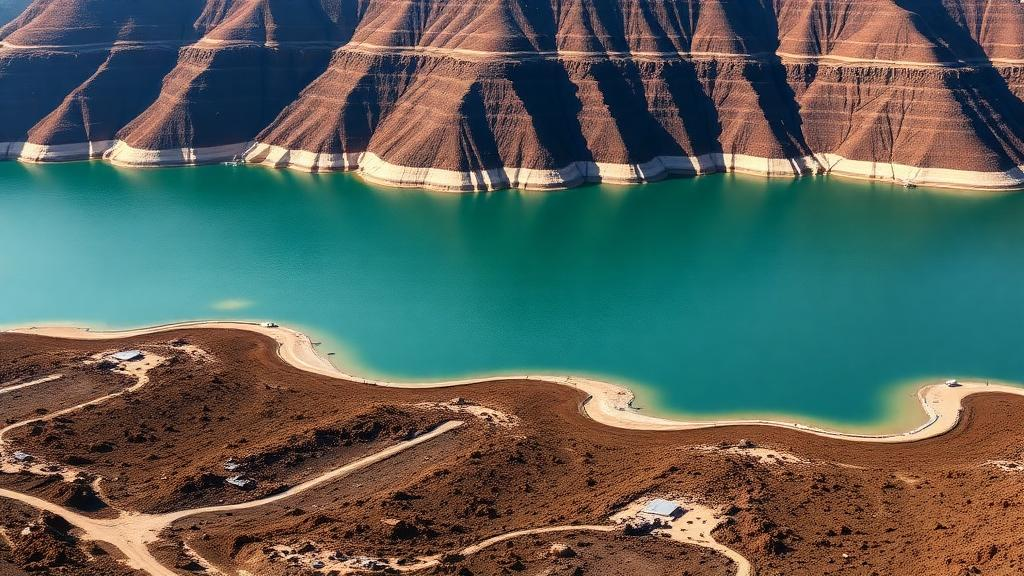
Beneath the terraced hillsides that feed Dianchi Lake, one of China’s most closely watched bodies of water, the soil is telling a story that surface inspections alone would miss. A new study of the Jinning phosphate-mining watershed in southwestern China has mapped, layer by layer, how decades of mining activity have reshaped the chemistry of the ground itself. The research, published in Environmental Geochemistry and Health, examined soils across five different land-use types and four depth intervals, revealing that the most serious contamination is concentrated in a single, identifiable zone: the tailings land where crushed phosphate ore residue accumulates. By treating soil depth as a central variable rather than an afterthought, the study offers a template for how mining regions around the world might audit their own buried risks.
The research team, led by Yanan Chen and Rui Liu of Yunnan University together with colleagues from the Yunnan Institute of Geo-Environment Monitoring and the University of Hong Kong, collected sixty composite soil samples from the watershed. The sampling design deliberately spanned the human geography of the landscape: tailings land, farmland, bare land, grassland, and natural forest. At each location, soils were drawn from four distinct layers, from the top ten centimeters down to ninety centimeters. This depth-resolved approach matters because many contamination surveys stop at the surface, potentially underestimating the total inventory of pollutants that could migrate downward toward groundwater or upward through plant roots. The seven elements measured were cadmium, chromium, copper, nickel, lead, zinc, and mercury, a roster that covers the most ecologically consequential heavy metals associated with phosphate extraction.
Phosphate ore is naturally laced with metals. When rock is mined, crushed, and processed, those impurities are liberated and concentrated in waste tailings, which can then be dispersed by wind and water. Cadmium is a particular concern in phosphate deposits worldwide, because it substitutes chemically for calcium in the mineral lattice and survives processing. The Jinning area, upstream of Dianchi Lake in Yunnan Province, has been shaped by phosphate extraction for years, and the lake itself has long suffered from nutrient pollution and algal blooms. What the new study adds is a quantitative picture of how the toxic metal burden is distributed not just across the landscape horizontally, but vertically through the soil profile, and how that distribution differs depending on what people have done with the land.
The headline finding is unambiguous. Tailings land emerged as the principal contamination hotspot of the entire watershed. In the surface layer of tailings-affected soils, cadmium reached an average concentration of 0.70 milligrams per kilogram, with a standard deviation of 0.35, while lead averaged 176.8 milligrams per kilogram, with a striking standard deviation of 130.0 that reflects the patchiness of deposition. The Nemerow comprehensive pollution index, a composite measure that emphasizes the worst pollutant at a site, registered 2.085 for tailings land, a value that signals substantial multi-element contamination. No other land-use type approached this level. Farmland, grassland, bare land, and natural forest carried comparatively lower burdens, though the study found that soil properties and metal concentrations varied meaningfully among all five categories.
Depth turned out to be as important as location. Across the watershed, soil organic matter, total nitrogen, available phosphorus, and available potassium generally declined with depth, while pH increased, a pattern consistent with the biological enrichment of topsoil by vegetation and agricultural management. The toxic metal risk followed a parallel vertical gradient in the most contaminated zone. The potential ecological risk index, a widely used metric developed by Lars Hakanson that weights each metal by its toxicity, fell from 184.52 in the top ten centimeters of tailings land to 110.34 in the sixty-to-ninety-centimeter layer. Notably, mean risk index values exceeded the threshold of 150, the boundary of moderate ecological risk, only in the upper thirty centimeters of soil. Below that, the risk declined, suggesting that the contamination is still largely a surface phenomenon rather than a fully penetrated profile.
Within the overall metal burden, two elements dominated the risk calculation. Cadmium and mercury contributed the largest shares of the potential ecological risk index, a reflection of their outsized toxicity coefficients relative to their measured concentrations. This is a critical nuance for remediation planning. An element like zinc might be present at elevated concentrations by mass, yet contribute comparatively little to ecological risk because it is far less toxic per unit. Cadmium, by contrast, is a cumulative poison that damages kidneys and bones in humans and disrupts soil organisms at low concentrations, and it is readily taken up by crops. Mercury, meanwhile, can be transformed by microbes into methylmercury, the form that bioaccumulates in aquatic food webs. A watershed that drains toward a major lake, as this one does toward Dianchi, makes that aquatic pathway particularly relevant.
The study deployed a battery of complementary assessment tools, each answering a slightly different question. The single-factor pollution index evaluates each element against a background or regulatory threshold, isolating which specific metals exceed safe levels. The Nemerow index then folds those individual scores into a single comprehensive value that is dominated by the worst offender. The geo-accumulation index compares measured concentrations to pre-industrial background values, providing a historical perspective on how much of the burden is anthropogenic. The enrichment ratio normalizes metal concentrations against a reference element to correct for natural variations in soil texture. Finally, the potential ecological risk index translates concentrations into a measure of harm potential. By triangulating across these methods, the researchers reduced the uncertainty that any single index can carry, and the convergence of their results on tailings land as the priority zone strengthens the case for targeted intervention.
The practical implications extend beyond the watershed itself. The authors identify tailings-affected soils as the priority management unit for the Jinning area, meaning that remediation resources should be concentrated where the risk index is highest rather than spread uniformly across the landscape. This finding aligns with a growing international consensus that mine tailings disposal sites are among the most consequential and undermanaged sources of metal contamination, and that approaches such as phytostabilization, the use of plants to immobilize metals in place, can be effective first steps in arid and semi-arid settings. The depth-resolved data also carry a warning for agriculture: because the moderate risk is confined to the upper thirty centimeters, the layer where most crop roots feed, the contamination is precisely where it can most easily enter the food chain. Cadmium accumulation in vegetables grown near phosphate operations has been documented in other Chinese mining regions, and the Yunnan-Guizhou phosphate belt is known for elevated cadmium in both ore and agricultural products.
For Dianchi Lake, the study adds a new dimension to an old problem. The lake’s celebrated struggles with eutrophication have focused attention on nitrogen and phosphorus runoff from farms and cities, but the metal dimension of upstream land use has received less systematic attention. The finding that available phosphorus declines with depth while surface soils in tailings areas carry elevated cadmium and lead suggests that the same erosion processes that move nutrients downslope can also mobilize metals toward the water. Sediments in receiving lakes are the ultimate sink for such particles, and metal-laden sediment can remobilize under changing chemical conditions. The research was supported by the National Natural Science Foundation of China and Yunnan Provincial programs, reflecting regional investment in understanding the environmental legacy of phosphate extraction.
What makes the study broadly significant is its methodological lesson: depth matters, and land use matters, and they matter together. A survey that sampled only surface soils across all five land-use types would have correctly flagged tailings land but might have overstated the uniformity of the risk. A survey that sampled only one land-use type at multiple depths would have missed the spatial contrast entirely. By crossing the two dimensions, the researchers produced a risk map that is actionable in three dimensions, identifying not just where to intervene but how deep remediation needs to reach. As phosphate demand continues globally, driven by fertilizer production and battery chemistry, watersheds like Jinning will multiply. The soils above Dianchi Lake now offer a measured, layered baseline for managing them, and a reminder that the most important environmental data sometimes lies well below the surface.
Subject of Research: Distribution of potentially toxic elements and ecological risk across land-use types and soil depths in a phosphate-mining watershed upstream of Dianchi Lake, China
Article Title: Land-use and depth-dependent distribution of potentially toxic elements and ecological risk in soils of a phosphate-mining watershed upstream of Dianchi Lake, China
Article References: Land-use and depth-dependent distribution of potentially toxic elements and ecological risk in soils of a phosphate-mining watershed upstream of Dianchi Lake, China. (n.d.). https://doi.org/10.1007/s10653-026-03514-z
Image Credits: AI Generated
DOI: 10.1007/s10653-026-03514-z
Keywords: phosphate mining, potentially toxic elements, soil contamination, cadmium, mercury, ecological risk index, tailings, soil depth, land use, Dianchi Lake, Yunnan, geochemistry
Cite Scienmag News
Sloane Callahan. (October 1, 2026). Phosphate Mining Leaves a Toxic Fingerprint in Soils Above a Famous Chinese Lake. Scienmag. https://scienmag.com/phosphate-mining-leaves-a-toxic-fingerprint-in-soils-above-a-famous-chinese-lake/
Sloane Callahan. "Phosphate Mining Leaves a Toxic Fingerprint in Soils Above a Famous Chinese Lake." Scienmag, 1 October 2026, https://scienmag.com/phosphate-mining-leaves-a-toxic-fingerprint-in-soils-above-a-famous-chinese-lake/. Accessed 1 October 2026.
Sloane Callahan. "Phosphate Mining Leaves a Toxic Fingerprint in Soils Above a Famous Chinese Lake." Scienmag. October 1, 2026. https://scienmag.com/phosphate-mining-leaves-a-toxic-fingerprint-in-soils-above-a-famous-chinese-lake/


