


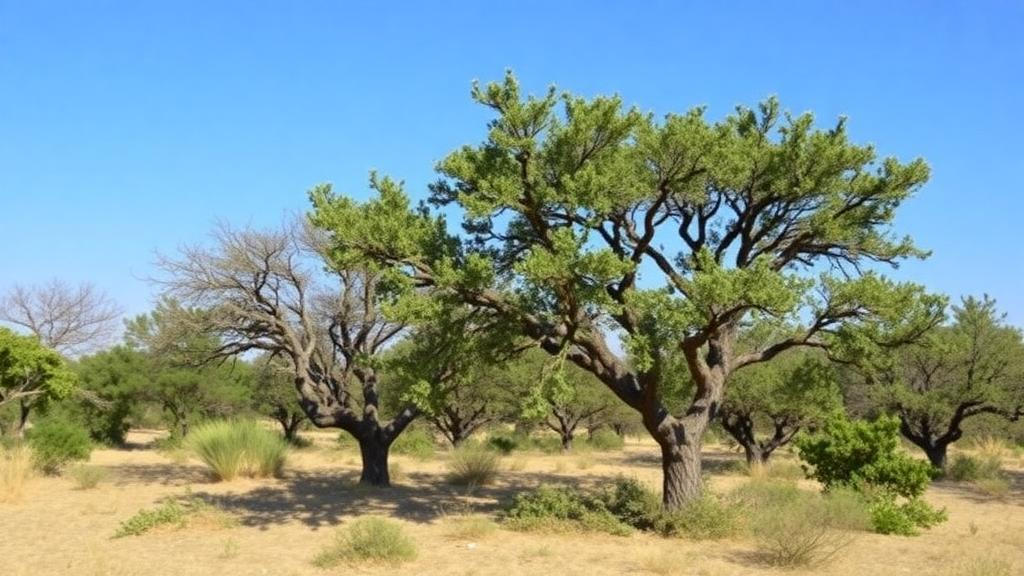
Two of the Mediterranean’s most iconic trees are quietly preparing to move house, and scientists in Algeria have now mapped exactly where they are likely to go. Cork oak (Quercus suber) and holm oak (Quercus ilex) anchor vast stretches of North Africa’s forests, supplying cork, fodder, fuelwood and shelter for an extraordinary web of life. A new study published in Plant Biosystems by Hichem Rais of Abdelhafid Boussouf University of Mila and colleagues has used species distribution modelling to chart where these two oaks can thrive today, and where the climate will allow them to persist in 2050, 2070 and 2090. The results offer both reassurance and warning: one species appears remarkably resilient, while the other faces a slow but steady erosion of its most valuable habitat.
The research team turned to MaxEnt, short for maximum entropy modelling, one of the most widely used tools in modern biogeography. The technique works by comparing the environmental conditions at locations where a species has been recorded with the conditions available across the whole study area, then estimating the probability of occurrence at every grid cell. Rather than requiring absence data, which is notoriously unreliable, MaxEnt builds a picture of a species’ ecological niche from presence records alone. For a country as topographically and climatically varied as Algeria, which spans Mediterranean coastline, high plateaus and the northern fringe of the Sahara, this approach is particularly powerful because it can capture the full breadth of conditions a species tolerates.
To drive the models, the researchers assembled occurrence records for both oak species, drawing on field knowledge and global biodiversity databases, and combined them with a suite of environmental predictor variables covering temperature, precipitation and terrain. Crucially, they projected the models forward using future climate scenarios for three time horizons, allowing them to track not just whether habitat will be lost or gained, but where the geography of suitability will shift. The performance of the models was assessed using the Area Under the Curve, or AUC, a standard statistical measure of discrimination. Values above roughly 0.8 are generally considered good, and above 0.9 excellent. Both oak models exceeded 0.96, a strikingly high score that indicates the models separated suitable from unsuitable terrain with near-perfect reliability.
The single most influential variable shaping the distribution of both species was the Martonne aridity index, a classic climatic measure that combines annual precipitation with mean temperature to express the degree of water availability across a landscape. Its dominance in the models makes ecological sense. Mediterranean oaks live at the dry edge of what trees can tolerate, and their growth, survival and regeneration are tightly governed by the balance between water arriving as rain and water lost to the atmosphere. In Algeria, where warming is outpacing the global average and droughts are becoming more frequent and severe, this finding underscores that aridity, not temperature alone, is the master variable controlling the fate of these forests.
When the researchers projected the models into the future, the two species told different stories. For cork oak, the annual rate of highly suitable habitat is expected to decline under every future scenario, with projected losses ranging from 0.040 percent to 0.191 percent per year. The numbers may look small, but compounded over decades they translate into a meaningful contraction of the species’ core range in Algeria. Cork oak is already under pressure across the western Mediterranean from land abandonment, overgrazing, fire and unexplained decline phenomena, so any additional climatic squeeze on its best habitat is cause for concern for foresters and conservationists alike.
Holm oak, by contrast, showed far greater stability. Its highly suitable habitat is projected to change only slightly, with shifts ranging from a loss of 0.021 percent to a gain of 0.164 percent per year depending on the scenario. This hardy evergreen is famously drought-tolerant, capable of surviving on thin soils and withstanding long summer dry seasons, and the model results reflect that toughness. In practical terms, the study suggests that holm oak could even hold its ground or modestly expand in some parts of Algeria as conditions change, making it a candidate species for stabilising forests in an increasingly arid landscape.
Perhaps the most vivid finding concerns elevation. The average elevation of suitable habitat is projected to shift under each climate scenario, ranging from 866 to 1,025 metres for cork oak and from 978 to 1,172.5 metres for holm oak. In other words, as the lowlands warm and dry, the climatic comfort zone for both species climbs the mountainsides, and holm oak consistently occupies higher ground than cork oak. This pattern echoes a well-documented global phenomenon in which mountain plant communities shift upslope in response to warming. The catch, as ecologists have repeatedly warned, is that mountains are cones: the higher a species climbs, the less land remains available, and slow-moving trees may lag far behind the pace of climate change.
The models also revealed a striking directional signature. Under most future scenarios, the highly suitable habitat for cork oak shifts towards the northeast of the country, while for holm oak it shifts towards the northwest. These compass bearings matter enormously for conservation planning. Northeastern Algeria, with the humid coastal ranges of Kabylia and El Kala, retains some of the wettest conditions in the country, and the projected northeastward drift of cork oak suitability suggests these areas will become increasingly critical refuges. The northwestward shift for holm oak points to a different set of priority landscapes, and the divergence between the two species means that a single, one-size-fits-all protected area network will not serve both trees equally well.
The practical value of this work lies in its maps. By identifying where habitat is highly suitable now and where it is likely to remain suitable through the end of the century, the study gives Algerian foresters a decision-support tool of real consequence. Rather than reacting to forest decline after it happens, managers can use these projections to prioritise which forest stands to protect, where to focus regeneration efforts, and which zones should be preserved as climate refugia. The authors emphasise that the maps are intended precisely for this purpose: helping foresters select the best conservation strategy for cork oak and holm oak and choose appropriate forest zones to be preserved before the climate window closes.
The study also sits within a growing body of Algerian research on climate-driven range shifts, including recent work on Atlas cedar, Aleppo pine, Phoenician juniper and the endemic oak Quercus afares, all pointing in a consistent direction: the country’s forest flora is being reshuffled by warming and drying. What makes the new findings compelling is the contrast between two closely related, sympatric oaks responding so differently to the same climatic pressures. As the Mediterranean basin warms faster than the global average, the fate of these forests will depend on whether conservation planning can anticipate the movement that the models now make visible. For Algeria’s cork and holm oaks, the future is not yet written, but the map of where it will unfold has finally been drawn.
Subject of Research: Species distribution modelling of cork oak and holm oak habitats in Algeria under climate change
Article Title: Modelling the current and future potential distributions of Quercus suber and Q. ilex (Fagaceae) in Algeria
Article References: Rais, H., Laala, A., Meghzili, I., Mennour, H., & Boucenna, H. (2026). Modelling the current and future potential distributions of Quercus suber and Q. ilex (Fagaceae) in Algeria. Plant Biosystems, 160(5), Article 239. https://doi.org/10.1007/s44473-026-00241-2
Image Credits: AI Generated
DOI: 10.1007/s44473-026-00241-2
Keywords: Quercus suber, Quercus ilex, Algeria, MaxEnt, species distribution modelling, climate change, aridity index, habitat suitability, Mediterranean forests, cork oak, holm oak, forest conservation
Cite Scienmag News
Gavin Prescott. (October 1, 2026). Algeria’s Cork and Holm Oaks Face Shifting Futures as Climate Redraws the Map. Scienmag. https://scienmag.com/algerias-cork-and-holm-oaks-face-shifting-futures-as-climate-redraws-the-map/
Gavin Prescott. "Algeria’s Cork and Holm Oaks Face Shifting Futures as Climate Redraws the Map." Scienmag, 1 October 2026, https://scienmag.com/algerias-cork-and-holm-oaks-face-shifting-futures-as-climate-redraws-the-map/. Accessed 1 October 2026.
Gavin Prescott. "Algeria’s Cork and Holm Oaks Face Shifting Futures as Climate Redraws the Map." Scienmag. October 1, 2026. https://scienmag.com/algerias-cork-and-holm-oaks-face-shifting-futures-as-climate-redraws-the-map/


