


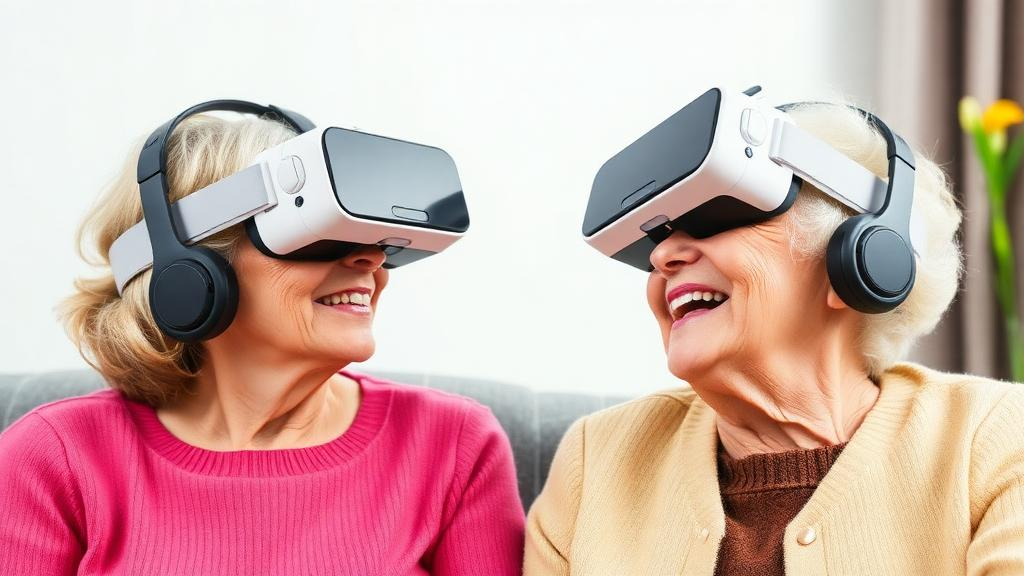
A pair of goggles, a quiet room, and ten minutes on a virtual beach may sound like an unlikely prescription for the aging brain, but a new randomized controlled trial suggests exactly that. Researchers in Brazil report that older adults living in long-term care institutions who completed a structured immersive virtual reality program showed measurable gains in global cognition, verbal memory, and attention, alongside a striking physiological signature of relaxation: their resting heart rates fell steadily across the intervention period. The study, published in Trends in Psychology, offers one of the most detailed looks yet at how consumer-grade virtual reality might serve as a non-invasive therapeutic tool for one of medicine’s most challenging populations.
The trial enrolled 33 residents, aged 60 to 99, from one public and one private long-term care facility. Fifteen of the participants were men, and the group spanned a wide educational range, from 18 people who had never learned to read to five with more than eight years of schooling. To qualify, volunteers had to demonstrate preserved cognitive function on the Mini-Mental State Examination, with cutoff scores adjusted for education level, and they were excluded if they had severe uncorrected sensory impairments, were taking sedative medications, or could not give informed consent. Using block randomization, the team assigned participants either to an immediate intervention group or to a delayed-intervention control group that continued the institution’s routine activities before crossing over to receive the same virtual reality protocol later in the study.
The technology itself was deliberately simple. Exposure was delivered through an Oculus Quest 2, a standalone headset that requires no external computer or wiring, making it practical for institutional settings. Participants rotated through three distinct ten-minute 360-degree scenarios accessed through a publicly available application: a beach with calm waves and underwater exploration, an open field with wildlife and natural sounds, and an urban simulation with pedestrians and moving vehicles. Sessions were held twice a week at two-day intervals over eight weeks, for a total of 16 sessions, always in the morning one to two hours after breakfast. The design drew on cognitive rehabilitation theory and multisensory stimulation, the idea that rich, engaging sensory environments can exercise attention, memory, and executive functions while simultaneously promoting calm.
Measuring what happened inside participants required a layered assessment strategy. Global cognition was screened with the Montreal Cognitive Assessment, verbal episodic memory with the Rey Auditory-Verbal Learning Test, working memory with the Digit Span subtest of the Wechsler Adult Intelligence Scale-III, and focused and divided attention with the Psychological Battery for Attention. Emotional health was tracked with the Geriatric Depression Scale and the SF-36 Quality of Life Questionnaire, while anxiety was assessed with the State-Trait Anxiety Inventory. Perhaps most distinctive was the physiological monitoring: a digital oximeter recorded peripheral oxygen saturation and heart rate, and a sphygmomanometer measured blood pressure at three standardized time points in every session, five minutes before the headset went on, five minutes into the virtual experience, and immediately after it was removed.
The cognitive results were the study’s clearest signal. After the 16 sessions, the intervention group showed statistically significant improvements on the Montreal Cognitive Assessment, indicating better global cognitive function, and significant gains on the Rey Auditory-Verbal Learning Test, suggesting enhanced learning capacity and overall memory performance. The researchers also documented a significant increase in the total average information retrieval capacity and relevant improvements in divided attention. When the two groups were compared before the crossover phase, the virtual reality group consistently outperformed the controls across most cognitive metrics, including reduced interference in retroactive attention, meaning that new information interfered less with the retrieval of previously learned material. The delayed-intervention group did improve after receiving its own virtual reality protocol, but the gains were more pronounced in the group that had been exposed first.
The physiological data told a quieter but equally compelling story. Across all 16 sessions, the average heart rate of participants declined significantly, from 79 beats per minute on the first day to 73 beats per minute on the sixteenth, a reduction the authors interpret as evidence of a genuine relaxation response rather than mere habituation to the equipment. Blood oxygen saturation remained stable or improved slightly throughout. Among the three environments, the beach scene elicited the most pronounced calming effect, corroborated both by the heart rate data and by participants’ frequent reports of tranquility. Intriguingly, standardized emotional health instruments, including the depression scale and the anxiety inventory, did not register statistically significant changes, even though participants consistently described feeling relaxed and enjoying the sessions. The authors suggest the eight-week window may have been too short, or the instruments too blunt, to capture subtle emotional shifts.
One of the study’s most striking findings had nothing to do with test scores. A common assumption in gerontechnology research is that elderly people will resist or avoid novel devices, yet the opposite occurred. Participants eagerly anticipated their sessions, and several expressed disappointment on days when they were not selected for the virtual reality activity. This enthusiasm challenges prevailing stereotypes about older adults’ aversion to technology and carries practical weight, because adherence is often the limiting factor in any long-term therapeutic program. An intervention that residents actively want, rather than merely tolerate, has a built-in advantage over conventional cognitive training drills.
The findings align with a growing body of literature showing that virtual reality can improve health markers, including balance, muscle strength, and cognition, in institutionalized older adults, and that virtual reality-based cognitive training benefits people with mild cognitive impairment and dementia. The relaxation effect is consistent with prior work suggesting that immersive media provides a non-invasive way to stimulate cognitive function while promoting engagement. The study also situates itself within a broader public health context: the World Health Organization projects that in several developing countries the elderly population will soon surpass the number of children, and institutionalization is known to contribute to psychological distress, loss of identity, and cognitive decline. Interventions that are inexpensive, safe, and enjoyable could therefore have outsized value as global demographics shift.
The authors are careful to frame the work as a proof of concept rather than a definitive trial. The sample of 33 participants is small and was drawn from just two institutions, which limits generalizability, and the study measured immediate outcomes without long-term follow-up, though a follow-up is planned. The physiological instruments were optimized for safety monitoring rather than fine-grained assessment of autonomic arousal, and future studies could incorporate heart rate variability or electrodermal activity, along with standardized emotional scales administered immediately before and after exposure. Unmeasured differences in medication remain a potential confounder. Still, the combination of significant cognitive gains, a documented relaxation response, and genuine participant enthusiasm makes a strong case that immersive virtual reality deserves larger, longer, and more diverse trials. For a population often defined by what it has lost, a technology that restores a morning at the beach, and measurably sharpens the mind while doing so, is a finding worth watching closely.
Subject of Research: Effects of immersive virtual reality on cognition and relaxation in institutionalized elderly people
Article Title: Improvements in Cognition and Promoting Relaxation: A Preliminary Study of Immersive Virtual Reality for Institutionalized Elderly
Article References: Improvements in Cognition and Promoting Relaxation: A Preliminary Study of Immersive Virtual Reality for Institutionalized Elderly. (n.d.). https://doi.org/10.1007/s43076-026-00515-w
Image Credits: AI Generated
DOI: 10.1007/s43076-026-00515-w
Keywords: virtual reality, elderly, cognitive decline, long-term care, memory, attention, relaxation, randomized controlled trial, gerontology, heart rate, cognitive rehabilitation, well-being
Cite Scienmag News
Glenn Wilkins. (October 1, 2026). Virtual Reality Headsets Boost Memory and Calm in Nursing Home Residents. Scienmag. https://scienmag.com/virtual-reality-headsets-boost-memory-and-calm-in-nursing-home-residents/
Glenn Wilkins. "Virtual Reality Headsets Boost Memory and Calm in Nursing Home Residents." Scienmag, 1 October 2026, https://scienmag.com/virtual-reality-headsets-boost-memory-and-calm-in-nursing-home-residents/. Accessed 1 October 2026.
Glenn Wilkins. "Virtual Reality Headsets Boost Memory and Calm in Nursing Home Residents." Scienmag. October 1, 2026. https://scienmag.com/virtual-reality-headsets-boost-memory-and-calm-in-nursing-home-residents/


