


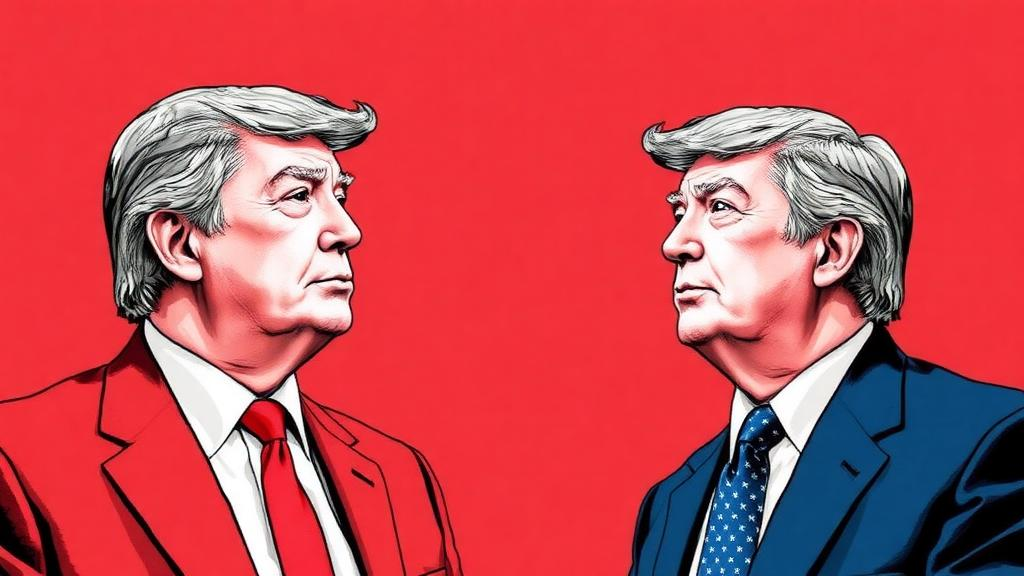
One of the strangest coalitions in modern democratic politics is now sitting at the heart of American power. Impoverished workers in de-industrialized rural regions and billionaires from Silicon Valley have converged on a shared political project, and a new analysis argues that this convergence is no accident of opportunism but the product of a deliberately constructed, comprehensive ideology. Writing in the journal Global Public Policy and Governance, political economist Ulrich Glassmann of Europa-Universität Flensburg takes aim at the standard view that populist movements rest on a so-called thin-centred ideology, a loose moral opposition between a virtuous people and a corrupt elite. Trumpism, he contends, is far thicker than that: it is a full-blown doctrine about the social and economic position of the United States in the global economy, one powerful enough to make both the richest and the poorest Americans accept material sacrifices in its defense.
The paradox that motivates the analysis is stark. During the first Trump campaign, public attention focused on low-income families hit by de-industrialization and on middle-income households anxious about their status. Today the movement is openly endorsed by figures such as Amazon founder Jeff Bezos and Facebook founder Mark Zuckerberg, whose company Meta donated one million dollars to Trump’s inauguration fund despite earlier personal disputes. PayPal founder Peter Thiel backed Trump from the start, and his association with J.D. Vance helped secure Vance’s path to the vice presidency. Elon Musk’s brief tenure at the head of the newly formed Department of Government Efficiency signaled that the agenda of some technology leaders extends beyond lower corporate taxes and deregulation. It reflects a conviction that the established administrative structures of the federal government should be dismantled to make room for radical innovation.
Yet the fiscal record cuts directly against the interests of the movement’s poorest supporters. The legislation nicknamed the Big Beautiful Bill cuts spending on Medicaid and the food assistance program SNAP by roughly 900 billion dollars through 2034, according to Congressional Budget Office estimates. The CBO’s distributional analysis shows that the bill’s tax cuts most benefit the highest income groups while the combined effect of tax and benefit changes is most damaging to the lowest deciles. Rural areas, where Medicaid dependence is high, will bear a disproportionate share of the losses, and rural voters form one of Trump’s most reliable constituencies. In counties where at least a quarter of voters’ personal income comes from government transfers, 63 percent cast their ballots for Trump in 2024. How can a movement simultaneously reward its wealthiest backers and strip benefits from the people who vote for it most loyally?
The demographic evidence deepens the puzzle rather than resolving it. Trump won those with a high school diploma or less by twenty points, and voters who attend religious services monthly or more often by thirty points, yet no single master variable explains the pattern. Gender, ethnicity, religion, education and place all interact: majorities of Black and Asian men backed Harris while most white and Hispanic men backed Trump; 63 percent of rural women voted for him, a 28-point margin. Income categories alone have limited explanatory power, with the lowest income tier split almost evenly, but the shift from 2020 is striking, as Biden’s 19-point advantage among the lowest earners collapsed to roughly one point for Harris. Glassmann’s conclusion is that rational-choice models of voting simply cannot account for behavior this resistant to material self-interest, and that ideology must be doing the work.
The intellectual core of the new ideology is a rejection of the economic theory that underpinned globalization. Classical trade theory, resting on David Ricardo’s principle of comparative advantage, holds that all nations gain when each specializes where it is relatively efficient, and that technologically leading economies would keep the high-end of the value chain while others supplied cheap labor. J.D. Vance, in a keynote at the a16z American Dynamism Summit, called this one of two great conceits of the globalization era. Because of network effects, he argued, partner economies inevitably climb into innovative, high-end production, turning economic collaboration into geopolitical rivalry. China, once dismissed as confined to labor-intensive sectors, expanded its share of world manufacturing value added sixfold between 1991 and 2012, from 4.1 to 24 percent, and now contests American technological leadership outright.
Vance’s second conceit is what he calls the hunger of Western economies for cheap labor. In this telling, Western firms were drugged by the promise that offshoring and low-wage competition would secure their competitiveness, so they stopped innovating and moved factories abroad instead. The empirical anchor here is the research on the China shock by David Autor, David Dorn and Gordon Hanson, which overturned the comfortable assumption that the aggregate labor-market effects of trade are negligible. Their work showed that competition from an unequally developed trading partner can impose severe, concentrated and persistent harm on specific regions and on the least educated workers, effectively creating enclaves of opposition to the global system inside democracies themselves. The steady growth of the American trade deficit since the 1970s, and its sharp acceleration after 2000, became the emblem of this failure, even though the United States retains a surplus in services trade and still leads the world in GDP.
What makes the doctrine genuinely unifying is its answer to the question of what should replace redistribution. Vance accuses Democrats of offering nothing but welfare substitutes to communities hollowed out by de-industrialization, a compassion, in his words, devoid of any expectation that reeked of giving up. Labor-market research supports the intuition behind this critique: psychological studies find that low-paid workers often fare better than the unemployed, suggesting that a sense of purpose, not just income, is decisive for well-being. The MAGA movement addresses this deficit existentially and even religiously, promising that radical reindustrialization and a national mission will restore meaning to lives that welfare checks could not. This is why, in Glassmann’s account, the ideology can override short-term material interests: it offers fulfillment of those interests the way a religious narrative offers paradise, deferred and conditional on collective struggle.
The religious register is not metaphorical. In a 2020 essay in the Catholic journal The Lamp, Vance described his conversion from atheist Yale law student to conservative Catholic, criticizing an elite culture obsessed with achievement but silent about the ultimate purpose of education. The pivotal encounter was a 2011 lecture by Peter Thiel, who linked the hyper-competitive misery of elite professionals to the technological stagnation of society at large. Thiel’s famous claim that America has stopped innovating sits oddly beside scholarship celebrating the knowledge economy, but it performs crucial ideological work: it tells both the displaced factory worker and the overworked engineer that they are losers of the same failed order. From this view, questions such as sustainable energy supply are not distributional problems but questions of civilizational survival, and therefore beyond the reach of ordinary redistributive politics.
That framing carries radical institutional consequences. If the existing state structures have blocked the necessary transformation, the argument runs, they are illegitimate and must be swept away; if multilateral institutions constrain national supremacy, they must be abandoned. Glassmann traces the philosophical machinery to Thiel’s adoption, through René Girard’s lectures at Stanford, of the concept of mimetic desire, the unconscious imitation of others’ wants, which Girard believed breeds envy and violence in groups. On this reading, liberal democracy’s promise of equality fuels destructive competition, so liberalism itself must give way to a techno-nationalist ideology wrapped in religious fervor. The result, Glassmann warns, is a strategy of conformity, or Gleichschaltung, extending through media, universities and courts, a drift toward competitive authoritarianism, withdrawal from international organizations, and unilateralism in a multipolar world, with the separation of powers itself under strain.
The article closes with an explicitly historical warning, invoking Hannah Arendt’s observation that the intellectuals who engaged with Nazi ideology were dangerous because they really believed in it, and Leo Strauss’s definition of nihilism as the desire to destroy modern civilization. Glassmann calls the present a Weimar moment, not because dictatorship is inevitable, but because the current administration has both the will and, increasingly, the capacity to overturn the constitutional order. Whether the coalition holds is an open question: inflation and growth problems caused by tariffs and investor uncertainty will test whether welfare-dependent voters continue to endorse policies that enrich tech billionaires. But the central lesson for scholars and for international actors is clear. Trumpism is not an incoherent tantrum of globalization’s losers. It is a coherent, thick, nationalist ideology, engineered to reconcile the interests of the very rich and the very poor around a global technology race, and it must be understood on those terms before its assumptions can be effectively contested.
Subject of Research: The ideological and economic foundations uniting low-income and elite supporters of the MAGA movement in the United States
Article Title: Understanding the political and economic thought of Trumpism: why have impoverished workers and wealthy technological elites in the U.S. adopted a shared ideology?
Article References: Glassmann, U. (2025). Understanding the political and economic thought of Trumpism: why have impoverished workers and wealthy technological elites in the U.S. adopted a shared ideology?. Global Public Policy and Governance, 5(4), 367-379. https://doi.org/10.1007/s43508-025-00137-5
Image Credits: AI Generated
DOI: 10.1007/s43508-025-00137-5
Keywords: Trumpism, populism, political ideology, globalization, China shock, comparative advantage, J.D. Vance, Peter Thiel, Silicon Valley, welfare policy, competitive authoritarianism, reindustrialization
Cite Scienmag News
Courtney Benton. (October 1, 2026). One Ideology for Rich and Poor: How Trumpism Binds Tech Billionaires and Struggling Workers. Scienmag. https://scienmag.com/one-ideology-for-rich-and-poor-how-trumpism-binds-tech-billionaires-and-struggling-workers/
Courtney Benton. "One Ideology for Rich and Poor: How Trumpism Binds Tech Billionaires and Struggling Workers." Scienmag, 1 October 2026, https://scienmag.com/one-ideology-for-rich-and-poor-how-trumpism-binds-tech-billionaires-and-struggling-workers/. Accessed 1 October 2026.
Courtney Benton. "One Ideology for Rich and Poor: How Trumpism Binds Tech Billionaires and Struggling Workers." Scienmag. October 1, 2026. https://scienmag.com/one-ideology-for-rich-and-poor-how-trumpism-binds-tech-billionaires-and-struggling-workers/


