


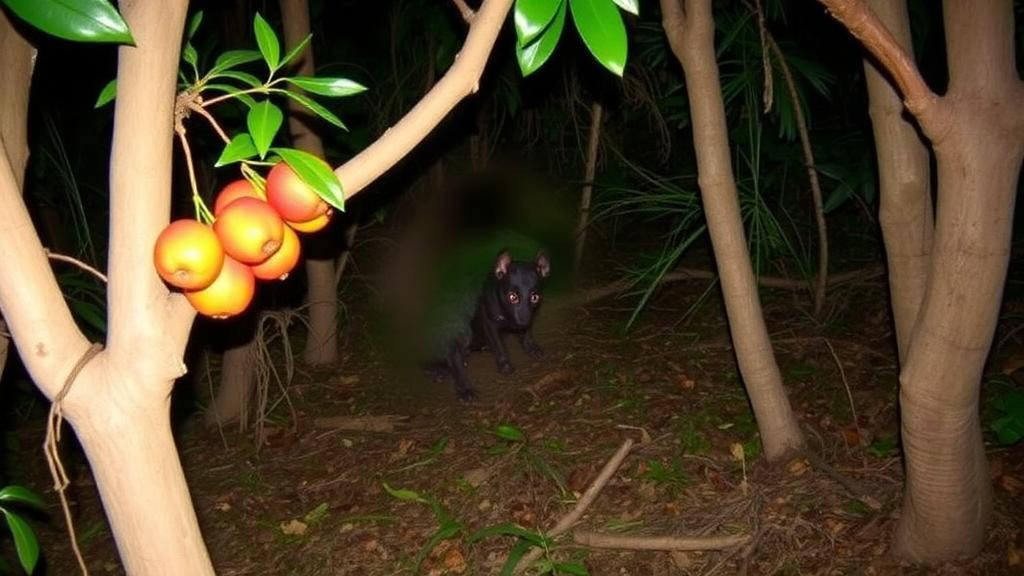
Deep in the rainforests of French Guiana, the fate of entire forest communities may rest on the shoulders, wings and paws of fruit-eating animals. Frugivorous vertebrates—the monkeys, birds, rodents and other creatures that consume fruit—are far more than casual diners. As seed dispersers and seed predators, they shape which trees regenerate, where seedlings take root and how forest composition evolves over decades. A new study published in Ecology and Evolution has now tracked how these vital animal communities respond to different histories of human disturbance, and the results reveal a subtle but consequential reshuffling of tropical wildlife that simple species counts would completely miss.
An international research team deployed 60 camera traps at nutmeg trees of the species Virola kwatae and Virola michelii, members of the Myristicaceae family, across three forest sites in French Guiana subjected to contrasting levels of human pressure. The first site was a protected mature forest, the least disturbed of the three. The second was a formerly exploited forest representing an intermediate disturbance level, where past human use had left its mark but active pressures had eased. The third and most disturbed site bordered a road and faced ongoing hunting and logging activity. By positioning cameras both on the forest floor and high in the canopy at fruiting nutmeg trees, the researchers captured a two-tiered portrait of the frugivore communities that few studies have attempted.
The most striking initial finding was what did not change. Species richness—the raw number of fruit-eating vertebrate species visiting the trees—remained remarkably consistent across all three sites. The canopy hosted 19 to 20 species at each location, while the understory supported 14 to 16. On paper, this might suggest that even the most heavily disturbed forest retains its full complement of seed dispersers. But the deeper analysis told a very different story, one that carries important lessons for how conservationists measure ecosystem health.
While the cast of characters stayed the same, the frequency of their appearances shifted dramatically. Terrestrial frugivore visitation rates fell sharply as disturbance increased, dropping from 232.5 plus or minus 53.7 individuals per 100 trap-days at the protected site to just 87.2 plus or minus 11.2 at the most disturbed site—a decline of more than 60 percent. In stark contrast, arboreal visitation rates moved in the opposite direction, tending to rise with disturbance, from 43.5 plus or minus 12.5 at the protected forest to 80.3 plus or minus 16 at the most disturbed one. The forest floor was emptying out even as the canopy grew busier, a pattern that hints at fundamentally different vulnerabilities between ground-dwelling and tree-dwelling fruit eaters.
The identity of the winners and losers proved equally revealing. In the canopy of the most disturbed site, visits were dominated by kinkajous (Potos flavus) and golden-handed tamarins (Saguinus midas), two arboreal species that appeared to thrive or at least persist under pressure. Meanwhile, in the understory of that same site, visitation rates dropped significantly for what the researchers classify as sensitive species—those with low reproductive rates or those targeted by hunters. Among the casualties were white-lipped peccaries (Tayassu pecari), large-bodied mammals that move seeds across long distances, and gray-winged trumpeters (Psophia crepitans), ground-dwelling birds known for their ecological sensitivity. The loss of such species is not merely a matter of biodiversity bookkeeping; each removal alters the seed dispersal services the forest depends upon.
To understand what drives these community patterns, the team modeled how environmental and site-level variables predicted assemblage composition, and the results differed sharply between the two vertical strata. In the canopy, four factors emerged as significant predictors of which species assembled at a given tree: the identity of the site itself, the diameter of the tree, the availability of fruit and the degree of canopy cover. This suggests that arboreal frugivores respond to a rich combination of landscape history and local resource structure, choosing their feeding grounds based on both the immediate payoff and the surrounding habitat conditions.
The understory told a simpler and arguably more troubling story. None of the measured micro-habitat variables contributed significantly to the structure of terrestrial frugivore assemblages. Instead, site identity was the single significant predictor. In other words, what mattered for ground-dwelling fruit eaters was not the local vegetation structure or fruiting conditions at a particular tree, but the disturbance history of the landscape as a whole. This pattern is consistent with the idea that hunting pressure and broad-scale human access, rather than fine-scale habitat features, are the dominant forces filtering terrestrial frugivore communities in these forests.
The methodological approach deserves attention for what it reveals about tropical ecology. Camera traps aimed at fruiting trees provide a standardized, non-invasive window into animal communities across vertical strata that are notoriously difficult to survey. Canopy wildlife is often invisible to ground-based observers, and many frugivores are cryptic, nocturnal or wary of humans. By monitoring the same nutmeg trees from below and above, the researchers could compare the responses of arboreal and terrestrial assemblages within the same resource patches, isolating the effects of disturbance history from those of food availability. The finding that the two strata responded in opposite directions would have been impossible to detect with ground-level surveys alone.
Why does this matter beyond French Guiana? Frugivorous vertebrates underpin the regeneration of large-seeded, animal-dispersed trees across the tropics, and nutmeg trees are a classic example of a plant that depends on specialized dispersers. When hunting strips the forest floor of peccaries and trumpeters, the seeds of these trees may pile up beneath parent plants, fall prey to seed predators, or fail to reach the light gaps they need to establish. Over time, such changes can shift forest composition toward tree species with abiotic or small-animal dispersal, rewiring ecosystem processes in ways that may take centuries to reverse. The apparent stability of species richness in this study serves as a warning: a forest can look intact on a checklist while its functional machinery quietly degrades.
The study’s conclusions carry clear implications for conservation planning. The researchers emphasize the importance of considering species-specific responses and the disturbance histories of individual sites, rather than relying on coarse measures of biodiversity. They also highlight the value of protected areas and forests under active restoration in maintaining functional frugivore assemblages. The intermediately disturbed site, once exploited but now recovering, offers a note of cautious optimism: forests given room to heal can retain much of their ecological function. But the most disturbed site, with its depleted ground-level community and kinkajou-dominated canopy, shows what happens when roads, logging and hunting converge. As tropical landscapes face mounting pressure, this research makes the case that protecting not just the number of species but the full functional web of seed dispersers is essential to keeping rainforests alive from the forest floor to the treetops.
Subject of Research: Responses of arboreal and terrestrial frugivore vertebrate assemblages to human disturbance histories in French Guianan tropical forests
Article Title: Arboreal and Terrestrial Frugivore Vertebrate Assemblage Diversity and Composition Vary With Disturbance Histories in Guianan Forests
Article References: Abensur, R., Coutant, O., Gloaguen, P., Gottstein, M., Pelon, C., Guilbert, E., Baltzinger, C., & Forget, P.-M. (2026). Arboreal and Terrestrial Frugivore Vertebrate Assemblage Diversity and Composition Vary With Disturbance Histories in Guianan Forests. Ecology and Evolution, 16(10), Article e74374. https://doi.org/10.1002/ece3.74374
Image Credits: AI Generated
DOI: 10.1002/ece3.74374
Keywords: French Guiana, frugivores, seed dispersal, camera traps, tropical forest, disturbance, hunting, kinkajou, white-lipped peccary, canopy ecology, conservation, Virola
Cite Scienmag News
Margaret Porter. (September 30, 2026). Camera Traps Reveal Hidden Shifts in Tropical Fruit-Eating Wildlife as Forest Disturbance Rises. Scienmag. https://scienmag.com/camera-traps-reveal-hidden-shifts-in-tropical-fruit-eating-wildlife-as-forest-disturbance-rises/
Margaret Porter. "Camera Traps Reveal Hidden Shifts in Tropical Fruit-Eating Wildlife as Forest Disturbance Rises." Scienmag, 30 September 2026, https://scienmag.com/camera-traps-reveal-hidden-shifts-in-tropical-fruit-eating-wildlife-as-forest-disturbance-rises/. Accessed 30 September 2026.
Margaret Porter. "Camera Traps Reveal Hidden Shifts in Tropical Fruit-Eating Wildlife as Forest Disturbance Rises." Scienmag. September 30, 2026. https://scienmag.com/camera-traps-reveal-hidden-shifts-in-tropical-fruit-eating-wildlife-as-forest-disturbance-rises/


