


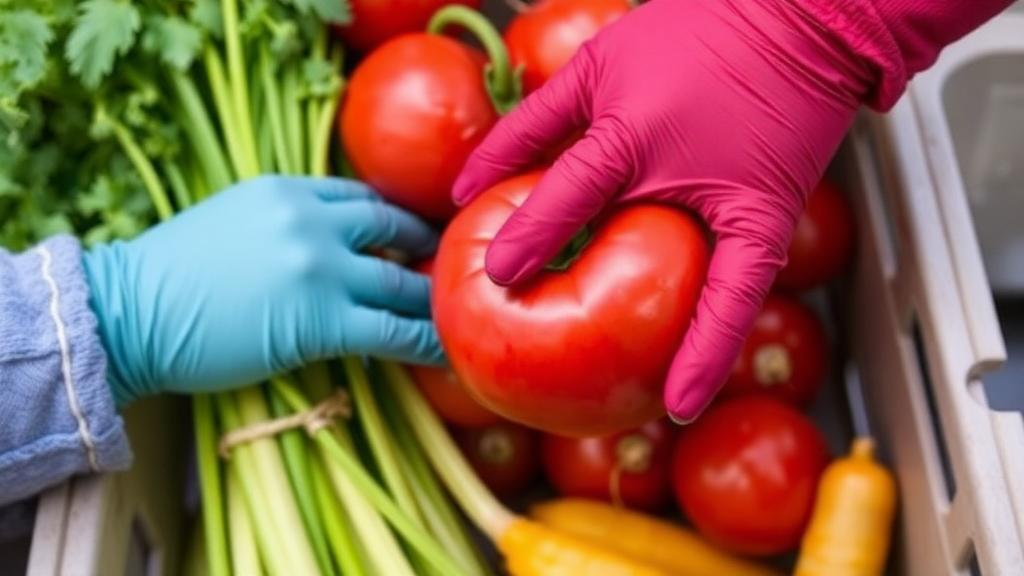
A team of engineers, plant scientists, and information researchers at the University of Tennessee, Knoxville has secured a central role in a nearly $1 million National Science Foundation project that aims to do something deceptively simple and remarkably ambitious: build a smart, connected network for growing and distributing locally produced food. The effort, known as DFARM, brings together two faculty members from the Tickle College of Engineering with a local nonprofit called Three3, additional University of Tennessee researchers, and community partners, all working toward a system that could reshape how neighborhoods coordinate what food is grown, where it is produced, and who ultimately receives it.
The project is led on the UT side by Jon Hathaway, a professor in the Department of Civil and Environmental Engineering who also serves as an associate director of the Tennessee Water Resources Research Center. Hathaway will steer the university’s involvement through the Institute for a Secure & Sustainable Environment, a research institute focused on sustainability challenges. Alongside him, Catherine Schuman, an assistant professor in the Min H. Kao Department of Electrical Engineering and Computer Science, brings expertise in optimization algorithms and user-interface development, two disciplines that sit at the computational heart of any system attempting to orchestrate dozens of distributed growing sites in real time.
The interdisciplinary roster does not stop there. Natalie Bumgarner, an associate professor of plant sciences in the Hebert College of Agriculture, and George Hope Chidziwisano, an assistant professor in the School of Information Sciences, round out the co-principal investigators. This combination is deliberate. Optimizing a community food network is not purely a software problem or purely an agricultural one; it requires understanding how plants respond to nutrient solutions, how sensors behave in humid growing environments, how interfaces communicate with growers who may have widely varying levels of technical experience, and how information flows between community organizations such as food pantries.
At its core, DFARM will employ a user-centered software platform designed to connect community gardens, indoor hydroponic systems, and local food hubs into a single coordinated network. The platform’s purpose is logistical intelligence: matching production capacity with demand, coordinating planting schedules across sites, and routing harvests to the organizations that need them most, including community food pantries. In an era when food insecurity and supply chain fragility have moved from abstract concerns to lived realities for many communities, the appeal of a locally controlled, digitally coordinated production system is easy to understand.
A major component of the buildout involves hardware as well as software. The team intends to purchase 30 new hydroponic systems, soil-free growing units that deliver water, oxygen, and essential materials directly to plant roots through a nutrient-rich water solution. Hydroponics has long been celebrated for its efficiency: because nutrients are delivered precisely and water can be recirculated, these systems can support food production year-round, independent of weather, and can expand growing capacity into locations where traditional garden space simply is not available. Rooftops, warehouses, community centers, and other unconventional spaces become viable production sites once soil is removed from the equation.
The technical challenge the UT researchers have set for themselves is determining exactly how much technological support is needed to make such systems succeed. Hathaway’s own work will focus on hydroponic sensing and connectivity, investigating the spectrum between minimal and maximal automation. At one end of that spectrum sit systems with no automated monitoring at all, where growers must check conditions manually. At the other end are fully instrumented platforms that display system conditions on a dashboard and issue alerts when something needs attention. Finding the right level of support for each growing context is a genuine research question, not a settled engineering decision.
The sensing technology itself will monitor three critical parameters within the hydroponic systems: water depth, electrical conductivity, and pH. Each of these matters enormously to plant health. Water depth determines whether roots have adequate access to the nutrient solution; conductivity provides a proxy for the concentration of dissolved nutrients available to the plants; and pH governs whether those nutrients can actually be absorbed, since even a perfectly balanced solution becomes unusable to plants if acidity drifts outside a viable range. From these sensors, data can be transferred for processing, allowing the system to notify growers when intervention is needed, either through the DFARM application or via a simple text message.
That last detail, the text message option, reflects the user-centered philosophy that runs through the entire project. Schuman and Chidziwisano’s contributions on interface design and information science are aimed at ensuring the platform meets growers where they are, rather than demanding that community volunteers become systems administrators. The broader UT team, whose expertise spans optimization algorithms, user-interface development, plant science, nutrition, and sensor technology, will develop these tools collaboratively, and UT graduate and undergraduate students will be embedded in the work, contributing to the algorithms, interfaces, and sensing systems as part of their training.
Hathaway has framed the effort as a textbook case of use-inspired research, the mode of inquiry in which fundamental scientific questions are pursued in direct service of real-world challenges. In his words, the project allows researchers to contribute to fundamental developments in their own fields while simultaneously addressing practical problems. Schuman echoed that sentiment, expressing enthusiasm for work that supports interdisciplinary research on a real-world problem and connects solutions to members of the broader community who stand to benefit most. That orientation, toward community benefit as a design requirement rather than an afterthought, distinguishes DFARM from purely laboratory-bound automation research.
Beyond its immediate goals of increasing local food production capacity and streamlining distribution, the project carries a larger ambition: to create a model that other communities could eventually adapt for their own needs. If the Knoxville network demonstrates that a modest fleet of instrumented hydroponic units, a handful of community gardens, and a coordinating software platform can meaningfully expand access to fresh, locally grown food, the blueprint becomes replicable. The nearly $1 million NSF investment reflects the agency’s growing interest in research that bridges engineering, agriculture, and community infrastructure, and the DFARM team’s results will be watched closely by anyone interested in whether smart, connected food systems can move from promising concept to everyday practice.
Subject of Research: An NSF-funded smart, connected community food production and distribution system using hydroponics, sensing, and optimization software
Article Title: University of Tennessee researchers join nearly $1 million project to build local smart food production network
Article References: University of Tennessee researchers join nearly $1 million project to build local smart food production network. (n.d.). Original publication
Image Credits: AI Generated
DOI: Not provided
Keywords: hydroponics, local food systems, National Science Foundation, sensors, food security, optimization algorithms, user-centered design, community gardens, sustainable agriculture, University of Tennessee, food distribution, interdisciplinary research
Cite Scienmag News
Denise Maddox. (September 30, 2026). Smart Food Network: Tennessee Engineers Win Nearly $1 Million NSF Grant to Rewire Local Food Production. Scienmag. https://scienmag.com/smart-food-network-tennessee-engineers-win-nearly-1-million-nsf-grant-to-rewire-local-food-production/
Denise Maddox. "Smart Food Network: Tennessee Engineers Win Nearly $1 Million NSF Grant to Rewire Local Food Production." Scienmag, 30 September 2026, https://scienmag.com/smart-food-network-tennessee-engineers-win-nearly-1-million-nsf-grant-to-rewire-local-food-production/. Accessed 30 September 2026.
Denise Maddox. "Smart Food Network: Tennessee Engineers Win Nearly $1 Million NSF Grant to Rewire Local Food Production." Scienmag. September 30, 2026. https://scienmag.com/smart-food-network-tennessee-engineers-win-nearly-1-million-nsf-grant-to-rewire-local-food-production/


