


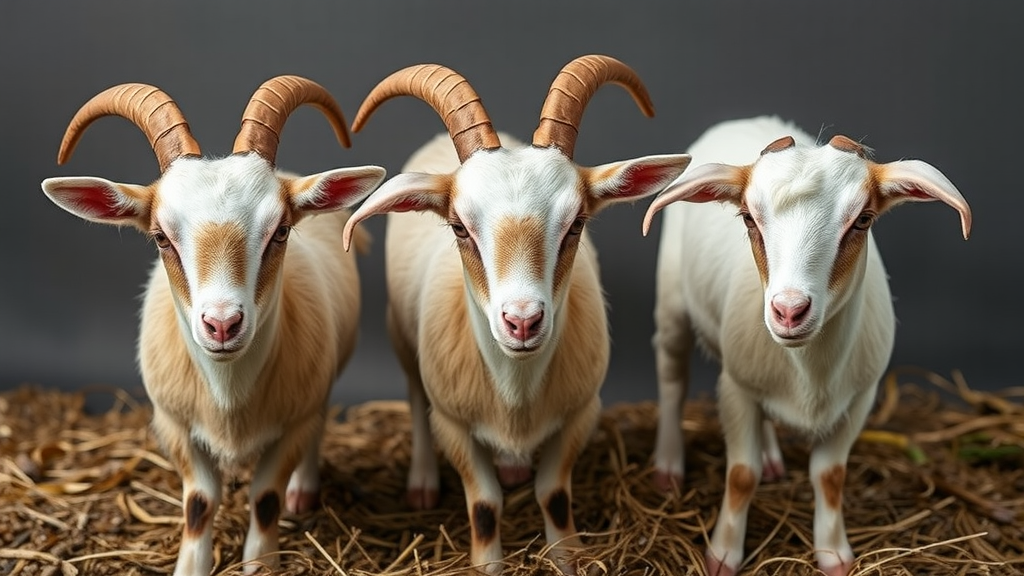
Goat meat is a staple protein across much of China, and the country’s indigenous goat breeds represent a genetic treasury that scientists are only beginning to characterize in chemical detail. A new study from researchers at China Agricultural University and their collaborators has now delivered one of the most comprehensive portraits yet of how breed shapes the chemistry of goat meat. By raising three native Guizhou breeds under identical conditions and then dissecting their meat with an arsenal of analytical techniques, the team showed that genetics alone leaves measurable, breed-specific fingerprints in everything from tenderness and color to amino acids, fatty acids, volatile compounds, and the muscle’s broader metabolite landscape.
The three breeds in question are the Guizhou Black, Guizhou White, and Qianbei Brown goats, all listed in China’s National Catalogue of Livestock and Poultry Genetic Resources. Forty-five healthy weaned male kids, fifteen per breed, were transferred to an experimental farm in Heishui Town, Guizhou Province, where they were housed individually, fed the same basal diet, and given free access to water until 6.5 months of age. Seven animals per breed were then randomly selected for slaughter, with one Guizhou White sample later excluded after contamination was detected during quality control, leaving a final cohort of seven Guizhou Black, six Guizhou White, and seven Qianbei Brown animals. Because diet, housing, and management were held constant, any differences that emerged could be attributed with far greater confidence to breed rather than environment.
The researchers focused on the Longissimus thoracis et lumborum, the long back muscle prized as a standardized cut in meat science. Within two hours of slaughter, roughly 200 grams of this muscle was collected from each carcass, with portions flash-frozen in liquid nitrogen for metabolomics and the remainder used for physicochemical and compositional analyses. The team measured pH and color at 45 minutes and 24 hours postmortem, drip loss, cooking loss, shear force, moisture, crude protein, and ether extract, following standardized protocols with calibrated instruments and multiple replicate readings per sample.
The quality measurements revealed that the breeds diverged most strikingly in early postmortem metabolism and texture rather than in basic composition. Guizhou White meat showed a higher pH at 45 minutes postmortem, greater lightness, higher moisture content, and the lowest shear force, indicating a slower early glycolytic decline that may help preserve muscle water status and a more tender bite. Guizhou Black meat stood out for stronger redness at both time points, while Qianbei Brown meat registered the highest shear force, suggesting a comparatively firmer muscle structure. Notably, drip loss, cooking loss, crude protein, and ether extract showed no significant breed differences, meaning the breeds differed mainly in how their muscles handled the hours after slaughter rather than in what they were made of.
Amino acid analysis of 18 total hydrolyzed amino acids added further nuance. Guizhou White meat contained significantly more glycine and proline, while Qianbei Brown meat carried more methionine. Guizhou White also had the highest total essential amino acid content. Yet the overall nutritional picture was remarkably consistent: the ratio of essential to non-essential amino acids hovered between 0.69 and 0.70 in all breeds, and essential amino acids made up roughly 41 percent of the total, figures that compare favorably with FAO/WHO/UNU reference values for human protein quality. Breed, in other words, fine-tuned the amino acid profile without fundamentally altering its nutritional adequacy.
The fatty acid story was more dramatic. The dominant fatty acids across all breeds were palmitic, stearic, and oleic acids, the typical signature of goat meat, but the minor polyunsaturated fatty acids told a breed-specific tale. Guizhou Black and Qianbei Brown meat was richer in linoleic acid, eicosatrienoic acid, and arachidonic acid, the n-6 family, whereas Guizhou White meat was enriched in the long-chain omega-3 fatty acids EPA and DHA and displayed a lower n-6 to n-3 ratio. Because polyunsaturated fatty acids are highly susceptible to oxidation and serve as major precursors for aldehydes, ketones, and alcohols during cooking, these lipid differences hint at divergent flavor-forming potential, though the study measured raw muscle and did not directly quantify volatiles generated during heating.
To capture the volatile landscape, the team deployed comprehensive two-dimensional gas chromatography coupled to time-of-flight mass spectrometry, a technique capable of resolving thousands of compounds in a single run. They detected 3,207 volatile features in raw meat, of which 941 were shared across all three breeds while 566, 457, and 590 were unique to Guizhou Black, Guizhou White, and Qianbei Brown respectively. Alcohols dominated the profile, followed by ketones and hydrocarbons, with Guizhou Black and Qianbei Brown generally showing higher abundances of organoheterocyclic compounds, alcohols, ketones, and carboxylic acids than Guizhou White. A rigorous global test confirmed a genuine breed association in the standardized volatile profile, and leave-one-out sensitivity analyses, in which each animal was removed in turn and the entire analysis recalculated, showed the association was stable across all twenty folds rather than driven by any single sample.
Applying a strict unified rule that combined statistical significance across 866 tested features with odor-activity prioritization, the researchers retained exactly eight volatile features of potential aroma relevance: 3-methyl-1-butanol, 1-octanol, 2-heptanone, (E)-2-octenal, 2-undecanone, ethyl hexadecanoate, nonanal, and trimethylpyrazine. Seven of these remained statistically stable in at least 80 percent of the leave-one-out folds, while trimethylpyrazine was moderately stable. The authors are careful to stress that these are chemically prioritized candidates, not confirmed aroma-active compounds, because no gas chromatography-olfactometry or human sensory testing was performed, and compound assignments were tentative, based on mass spectral library matching supported by retention index comparison.
Untargeted LC-MS metabolomics rounded out the picture, putatively annotating thousands of features spanning amino acids, peptides, fatty acids and their esters, saccharides, and glycerophosphocholines. The global metabolite profile also showed a breed association that survived every leave-one-out fold. Pathway summaries pointed to glycerophospholipid metabolism, glycine, serine and threonine metabolism, alpha-linolenic acid metabolism, arachidonic acid metabolism, and beta-alanine metabolism, patterns directionally consistent with the measured amino acid and fatty acid differences. However, no individual metabolite feature survived multiple-testing correction across all 7,585 preprocessed features, so the researchers frame these pathway findings as hypothesis-generating rather than validated breed markers. Exploratory correlation analysis between metabolite and volatile features revealed chemically plausible co-variation patterns linking phospholipid-related features with aldehydes, alcohols, and ketones, but the authors emphasize these within-cohort associations cannot establish biochemical causality.
The study’s real contribution lies less in any single discovery than in its disciplined framework. By combining standardized rearing, tissue-specific sampling, integrated compositional and omics layers, and transparent small-sample sensitivity analyses, the researchers have produced a controlled baseline dataset for three understudied indigenous breeds and a prioritization pipeline for future validation. The team is candid about the limits: the cohort was small and slightly unbalanced, only the back muscle was sampled without matched fat depots, raw rather than cooked meat was profiled, and neither sensory panels nor aroma-recombination experiments were conducted. The logical next steps they outline are ambitious but clear: a larger preregistered cohort with independent replication, matched muscle and fat depots from the same animals, targeted quantification with authentic standards, standardized cooking protocols, and finally gas chromatography-olfactometry and trained sensory panels to connect chemistry to what eaters actually perceive. Until then, the message is a measured one: breed demonstrably shapes the chemical architecture of goat meat, but translating those chemical signatures into guaranteed flavor differences will require the harder work of linking molecules to the human senses.
Subject of Research: Breed-associated chemical, volatile, and metabolomic variation in goat meat from three indigenous Guizhou breeds
Article Title: Breed-associated chemical, volatile, and metabolomic profiles of Longissimus thoracis et lumborum muscle in three indigenous Guizhou goat breeds
Article References: Yang, T., Ren, G., Mao, F., Li, S., Yang, L., Zhang, N., Chen, L., He, P., & Luo, H. (2026). Breed-associated chemical, volatile, and metabolomic profiles of Longissimus thoracis et lumborum muscle in three indigenous Guizhou goat breeds. Journal of Agriculture and Food Research, 31, Article 103304. https://doi.org/10.1016/j.jafr.2026.103304
Image Credits: AI Generated
DOI: 10.1016/j.jafr.2026.103304
Keywords: goat meat, meat quality, Guizhou breeds, volatile compounds, metabolomics, fatty acids, amino acids, GC×GC-TOF-MS, lipid oxidation, flavor chemistry, indigenous livestock, Longissimus thoracis et lumborum
Cite Scienmag News
Juliet Wilcox. (September 27, 2026). Three Guizhou Goat Breeds Leave Distinct Chemical Fingerprints in Their Meat. Scienmag. https://scienmag.com/three-guizhou-goat-breeds-leave-distinct-chemical-fingerprints-in-their-meat/
Juliet Wilcox. "Three Guizhou Goat Breeds Leave Distinct Chemical Fingerprints in Their Meat." Scienmag, 27 September 2026, https://scienmag.com/three-guizhou-goat-breeds-leave-distinct-chemical-fingerprints-in-their-meat/. Accessed 27 September 2026.
Juliet Wilcox. "Three Guizhou Goat Breeds Leave Distinct Chemical Fingerprints in Their Meat." Scienmag. September 27, 2026. https://scienmag.com/three-guizhou-goat-breeds-leave-distinct-chemical-fingerprints-in-their-meat/


