


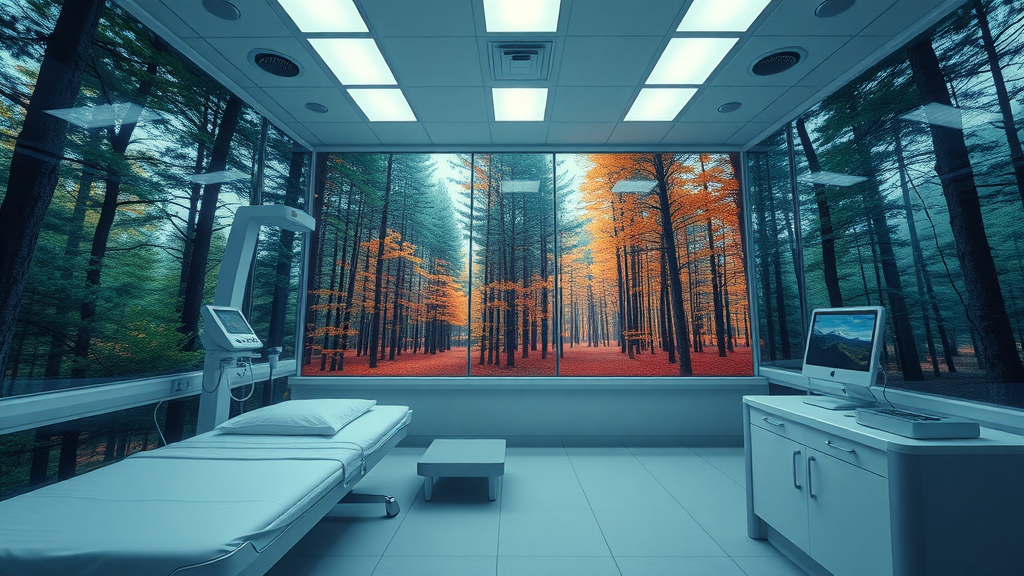
A quiet revolution is unfolding amid the noise and urgency of the emergency department, and it comes in the form of a headset. Researchers in Ankara, Turkey, have shown that immersing patients with dangerously high blood pressure in a virtual reality landscape of a flowing river, tall trees and a wooden suspension bridge, while streaming classical music through a smartphone, can significantly lower their blood pressure within just fifteen minutes of arrival. The findings, presented at the European Emergency Medicine Congress in Paris by the European Society for Emergency Medicine, come from a randomised controlled trial of 130 adult patients and suggest that a cheap, drug-free, side-effect-free intervention could become a supportive tool in one of medicine’s most chaotic environments. For a condition that brings enormous numbers of people through emergency doors every day, the implications are hard to ignore.
The patients in question arrived with what clinicians call hypertensive urgency: blood pressure readings of 180 mmHg or higher on the systolic, or top, number, or 110 mmHg or higher on the diastolic, or bottom, number, but without any symptoms or signs of acute damage to organs such as the heart, brain or kidneys. This presentation is extremely common, according to Dr Safa Dönmez, associate professor of emergency medicine at the University of Health Sciences, Ankara City Health Application and Research Center, who led the study. These patients receive standard blood pressure medication, but Dönmez noticed that many were also visibly anxious and frightened. That matters medically, not just emotionally. Anxiety triggers the release of stress hormones that constrict blood vessels and drive blood pressure even higher, and the emergency department itself, with its noise, bright lights and uncertainty, can amplify the problem.
That observation prompted a deceptively simple question: if patients could be made to feel calmer, would their blood pressure come down faster? To find out, Dönmez and his colleague Dr Kadir Yenal, an emergency medicine specialist at Ankara Bilkent City Hospital, randomised 130 patients into two groups of 65. Everyone received the same standard medication to lower blood pressure. The control group received nothing further. The intervention group, however, donned VR headsets of the kind familiar from gaming and were transported to a peaceful nature scene: a river winding through a forest, tall trees swaying overhead and a wooden suspension bridge spanning the water. Simultaneously, they listened to a carefully curated playlist of classical music on a smartphone, chosen for the calming, structured qualities of composers including Bach, Mozart, Debussy, Vivaldi, Tchaikovsky, Saint-Saëns, Haydn and Corelli.
The researchers tracked blood pressure at five time points: 15, 30, 60, 90 and 120 minutes after presentation. Rather than relying solely on the familiar top-and-bottom readings, they focused on mean arterial pressure, or MAP, a single figure that combines systolic and diastolic values to represent the average pressure in the arteries across one cardiac cycle. A normal MAP sits roughly between 70 and 100 mmHg; the patients in this study arrived with MAP readings of around 130 to 138 mmHg, well into dangerous territory. Anxiety was assessed with the State Anxiety Inventory, a validated questionnaire that distinguishes between state anxiety, how anxious a person feels in the moment, and trait anxiety, anxiety as an enduring personality characteristic, both scored from 20 to 80 with higher numbers indicating greater anxiety.
The results revealed a striking early advantage for the virtual forest. At 15 minutes, MAP in the control group had fallen from 138 mmHg to 126 mmHg, while in the VR group it dropped from 132 mmHg to 116 mmHg. At 30 minutes the figures were 119 mmHg for controls versus 112 mmHg for the VR group. Expressed as percentage reductions, the control group achieved 8 percent at 15 minutes and 14 percent at 30 minutes, compared with 12 percent and 15 percent respectively in the VR group. Because randomisation had left the VR group with slightly lower starting blood pressures, the team analysed both absolute values between groups and the magnitude of reduction within each group, a methodologically careful approach. Dr Yenal reported that after 15 minutes the VR group’s blood pressure had fallen approximately 4 to 5 mmHg more than the control group’s, a difference that was statistically significant, meaning it was unlikely to be due to chance.
The advantage, however, proved time-limited. From 60 minutes onwards, the two groups were essentially equivalent, a pattern the researchers interpret as evidence that the intervention accelerates early stabilisation rather than providing long-term blood pressure control. Even so, Dönmez argues that this early window carries real clinical weight. In a busy emergency department, bringing blood pressure under control quickly matters both for patient safety and for the efficient use of resources, and if a non-drug intervention can modestly speed that process, it has practical value. The technology involved is inexpensive, easy to use and free of side effects, which makes the prospect of routine adoption considerably less daunting than a new pharmacological agent would be.
The anxiety data told an equally compelling story. At baseline, the VR patients were significantly more anxious than the controls, with trait anxiety scores of about 46 compared with about 38, an unlucky quirk of randomisation that ultimately made the results more impressive rather than less. Over the observation period, trait anxiety fell by an average of eight points in the VR group versus four points in the control group, a statistically significant difference. By the end of the two hours, both groups had reached similar post-intervention anxiety levels, but the VR group had travelled much further from a higher starting point of anxious temperament. As Yenal noted, that greater improvement from a worse baseline is precisely what makes the finding notable.
The study has clear strengths: it was randomised, it used the same standardised equipment for blood pressure measurement in both groups, and not a single patient dropped out. But the limitations are honest and instructive. The baseline difference in blood pressure between groups complicates interpretation. It was a single-centre trial with only two hours of follow-up. Crucially, because the headset and the music were always delivered together, it is impossible to say which component drove the effect, or whether both are necessary. And since patients and staff could see who was wearing the headsets, a placebo effect cannot be excluded. The team now plans larger multi-hospital studies with longer follow-up, separate testing of VR and music, and an investigation of whether letting patients choose their own music changes the outcome.
Independent experts are cautiously encouraged. Dr Felix Lorang, head of the emergency department at Klinikum Lippe in North Rhine-Westphalia, Germany, and a member of the EUSEM abstract selection committee who was not involved in the research, said that although the study was single-centre, the results are interesting and deserve further investigation. In his view, they raise the possibility that the approach is not only safe and feasible but offers meaningful benefits, particularly in reducing anxiety and achieving faster blood pressure control in the early stages of treatment, and might even avoid unnecessary medication. He emphasised that the intervention was used in addition to, not instead of, adjustment of blood pressure medication. For patients, Dönmez offers a vivid summary: if you arrived in the emergency department frightened, with markedly elevated blood pressure, a few minutes in a peaceful virtual forest listening to Mozart would likely be very welcome indeed.
Subject of Research: Virtual reality and classical music therapy for reducing blood pressure and anxiety in emergency department patients with hypertensive urgency
Article Title: Virtual reality and classical music help to reduce blood pressure in patients in an emergency department
Article References: Virtual reality and classical music help to reduce blood pressure in patients in an emergency department. (n.d.). Original publication
Image Credits: AI Generated
DOI: Not provided
Keywords: virtual reality, classical music, hypertensive urgency, emergency medicine, blood pressure, mean arterial pressure, anxiety, randomised controlled trial, non-pharmacological intervention, patient care, stress hormones, European Emergency Medicine Congress
Cite Scienmag News
Ophelia Keating. (September 26, 2026). Virtual Forests and Mozart: VR Calms Blood Pressure Spikes in the Emergency Room. Scienmag. https://scienmag.com/virtual-forests-and-mozart-vr-calms-blood-pressure-spikes-in-the-emergency-room/
Ophelia Keating. "Virtual Forests and Mozart: VR Calms Blood Pressure Spikes in the Emergency Room." Scienmag, 26 September 2026, https://scienmag.com/virtual-forests-and-mozart-vr-calms-blood-pressure-spikes-in-the-emergency-room/. Accessed 26 September 2026.
Ophelia Keating. "Virtual Forests and Mozart: VR Calms Blood Pressure Spikes in the Emergency Room." Scienmag. September 26, 2026. https://scienmag.com/virtual-forests-and-mozart-vr-calms-blood-pressure-spikes-in-the-emergency-room/


