


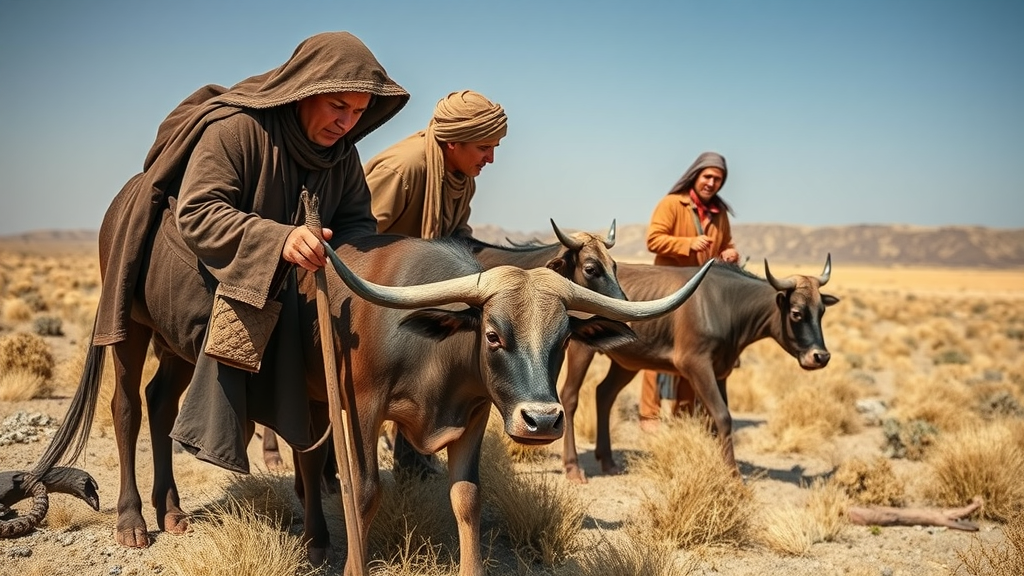
Deep in the Surkhan Darya region of southern Uzbekistan, a Bronze Age settlement called Kattabulak is rewriting what archaeologists thought they knew about how ancient communities in Central Asia managed their animals and grew their food. A new study published in Archaeological and Anthropological Sciences presents stable carbon and nitrogen isotope data from animal bones recovered at the site, and the results point to a surprisingly diversified livestock economy in which cattle, sheep, goats and horses were raised under distinctly different feeding regimes. Most striking of all, the data suggest that cattle at Kattabulak had regular access to millet or its byproducts, making the site one of the clearest examples yet of foddering with cultivated crops in southern Central Asia during the second millennium BCE.
The research, led by Xue Ling and Zhuoran Zhang of Northwest University in Xi’an together with colleagues from Termez State University and other institutions in Uzbekistan and China, focused on bone collagen extracted from the faunal assemblage excavated at Kattabulak. Stable isotope analysis of carbon and nitrogen in collagen is a well-established technique for reconstructing ancient animal diets. Carbon isotope ratios distinguish between animals that ate C3 plants, such as most trees, shrubs and cool-season grasses, and those that consumed C4 plants, which include millet and other tropical grasses that use a different photosynthetic pathway. Nitrogen isotope ratios, meanwhile, reflect trophic level and can be influenced by factors such as aridity, manuring and the consumption of animal products.
The isotopic results divided the Kattabulak livestock into two clearly different groups. Sheep and goats, represented by eleven individuals, produced a mean carbon isotope value of minus 18.42 per mil with a standard deviation of 1.44 per mil, and a mean nitrogen value of 7.94 per mil. Horses, with five individuals analyzed, yielded a mean carbon value of minus 16.56 per mil and a mean nitrogen value of 8.24 per mil. Crucially, these values broadly overlap with those of eleven wild herbivores from the site, which averaged minus 17.75 per mil for carbon and 7.41 per mil for nitrogen. That overlap is the isotopic fingerprint of free-grazing animals, creatures turned out onto natural pastures and living largely on the same wild vegetation as their undomesticated counterparts.
Cattle tell a very different story. The five cattle individuals analyzed produced a mean carbon isotope value of minus 14.40 per mil, substantially higher than the ovicaprids, equids or wild herbivores, and a mean nitrogen value of 9.86 per mil, also markedly elevated. Carbon values in this range indicate sustained consumption of C4 biomass, and in the Bronze Age Central Asian context the most plausible source is millet, either fed directly as grain or indirectly as stalks, chaff and other byproducts of the harvest. The elevated nitrogen values may reflect the same foddering practice, since millet grown on manured irrigated fields carries higher nitrogen signatures, or they may indicate that cattle were kept in closer proximity to the settlement and its agricultural residues.
This pattern implies a diversified management system in which different species were treated differently according to their economic roles. Sheep, goats and horses roamed free, perhaps tended by herders who moved them across the surrounding landscapes, while cattle were integrated more tightly into the agricultural core of the settlement, fed on the products of cultivated fields and possibly used for traction, dairying or both. Such a system would have made ecological sense. Cattle require more water and better forage than sheep or goats, and keeping them near irrigated fields would have allowed farmers to recycle crop byproducts, exploit manure for field fertility and maintain the animals needed for plowing within easy reach.
The findings carry particular weight because Kattabulak sits within the territory of the Sapalli culture, a southern Central Asian Bronze Age archaeological culture known for its fortified settlements, proto-urban centers such as Dzharkutan and Sapallitepa, and its connections to the wider Oxus Civilization, also called the Bactria-Margiana Archaeological Complex. These communities practiced irrigation agriculture along river valleys, and the new isotope data provide direct biological evidence that animal husbandry was woven into that irrigated agro-pastoral economy rather than existing as a separate, mobile strand of the subsistence system. The herding strategies documented at Kattabulak contrast with those known from northern Central Asia, where steppe communities relied more heavily on extensive mobility and showed different patterns of C4 plant consumption in their livestock.
Millet itself is one of the great travelers of prehistory. Domesticated in northern China, where common millet and foxtail millet were cultivated as early as ten thousand years ago, the crop spread westward across Eurasia during the third and second millennia BCE, a movement sometimes described as the trans-Eurasian crop exchange. Archaeobotanical finds have traced broomcorn millet to the central Eurasian steppe by the late third millennium BCE, and isotopic studies of human bone collagen have charted what researchers have called the Isotopic Millet Road, a corridor of rising C4 consumption stretching from northern China toward Europe. The Kattabulak data add a southern branch to this map, showing that by the Bronze Age millet had reached the irrigated oases of southern Uzbekistan and was being used not only as human food but also as animal fodder.
The use of millet as fodder rather than solely as a staple crop is a subtle but important distinction. When millet enters the human food chain directly, it shows up strongly in human bone collagen. When it is channeled through livestock, its isotopic signature appears first in the animals and only secondarily, and in diluted form, in the people who consumed their meat, milk or labor. The Kattabulak pattern therefore suggests a sophisticated agricultural economy in which crop production, animal management and field fertility were deliberately linked. Feeding cattle on millet byproducts would have converted agricultural waste into meat, milk and draft power, while the resulting manure could return nutrients to the irrigated fields, closing a loop that intensified production in an oasis environment where arable land and water were both precious and limited.
The study also underscores how local environmental and social conditions shaped animal management across Bronze Age Eurasia. In the arid Surkhan Darya valley, with its hot summers and limited pasture, free-grazing sheep, goats and horses could exploit the natural vegetation of the surrounding foothills and steppe, while cattle benefited from the shelter and feed of the settlement. In the wetter, more northerly regions of Kazakhstan and the Tianshan, other communities adopted different solutions, from transhumance to foddering with cultivated crops in mountain valleys. The comparison highlights that there was no single Bronze Age pastoralism but rather a spectrum of adaptive strategies, each tuned to local ecology, agricultural scale and cultural practice, including the presence and extent of millet cultivation itself.
For archaeologists, the Kattabulak results demonstrate the power of faunal stable isotope analysis to recover management practices that leave no trace in architecture or artifacts. The bones of ordinary livestock, carefully sampled and measured, can reveal which animals grazed free and which were fed at the trough, and can trace the movement of a domesticated crop through an ancient economy. As isotope databases for Central Asia continue to grow, sites like Kattabulak will help scholars map the full diversity of Bronze Age lifeways across the region, from the mobile herders of the northern steppes to the irrigation farmers of the southern oases, and to understand how the spread of millet reshaped both human diets and the animals that sustained them. The research was funded by the National Key Research and Development Program of China and partner institutions, and the underlying data are available in the article’s supplementary materials.
Subject of Research: Bronze Age herding strategies and millet foddering in southern Central Asia revealed by faunal stable isotope analysis
Article Title: New evidence for Bronze Age herding strategies and millet exploitation in Southern Central Asia from faunal stable isotope analysis at Kattabulak, Surkhan Darya, Uzbekistan
Article References: Ling, X., Zhang, Z., Shaydullaev, A. S., Kholtojiyevich, U. S., Zhu, L., Zou, T., Sidikova, M., Shaydullayev, S., Normuminov Bakhtiyor ugli, M., Wang, Y., Ding, Y., Zhu, J., Li, D., Festa, M., & Ma, J. (2026). New evidence for Bronze Age herding strategies and millet exploitation in Southern Central Asia from faunal stable isotope analysis at Kattabulak, Surkhan Darya, Uzbekistan. Archaeological and Anthropological Sciences, 18(10), Article 206. https://doi.org/10.1007/s12520-026-02573-8
Image Credits: AI Generated
DOI: 10.1007/s12520-026-02573-8
Keywords: Kattabulak, Bronze Age, Central Asia, Uzbekistan, stable isotopes, millet, herding strategies, agro-pastoralism, Sapalli culture, cattle, Oxus Civilization, zooarchaeology
Cite Scienmag News
William Thompson. (September 26, 2026). Bronze Age Herders in Uzbekistan Fed Cattle on Millet, Isotopes Reveal. Scienmag. https://scienmag.com/bronze-age-herders-in-uzbekistan-fed-cattle-on-millet-isotopes-reveal/
William Thompson. "Bronze Age Herders in Uzbekistan Fed Cattle on Millet, Isotopes Reveal." Scienmag, 26 September 2026, https://scienmag.com/bronze-age-herders-in-uzbekistan-fed-cattle-on-millet-isotopes-reveal/. Accessed 26 September 2026.
William Thompson. "Bronze Age Herders in Uzbekistan Fed Cattle on Millet, Isotopes Reveal." Scienmag. September 26, 2026. https://scienmag.com/bronze-age-herders-in-uzbekistan-fed-cattle-on-millet-isotopes-reveal/


