


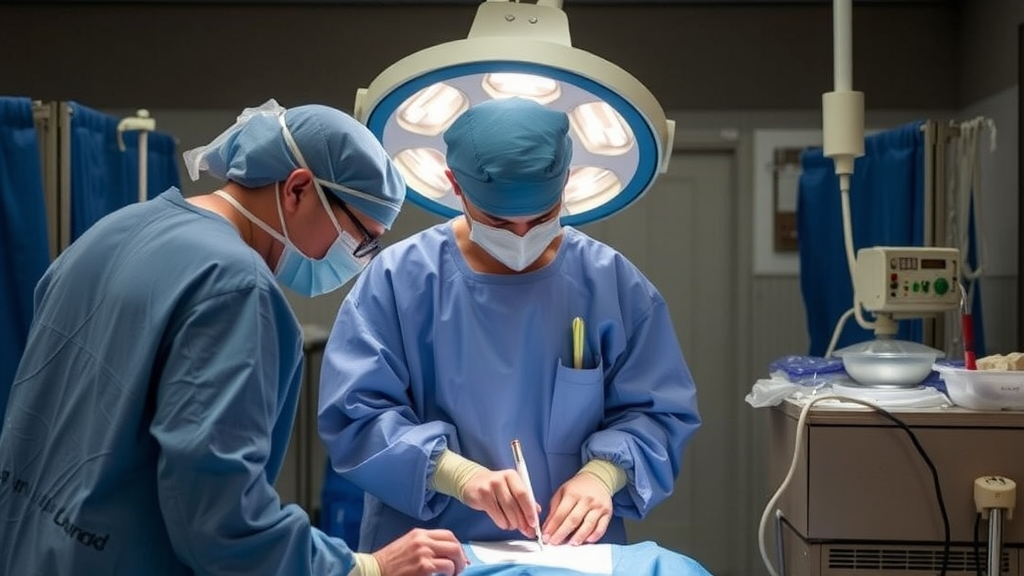
Patients who live in the hottest parts of American cities appear to face measurably worse odds of recovering well after major surgery, according to new research drawing on health records from nearly 700,000 people across 3,144 U.S. counties. The study, scheduled for presentation at the American College of Surgeons Clinical Congress 2026 in Washington from September 26 to 29, links the intensity of the urban heat island surrounding a patient’s home to the likelihood of achieving what surgeons call a textbook outcome: an uncomplicated operation, no readmission, no prolonged hospital stay, and survival of at least 30 days.
The numbers behind the finding are striking in their consistency. Above a heat island intensity threshold of 2.19 degrees Celsius, or about 3.9 degrees Fahrenheit, every additional 1 degree Celsius of neighborhood heat excess was associated with 8 percent higher odds of failing to reach that textbook outcome. In a cohort of 697,552 patients with an average age of 76, only 50.2 percent achieved the composite benchmark. The remainder experienced complications in 25.2 percent of cases, prolonged hospital stays in 22.9 percent, readmission within the study window in 14.8 percent, and death within 30 days in 7.1 percent.
An urban heat island is the well-documented phenomenon by which developed areas run warmer than their rural or suburban surroundings. Asphalt, concrete, brick, and dark roofing materials absorb solar radiation during the day and re-emit it slowly at night, while the scarcity of trees and vegetation removes the shade and evaporative cooling that natural landscapes provide. The result is a temperature differential that can vary substantially from one neighborhood to the next within the same city, meaning two patients discharged from the same hospital on the same day may return to environments that differ by several degrees during a heat wave.
To capture that variation at scale, the research team, led by senior author Dr. Timothy M. Pawlik, professor and chair of the Department of Surgery at The Ohio State University Wexner Medical Center, developed a method they call the Adaptive Spatiotemporal Environmental Thermal Health Exposure Resolution framework. The approach uses satellite-derived temperature data to connect each patient’s residential area with urban heat island intensity, postoperative outcomes, and community characteristics. Rather than relying on a single weather station reading for an entire metropolitan area, the framework resolves thermal exposure at the neighborhood level, which is precisely the scale at which heat risk diverges between tree-lined streets and heat-trapping industrial corridors.
One of the most consequential aspects of the analysis is that the heat-recovery association was not distributed evenly across the population. The relationship between neighborhood heat and suboptimal surgical recovery was stronger among Black patients and among residents of communities with high scores on the Social Vulnerability Index, a composite measure developed by public health agencies to quantify community-level social and economic disadvantage, including factors such as poverty, housing quality, and access to transportation. This pattern echoes a broader body of environmental health research showing that the burdens of extreme heat fall hardest on communities with the fewest resources to adapt.
The effect also varied by the type of operation. When the researchers restricted their analysis to heat island exposure above the 2.19 degree Celsius threshold, the association was particularly pronounced among patients undergoing cancer-related procedures, emergency surgeries, and operations carrying high cardiac risk. Dr. Pawlik offered a physiological rationale for the cardiac signal: dehydration and shifts in the body’s fluid balance during high heat place additional stress on the cardiovascular system, and cardiac patients may have less reserve to tolerate those stresses while a surgical wound heals and the body mounts its recovery.
The proposed mechanisms are biologically plausible. Postoperative recovery demands stable hydration, adequate perfusion of healing tissues, and the ability to mount an immune response without additional physiological strain. Sustained heat exposure increases insensible fluid loss through sweating, can thicken blood and strain the heart, and disrupts sleep, all of which are known to complicate convalescence. Older adults, who made up the bulk of this cohort, are especially vulnerable because the body’s thirst response and sweating efficiency decline with age, and because many take medications such as diuretics or beta blockers that further impair thermoregulation and fluid balance.
Because the study is observational, it identifies an association rather than proving that residential heat exposure caused the worse outcomes. Patients in hotter neighborhoods may differ from those in cooler ones in ways the analysis could not fully disentangle, including housing quality, air conditioning access, baseline health, and proximity to follow-up care. Still, the dose-response pattern, in which risk climbs steadily with each additional degree of heat island intensity above the threshold, and the concentration of the effect among physiologically vulnerable patients lend weight to the argument that heat itself is a meaningful variable in surgical recovery.
The practical implications reach into the everyday mechanics of discharge planning. Dr. Pawlik framed the issue in bluntly practical terms: does the patient have air conditioning in the house, does the family have a fan, and will the patient be able to stay hydrated at home? He suggested that questions about heat exposure may need to be increasingly incorporated into discharge planning, particularly during hot weather, and that surgical teams should screen for heat exposure and connect at-risk patients with community resources before they leave the hospital. In practice, that could mean asking about home cooling the way clinicians already ask about home oxygen or caregiver support.
Access to cooling, however, is far from equal. Public health guidance identifies older adults, people with chronic health conditions or disabilities, people with limited incomes, people experiencing homelessness, and those without safe, adequately cooled housing as being at highest risk during extreme heat. Many communities open cooling centers during periods of dangerous temperatures, and hospitals, patients, and caregivers can consult state-by-state directories to locate local assistance. As climate change intensifies heat waves and lengthens the warm season across much of the United States, the study’s authors argue that the environment a patient returns to must be treated as part of the clinical picture, not as background noise. Heat, the data suggest, is not merely uncomfortable; for hundreds of thousands of surgical patients, it may be a measurable determinant of whether they heal.
Subject of Research: The association between urban heat island intensity and postoperative surgical recovery outcomes across the United States
Article Title: Urban heat islands linked to worse recovery after major surgery
Article References: Urban heat islands linked to worse recovery after major surgery. (n.d.). Original publication
Image Credits: AI Generated
DOI: Not provided
Keywords: urban heat island, surgery, postoperative outcomes, textbook outcome, health disparities, social vulnerability, climate change, discharge planning, dehydration, cardiac risk, satellite temperature data, American College of Surgeons
Cite Scienmag News
Violet Maxwell. (September 26, 2026). Neighborhood Heat May Undermine Surgical Recovery, Study of 700,000 Patients Finds. Scienmag. https://scienmag.com/neighborhood-heat-may-undermine-surgical-recovery-study-of-700000-patients-finds/
Violet Maxwell. "Neighborhood Heat May Undermine Surgical Recovery, Study of 700,000 Patients Finds." Scienmag, 26 September 2026, https://scienmag.com/neighborhood-heat-may-undermine-surgical-recovery-study-of-700000-patients-finds/. Accessed 26 September 2026.
Violet Maxwell. "Neighborhood Heat May Undermine Surgical Recovery, Study of 700,000 Patients Finds." Scienmag. September 26, 2026. https://scienmag.com/neighborhood-heat-may-undermine-surgical-recovery-study-of-700000-patients-finds/


