


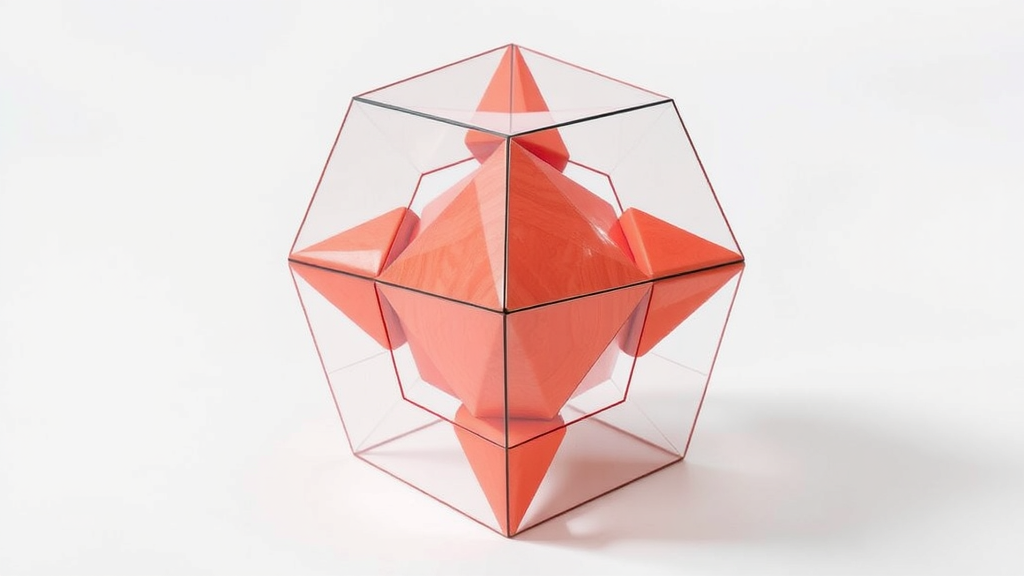
Every triangle-hungry algorithm has a quiet assumption baked into it: that any solid shape can be chopped into simple pieces using only the corners it already has. In the plane, this is rock solid. Any polygon, no matter how gnarly its outline, can be divided into triangles whose corners are exactly the polygon’s own vertices, with the pieces meeting neatly edge to edge. A century of computational geometry has been built on that guarantee. Now, a team of Hungarian mathematicians has pushed a famous century-old counterexample into a dimension where almost nobody had dared to look, and the result is as startling as it is useful: a fully explicit, rigorously proven four-dimensional solid that simply refuses to be triangulated.
The shape descends directly from a 1928 discovery by the German mathematician Erik Schönhardt, who constructed a deceptively simple object: a triangular prism twisted so that its two triangular ends rotate out of alignment. In this twisted prism, Schönhardt showed, every diagonal that is not part of the boundary lies entirely outside the body. Pick any four of its six vertices and the tetrahedron they span pokes out of the solid. There is, quite literally, no interior tetrahedron compatible with the twisted faces, so the shape cannot be divided into tetrahedra without adding new points. In 1911, N. J. Lennes had already sketched a similar obstruction, but Schönhardt’s six-vertex example became the canonical specimen, and he proved that any simple polyhedron with the same property needs at least six vertices.
For nearly a century, mathematicians refined and extended this three-dimensional curiosity. Bagemihl replaced one twisted edge with a concave curve studded with extra vertices, producing nontriangulable polyhedra with any number of vertices from six upward. Rambau widened the top and bottom triangles into larger polygons, obtaining twisted prisms over any n-gon. Kuperberg produced an even stranger body in which no tetrahedron built from the original vertices contains the body’s midpoint. What all of these examples share is a single common thread: a fixed boundary face that cannot be extended into a simplex lying wholly inside the solid, either because every candidate simplex sprouts an exterior edge or because the combinatorics of the face lattice forbid a compatible decomposition.
The new work, published in the open-access journal Heliyon by Antal Joós, Attila Kovari, and Bálint Nagy, takes the decisive step into the fourth dimension. The authors construct an eight-vertex body they call B: take a regular tetrahedron as the base, place a second tetrahedron parallel to it at height 2, and rotate the top copy by a small angle of negative 0.01 radians within the appropriate coordinate plane. The convex hull of these eight points is a twisted four-dimensional prism. The mathematicians then carve away four carefully chosen four-dimensional simplices whose interiors are pairwise disjoint, and what remains is a genuine 4-polytope whose facets are all tetrahedra, a direct higher-dimensional analogue of Schönhardt’s construction.
The proof of nontriangulability is a small masterpiece of algebraic bookkeeping. The authors introduce a determinant function that measures, for any point in four-dimensional space, which side of a hyperplane it lies on. Exact sign computations show that the four removed simplices are cleanly separated, that the eight designated points are truly vertices, and that a specific interior point q, the average of all eight vertices, survives the carving and sits strictly inside the remaining body. The crux comes from the base facet: in any hypothetical triangulation, that tetrahedral facet must itself be the face of some 4-simplex, and the only candidates are the four simplices obtained by joining the base to one of the four top vertices. Each of these, the determinant tables show, overlaps the interior of one of the removed pieces. No candidate fits. The contradiction is absolute, and the four-dimensional body is certified nontriangulable.
Remarkably, the obstruction is robust. Because the proof rests on strict determinant inequalities, small perturbations of the vertex positions or the twist angle preserve nontriangulability, meaning the example is not a knife-edge accident but a stable geometric phenomenon. The authors leave tantalizing questions open: over exactly what range of rotation angles does the body remain nontriangulable, what affine transformations can the tetrahedral layers tolerate, and could cubes or other shapes replace the tetrahedra in the construction?
Equally important are the dimension-raising lemmas that follow. The team proves that a pyramid erected over any nontriangulable base is itself nontriangulable, that any polytope carrying a nontriangulable facet in a supporting hyperplane inherits the property, and that bipyramids and suitably split bodies extend the same obstruction upward. These lemmas generate infinite families of nontriangulable polytopes in every dimension from four upward. With characteristic rigor, the authors also demonstrate the limits of such inheritance: they exhibit a four-dimensional body that is perfectly triangulable yet whose cross-section is the nontriangulable Schönhardt polyhedron, proving that a bad cross-section alone does not doom a higher-dimensional body. The precise sufficient conditions, distilled into their Proposition 1, specify exactly when a nontriangulable three-dimensional time slice forces the full four-dimensional spacetime body to be nontriangulable.
That spacetime framing is where the mathematics collides with the real world. Many modern engineering and medical problems treat time as a genuine fourth coordinate: a beating heart imaged by 4D CT, airways swelling and contracting through the breathing cycle, coronary arteries reconstructed dynamically for fluid simulations, robots navigating a workspace while an explicit clock ticks. In each case, the natural geometric object is a four-dimensional polyhedral body, and the natural discretization is a mesh of 4-simplices, the four-dimensional analogues of tetrahedra. The new theorems show that when the underlying three-dimensional geometry is sufficiently twisted or nonconvex and the conditions of Proposition 1 hold, simplex-only meshes built from the original sampled vertices are not merely inconvenient but mathematically impossible. Software must insert additional Steiner points or refine the domain, and the new results quantify why that insertion is unavoidable rather than a limitation of current algorithms.
The medical implications are concrete. The inner surface of a heart ventricle is grooved and trabeculated, and if that nonconvexity is strong enough, even a single three-dimensional snapshot can resemble a theoretical twisted polyhedron; stacking the cardiac cycle into a four-dimensional mantle may inherit the meshing obstruction. Bronchial trees, with their branching curvatures and pocketed geometry, present similar risks. In robotics, motion planning through elongated twisted corridors, or coordination of multiple arms whose combined configuration spaces are highly nonconvex, may force planners to add nodes or refine the discretized space in ways the theorems now anticipate. Engineers analyzing deforming fuselages, thermally buckling structures, or pressure-fluctuating pipelines face the same lesson whenever a three-dimensional shape deforms through time in a nontriangulable fashion.
The authors are candid about the computational frontier that remains. Deciding whether an arbitrary polytope is nontriangulable is hard, and even minimum-size triangulations of convex three-dimensional polytopes are known to be NP-hard, so every guaranteed Steiner point carries a cost that can grow with geometric complexity. The new certification for the four-dimensional family, however, is refreshingly checkable: the determinant signs can be evaluated directly from the vertex coordinates. Future work will need adaptive algorithms for optimal Steiner placement, robustness analysis under the noisy vertex data that real medical imaging delivers, and possibly machine-learning heuristics to predict which configurations demand extra points. For now, the message of this paper resonates far beyond the seminar room: nontriangulability is no three-dimensional curiosity. It lives robustly in higher dimensions, it travels through time, and it tells the engineers and clinicians of the four-dimensional data age exactly when their meshes must break the old rules and add new points.
Subject of Research: Higher-dimensional nontriangulable polytopes and their role in spacetime mesh generation
Article Title: Higher-dimensional nontriangulable polytopes: Theory, proofs, and implications in engineering and medical simulation
Article References: Joós, A., Kovari, A., & Nagy, B. (2026). Higher-dimensional nontriangulable polytopes: Theory, proofs, and implications in engineering and medical simulation. Heliyon, 12(15), Article e45442. https://doi.org/10.1016/j.heliyon.2026.e45442
Image Credits: AI Generated
DOI: 10.1016/j.heliyon.2026.e45442
Keywords: nontriangulable polytopes, Schönhardt polyhedron, computational geometry, triangulation, four-dimensional geometry, Steiner points, mesh generation, 4D medical imaging, robot motion planning, combinatorics, polytopes, spacetime meshing
Cite Scienmag News
Reid Dalton. (September 26, 2026). Mathematicians Build the First Four-Dimensional Shape That Cannot Be Cut Into Simpler Pieces. Scienmag. https://scienmag.com/mathematicians-build-the-first-four-dimensional-shape-that-cannot-be-cut-into-simpler-pieces/
Reid Dalton. "Mathematicians Build the First Four-Dimensional Shape That Cannot Be Cut Into Simpler Pieces." Scienmag, 26 September 2026, https://scienmag.com/mathematicians-build-the-first-four-dimensional-shape-that-cannot-be-cut-into-simpler-pieces/. Accessed 26 September 2026.
Reid Dalton. "Mathematicians Build the First Four-Dimensional Shape That Cannot Be Cut Into Simpler Pieces." Scienmag. September 26, 2026. https://scienmag.com/mathematicians-build-the-first-four-dimensional-shape-that-cannot-be-cut-into-simpler-pieces/


