


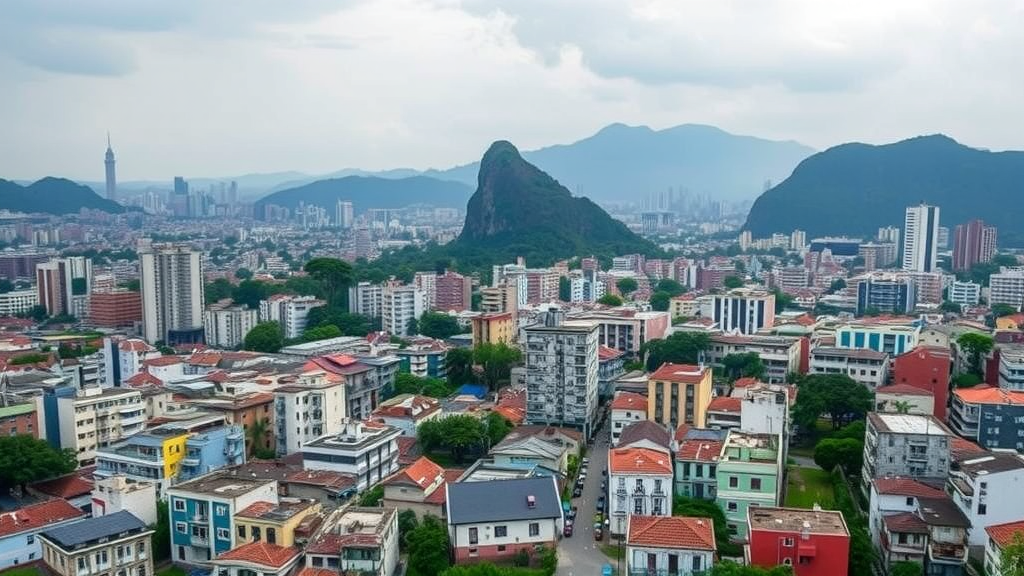
In one of the world’s most famous coastal cities, whether a household can reliably fill a glass of water depends strikingly on where it stands on the map. A new population-based study of Rio de Janeiro finds that household water insecurity is not randomly distributed but follows the city’s deep socioeconomic fault lines, with residents of the city’s poorer Central and North zones roughly twice as likely to experience water insecurity as those in the affluent South zone. The research, published in the International Journal for Equity in Health, provides some of the most detailed evidence yet that urban water problems are problems of territory and inequality rather than simply problems of infrastructure coverage.
Juliana Bem-Lignani of the State University of Rio de Janeiro and Rosana Salles-Costa of the Federal University of Rio de Janeiro analyzed data from the First Survey on Food and Nutritional Insecurity in Rio de Janeiro, conducted in 2024. The survey drew a probabilistic sample of 2,000 households spread across the municipality’s five residential zones: South, Central, North, West and Southwest. Because the sample was designed to represent the city’s households rather than merely the people willing to answer a questionnaire, the results can be generalized to the population of each territory, a critical feature for a study whose central question is precisely geographic.
The instrument at the heart of the study was the Portuguese version of the Water Insecurity Experiences Scale, known as WISE. Unlike measures that simply ask whether a home has a piped connection, experience-based scales probe what actually happens in daily life: whether there was enough water for drinking and cooking, whether the supply was interrupted, whether households had to change routines to cope. This distinction matters technically because a connection to the network does not guarantee an adequate, regular and safe flow, and the authors argue that lived experience captures dimensions of water access that infrastructural indicators miss.
The territorial pattern that emerged was stark. The South and Southwest zones, home to better socioeconomic conditions, reported daily water supply in 82.2 percent and 75.9 percent of households respectively. By contrast, the Central and North zones showed worse socioeconomic indicators and more frequent supply interruptions, affecting 19.2 percent and 20.6 percent of households. The West zone occupied an intermediate position overall but stood out for rationing, with 30.8 percent of households reporting intermittent service. These are not marginal differences; in a city where water is constitutionally recognized as a social right, a fifth of households in some territories facing interruptions represents a substantial equity gap.
Experience-based water insecurity tracked the same geography. In the South and Southwest zones, 25.1 percent and 27.1 percent of households respectively reported water insecurity. In the Central and North zones the figures climbed to 46.9 percent and 48.3 percent, nearly one household in two. In other words, residents of the city’s central and northern territories were experiencing water insecurity at nearly double the rate of those in the wealthier southern coast, a gradient that parallels well-documented disparities in income, food security and health across the same zones.
To test whether the association between territory and water insecurity was real rather than an artifact of household composition, the researchers used multinomial logistic regression, a statistical model suited to outcomes with multiple ordered or unordered categories. Here the outcome was water insecurity at low, moderate or higher levels, and the models were adjusted for the socioeconomic characteristics of the household reference person and for the household’s water access conditions. Adjusting for these covariates is what allows the analysis to ask whether place itself, with all its social and infrastructural history, adds explanatory power beyond the individual household’s profile.
The answer was yes. Compared with households in the South zone, living in the West zone was associated with 2.4 times the odds of low water insecurity, with a 95 percent confidence interval of 1.5 to 3.7, and living in the North zone carried 2.1 times the odds, with a confidence interval of 1.3 to 3.5. In the Central zone, households had 2.5 times the odds of moderate water insecurity relative to the South, with a confidence interval of 1.2 to 5.2. Because these intervals exclude one, the associations are statistically robust at conventional thresholds, and the consistency of the twofold pattern across separate zones strengthens the interpretation that territory is a meaningful analytical unit for water insecurity.
The study’s conceptual framing draws on the idea that access to water can serve as a marker of social inequities more broadly. Brazil recognizes water as a social right, yet the persistence of unequal access, reliability and quality means that formal legal recognition has not translated into uniform lived experience. The authors conclude that the differences between territories reflect and reinforce social inequalities, and that being connected to the water network alone does not ensure an adequate supply. That finding carries direct policy weight: investments that stop at extending pipes may leave untouched the interruptions, rationing and quality problems that define insecure water access in the poorest territories.
For Rio de Janeiro, the implications point toward policies that target structural and social determinants rather than infrastructure alone. The municipality’s water system is operated by the State Water and Sewage Company, and the city’s history of pronounced territorial disparity, intensified by economic shocks, means that rationing and interruption regimes fall unevenly on households with the fewest resources to buffer them, such as those unable to buy bottled water or store large reserves. The researchers suggest that water insecurity should be monitored alongside food insecurity as a dimension of social inequality, an approach reflected in the survey’s integrated design.
The study was approved by the Research Ethics Committee of the Clementino Fraga Filho University Hospital at the Federal University of Rio de Janeiro, and all participants gave informed consent. Funded by Brazil’s National Council for Scientific and Technological Development, the Rio de Janeiro State Research Support Foundation and the city’s municipal council, the work illustrates how experience-based measurement combined with territory-level sampling can turn a diffuse sense of urban unfairness into precise, actionable evidence. As climate variability tightens pressure on urban water systems worldwide, the Rio findings offer a replicable template: map the lived experience of water insecurity, match it to the social geography of the city, and direct policy where the odds are doubled.
Subject of Research: Association between territorial socioeconomic inequality and household water insecurity in Rio de Janeiro
Article Title: Territories marked by social inequities associated with household water insecurity in Rio de Janeiro/Brasil
Article References: Bem-Lignani, J., & Salles-Costa, R. (2026). Territories marked by social inequities associated with household water insecurity in Rio de Janeiro/Brasil. International Journal for Equity in Health. https://doi.org/10.1186/s12939-026-03020-9
Image Credits: AI Generated
DOI: 10.1186/s12939-026-03020-9
Keywords: water insecurity, Rio de Janeiro, social inequality, WISE scale, household water access, urban equity, public health, Brazil, cross-sectional study, territorial disparities, water policy, socioeconomic factors
Cite Scienmag News
Courtney Benton. (September 25, 2026). Water Insecurity Maps Onto Social Inequality Across Rio de Janeiro’s Neighborhoods. Scienmag. https://scienmag.com/water-insecurity-maps-onto-social-inequality-across-rio-de-janeiros-neighborhoods/
Courtney Benton. "Water Insecurity Maps Onto Social Inequality Across Rio de Janeiro’s Neighborhoods." Scienmag, 25 September 2026, https://scienmag.com/water-insecurity-maps-onto-social-inequality-across-rio-de-janeiros-neighborhoods/. Accessed 25 September 2026.
Courtney Benton. "Water Insecurity Maps Onto Social Inequality Across Rio de Janeiro’s Neighborhoods." Scienmag. September 25, 2026. https://scienmag.com/water-insecurity-maps-onto-social-inequality-across-rio-de-janeiros-neighborhoods/


