


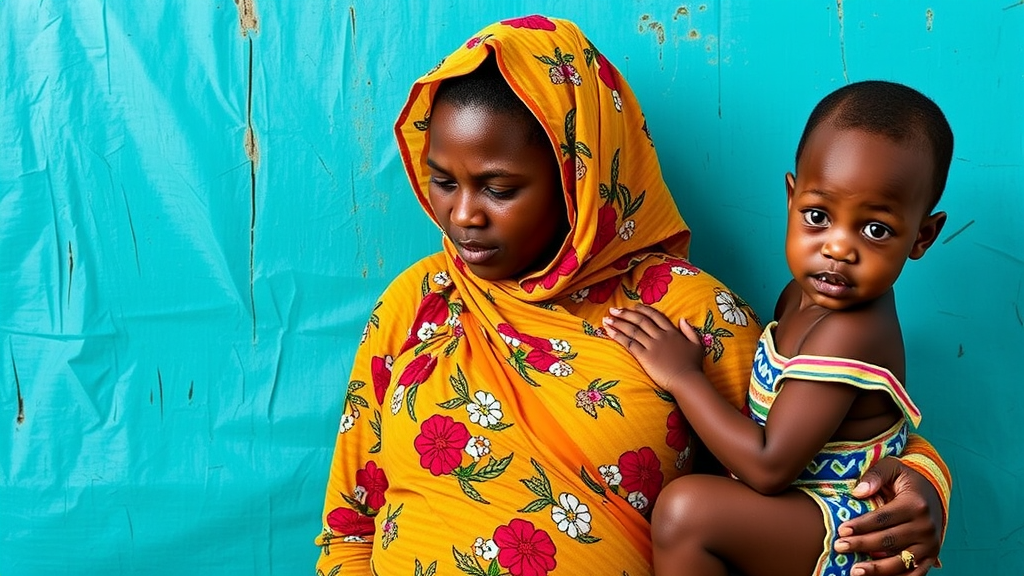
A sweeping new analysis of 46 African countries has found that nearly three-quarters of the continent’s health systems are operating well below their potential when it comes to keeping mothers, newborns, and children alive. The study, published in BMC Health Services Research by Youssef Er-Rays of Abdelmalek Essâadi University in Morocco and Hamid Ait Lemqeddem of Ibn Tofail University, applied a rigorous economic technique known as data envelopment analysis to a question that has long frustrated policymakers: why do some countries achieve far better survival outcomes than others despite spending similar amounts of money? The answer, the researchers show, is that money alone is a poor predictor of success. What separates efficient health systems from inefficient ones is not how much they invest but how effectively they convert that investment into measurable reductions in maternal, neonatal, and infant deaths.
The stakes could hardly be higher. Sustainable Development Goal 3.1 calls on countries to reduce maternal mortality to fewer than 70 deaths per 100,000 live births by 2030, while Goal 3.2 targets neonatal mortality below 12 deaths per 1,000 live births. Across the 46 countries examined, Africa remains far from both benchmarks. Maternal mortality averaged a staggering 354.2 deaths per 100,000 live births, roughly five times the global target, and neonatal mortality stood at 23.5 per 1,000 live births, nearly double the agreed ceiling. With the 2030 deadline approaching, the study offers a stark quantitative diagnosis of why progress has stalled, and it points to a factor that international donors and national governments alike have often overlooked in their push to increase funding.
To measure efficiency, the researchers turned to a method originally developed for evaluating the productivity of firms and public agencies. Data envelopment analysis constructs a mathematical frontier representing best practice: each country is treated as a decision-making unit that consumes inputs, such as health spending, doctors, nurses and midwives, and hospital beds, to produce outputs, including reductions in maternal, neonatal, infant, and stillbirth mortality alongside gains in service coverage. Countries whose combination of inputs and outcomes places them on this frontier are deemed technically efficient; those falling inside it are wasting resources relative to what their peers demonstrate is achievable. The team ran the analysis twice, once under constant returns to scale and once under variable returns to scale, the latter allowing for the fact that small countries may face different scaling dynamics than large ones.
The results were sobering. Only 12 of the 46 countries, or roughly one in four, sat on the efficiency frontier, meaning 74 percent of the continent’s health systems perform below best-practice levels. Mean efficiency under variable returns to scale came out at 0.849, a figure with a striking practical interpretation: inefficient systems could theoretically achieve their current outcomes while using approximately 15 percent fewer inputs. Put differently, hundreds of millions of dollars in health spending across the continent are effectively being absorbed by structural waste rather than translated into saved lives. Three small nations emerged as the continent’s benchmark performers: Eritrea, Seychelles, and São Tomé and Príncipe. Their appearance at the top of the efficiency rankings is itself instructive, since none of them ranks among Africa’s biggest health spenders, underscoring the study’s central message that resourcefulness matters more than resources.
Having quantified the efficiency gap, the researchers then asked what explains it. This is where the second stage of their two-stage design comes in. Using Tobit regression, a statistical model suited to dependent variables that are bounded between zero and one, as efficiency scores are, they tested whether a set of financial, coverage, governance, and health-system factors predicted a country’s efficiency score. The inputs and outputs drawn from World Health Organization data spanning 2005 to 2021 included current health expenditure as a share of gross domestic product, per capita health spending, external donor financing, the density of doctors, nurses, midwives, and hospital beds, the proportion of births attended by skilled personnel, vaccination card visibility, and the composite coverage index, a summary measure of reproductive, maternal, newborn, and child health interventions.
The regression results challenge a comfortable assumption that has shaped global health policy for two decades. Current health expenditure, the composite coverage index, and per capita health spending were all negatively associated with efficiency scores. In plain terms, countries that spend more, and countries that achieve higher coverage of maternal and child health services, are not automatically better at converting those resources into mortality reductions. Higher spending can coexist with, and may even mask, deep inefficiencies in how funds are allocated and managed. The finding does not imply that investment is unnecessary; rather, it demonstrates that investment without accountability and optimization yields diminishing returns. A system can report high coverage of antenatal visits or skilled birth attendance while still failing to prevent the deaths that those services are supposed to avert, if quality, timing, and targeting are poor.
The preferred Tobit model displayed remarkably strong explanatory power, with a pseudo-R-squared of 0.8943, indicating that the variables the researchers examined account for the vast majority of the variation in efficiency across the continent. This is unusual in health-systems research, where cross-country models often explain only a fraction of the variance. The strength of the result suggests that the framework captures something real about how African health systems function, and it gives the findings practical weight for governments designing reforms. The study’s period, covering the years from 2005 through 2021, also means the analysis reflects the strains of recent global shocks, including the COVID-19 pandemic, which disrupted routine maternal and child health services across much of the continent.
The authors’ conclusions extend beyond measurement to prescription. Achieving the maternal, newborn, and child health targets of the Sustainable Development Goals, they argue, requires more than increased investment. African health systems must strengthen accountability mechanisms so that funds reach frontline services, optimize resource allocation to match the epidemiological burden, close persistent gaps in the health workforce and infrastructure, and adapt practices from efficient peers. The benchmark countries identified by the analysis provide a natural laboratory for this kind of peer learning. Rather than importing models from high-income countries with fundamentally different resource environments, policymakers can study how countries facing similar constraints manage to extract more health gain from each dollar spent.
What makes the study distinctive within the crowded field of Sustainable Development Goal monitoring is its shift of focus from outcomes to conversion. Most assessments of progress toward Goals 3.1 and 3.2 simply track whether mortality ratios are falling and by how much. That approach implicitly rewards wealthy countries and penalizes poor ones, regardless of how well each manages what it has. By framing each health system as a production process and measuring its distance from the empirical frontier, data envelopment analysis offers a fairer and more actionable benchmark. It tells a finance ministry not merely that it is lagging, but by roughly how many percentage points its inputs could be trimmed, or equivalently how much additional output it should expect, if it operated as efficiently as the best performers under comparable conditions.
The study arrives at a critical juncture. With five years left on the Sustainable Development Goal calendar, many African countries are widely acknowledged to be off track for the maternal and newborn survival targets, and fresh financing alone is unlikely to close the gap in time. The evidence assembled by Er-Rays and Ait Lemqeddem suggests that the continent’s fastest route to progress runs through efficiency: reclaiming the roughly 15 percent of wasted capacity embedded in underperforming systems would represent an enormous, largely untapped resource at a moment when every percentage point of mortality reduction counts. Whether governments and their partners act on that evidence, by treating efficiency, equity, and measurable health gains as the organizing principles of health-sector reform, may well determine whether the promises made in 2015 are kept by 2030.
Subject of Research: Efficiency of maternal, newborn, and child health services in achieving Sustainable Development Goals 3.1 and 3.2 across African countries
Article Title: Efficiency of maternal, newborn, and child services in achieving Sustainable Development Goals 3.1 and 3.2 in Africa: a two-stage data envelopment analysis
Article References: Er-Rays, Y., & Lemqeddem, H. A. (2026). Efficiency of maternal, newborn, and child services in achieving Sustainable Development Goals 3.1 and 3.2 in Africa: a two-stage data envelopment analysis. BMC Health Services Research. https://doi.org/10.1186/s12913-026-15692-8
Image Credits: AI Generated
DOI: 10.1186/s12913-026-15692-8
Keywords: maternal health, newborn health, child health, Sustainable Development Goals, Africa, health systems, data envelopment analysis, Tobit regression, health economics, technical efficiency, health financing, neonatal mortality
Cite Scienmag News
Harold Sullivan. (September 25, 2026). Most African Health Systems Waste Resources on Maternal and Child Care, Study Finds. Scienmag. https://scienmag.com/most-african-health-systems-waste-resources-on-maternal-and-child-care-study-finds/
Harold Sullivan. "Most African Health Systems Waste Resources on Maternal and Child Care, Study Finds." Scienmag, 25 September 2026, https://scienmag.com/most-african-health-systems-waste-resources-on-maternal-and-child-care-study-finds/. Accessed 25 September 2026.
Harold Sullivan. "Most African Health Systems Waste Resources on Maternal and Child Care, Study Finds." Scienmag. September 25, 2026. https://scienmag.com/most-african-health-systems-waste-resources-on-maternal-and-child-care-study-finds/


