


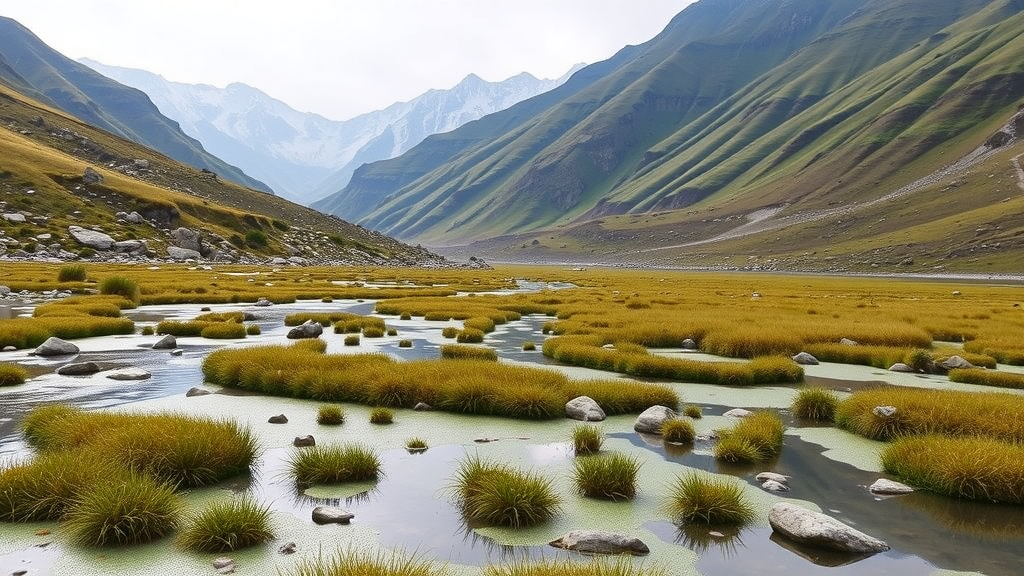
High on the Yunnan Plateau in southwestern China, where the Napahai wetland sits within the Three Parallel Rivers region near the Qinghai-Tibet Plateau, an international research team has uncovered evidence that this isolated alpine ecosystem carries a genetic fingerprint visible in one of life’s most fundamental molecular machines. A new metagenomic study of the wetland’s viral and microbial communities reveals that its DNA polymerase genes, the sequences encoding the enzymes responsible for copying DNA and maintaining genome stability, cluster together in patterns that distinguish the site from marine waters, freshwater lakes, hot springs, agricultural paddies, and even other wetlands. The work, published in the journal Environmental and Biogeochemical Processes by researchers including corresponding author Xiuling Ji of Kunming University of Science and Technology, suggests that geography and local environmental conditions can leave a recognizable imprint on the genes that govern DNA replication.
DNA polymerases occupy a central position in molecular biology. These enzymes read existing DNA strands and synthesize new complementary strands, a process essential to replication, repair, and the faithful transmission of genetic information across generations. Because polymerase genes differ systematically among viruses, bacteria, archaea, and other organisms, they offer researchers a powerful molecular lens. Rather than relying on a single marker gene, scientists can survey entire communities of polymerase sequences recovered directly from environmental samples and use the resulting data to probe genetic diversity and evolutionary relationships. In this study, the team focused on three major polymerase families, PolA, PolB, and PolC, each with its own evolutionary history and distribution across the tree of life.
The research drew on viral metagenomic data collected from soil and water at the Napahai wetland. Metagenomics allows scientists to sequence genetic material extracted directly from an environment, bypassing the need to culture individual organisms, which is particularly valuable in ecosystems where most microbes resist laboratory cultivation. The researchers compared the Napahai polymerase sequences with a reference collection drawn from a wide range of habitats and biological sources. In total, 1,222 DNA polymerase gene sequences entered the analysis, comprising 104 sequences from Napahai, 578 from other habitats, and 540 from other sources, creating a dataset broad enough to test whether the plateau wetland’s sequences truly stood apart.
Phylogenetic analyses, which reconstruct evolutionary relationships by comparing sequence similarities, revealed that each of the three polymerase families displayed its own evolutionary structure. More strikingly, the Napahai sequences repeatedly formed cohesive and distinctive subclusters within those structures. This pattern held even when the researchers compared the plateau sequences against counterparts from marine environments, lakes, hot springs, other wetlands, and paddy fields. The consistency across all three polymerase families strengthened the conclusion that the clustering was not an artifact of a single gene family but a property of the wetland’s broader genetic community.
Ordination analyses, a complementary statistical approach for visualizing genetic similarities and differences among samples, told the same story. Principal coordinate analysis showed that the Napahai DNA polymerase sequences occupied distributions that differed from those of several comparison habitats. Nonmetric multidimensional scaling, a technique that arranges samples in a low-dimensional space according to their measured distances, likewise placed the Napahai sequences in a separate cluster. The quality of that ordination was high: the analysis returned a low stress value of 0.0546, indicating that the two-dimensional representation faithfully preserved the underlying distance relationships, and an R² value of 0.9739, reflecting how strongly the ordination captured the observed patterns.
The authors propose that Napahai’s unusual environmental setting may help drive this genetic differentiation. The wetland lies within the Three Parallel Rivers region, a landscape shaped by the tectonic forces of the nearby Qinghai-Tibet Plateau. Its microbial communities experience distinctive alpine geography, seasonal hydrology marked by pronounced wet and dry cycles, strong solar radiation at altitude, and climatic influences associated with Indian Ocean airflows. Together, these factors could select for particular microbial lineages and particular genetic variants, shaping the composition of polymerase genes recovered from the site. As corresponding author Xiuling Ji explained, the unusual geography and environmental conditions of the Napahai plateau wetland may leave a recognizable signature in the genes involved in DNA replication, offering a new way to examine how microbial communities differ across environments and how wetland ecosystems may influence genetic diversity.
The findings raise an intriguing possibility: DNA polymerase genes could serve as biogeographical markers, tools for distinguishing microbial communities sampled from different habitats in much the same way that certain marker genes are used to fingerprint environments today. If polymerase gene distributions reliably track environmental setting, they could complement existing methods for monitoring biodiversity, tracking ecosystem change, and comparing microbial communities across landscapes. For high-altitude wetlands, ecosystems that filter water, store carbon, and support biodiversity yet remain understudied at the genetic level, such tools could illuminate how these fragile environments respond to shifting climate and land use.
At the same time, the researchers are careful to frame the study as exploratory rather than definitive. The community-level analysis rested on two composite soil samples and one pooled water sample, a sampling design that captures a broad signal but cannot quantify variation among individual sampling points or seasons. The authors emphasize that the distinctive clustering patterns they observed require validation with greater biological replication before they can be generalized. Replication matters in metagenomics because spatial heterogeneity within a wetland, temporal variation across hydrological phases, and technical variation among sequencing runs can all influence the genetic profiles recovered from a site.
Future research is already implied by the study’s design. Surveys across additional wetlands and terrestrial environments could determine whether similar DNA polymerase signatures occur elsewhere, or whether they are unique to settings like Napahai where isolation, altitude, and climate converge. Such work could also clarify the ecological and evolutionary processes responsible for the distribution of these genes, distinguishing among hypotheses such as geographic isolation, environmental selection, and limited dispersal of microbial lineages. As metagenomic datasets grow and reference collections expand, polymerase genes may join the standard toolkit for reading the biogeography of microbial life, one sequence cluster at a time.
Subject of Research: Genetic diversity of DNA polymerase genes in a high-altitude plateau wetland
Article Title: High-altitude wetland reveals a distinctive genetic signature in DNA polymerase genes
Article References: High-altitude wetland reveals a distinctive genetic signature in DNA polymerase genes. (n.d.). Original publication
Image Credits: AI Generated
DOI: Not provided
Keywords: DNA polymerase, metagenomics, Napahai wetland, microbial diversity, biogeography, phylogenetics, alpine ecosystem, Qinghai-Tibet Plateau, PolA, PolB, PolC, viral metagenomics
Cite Scienmag News
Juliet Wilcox. (September 25, 2026). Alpine Wetland in China Yields Distinctive Genetic Signature in DNA Polymerase Genes. Scienmag. https://scienmag.com/alpine-wetland-in-china-yields-distinctive-genetic-signature-in-dna-polymerase-genes/
Juliet Wilcox. "Alpine Wetland in China Yields Distinctive Genetic Signature in DNA Polymerase Genes." Scienmag, 25 September 2026, https://scienmag.com/alpine-wetland-in-china-yields-distinctive-genetic-signature-in-dna-polymerase-genes/. Accessed 25 September 2026.
Juliet Wilcox. "Alpine Wetland in China Yields Distinctive Genetic Signature in DNA Polymerase Genes." Scienmag. September 25, 2026. https://scienmag.com/alpine-wetland-in-china-yields-distinctive-genetic-signature-in-dna-polymerase-genes/


