


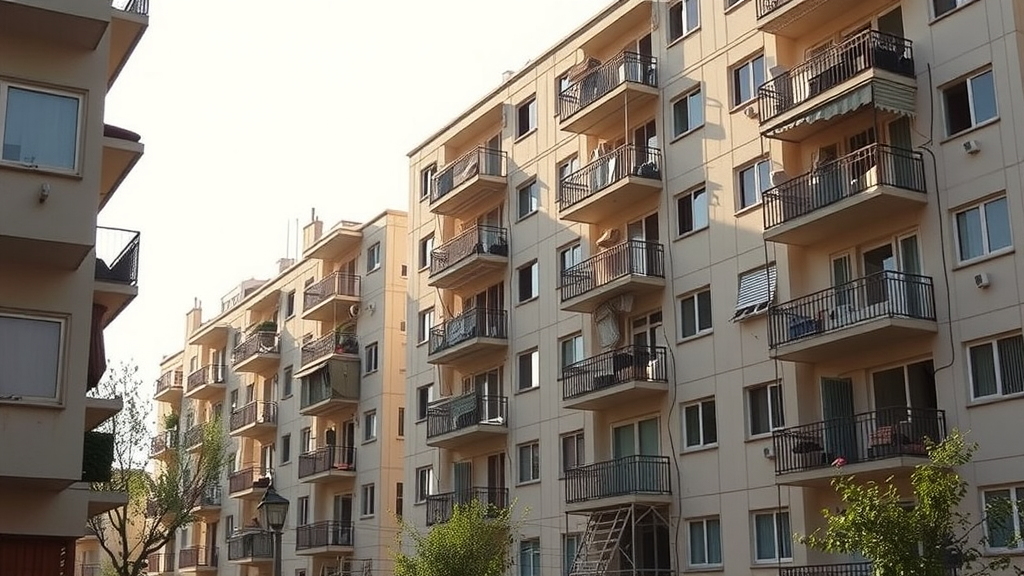
In one of the most detailed studies of its kind, an architect in Tehran has quantified exactly how much sunlight the Iranian capital’s residential blocks lose to their own building regulations, and shown that a surprisingly modest change in where buildings sit on their plots could restore much of it. The research, published in Discover Cities, modeled a typical medium-density Tehran neighborhood block and found that under current rules, only the topmost floor of buildings on the southern side of a street receives direct sunlight at midday during the winter solstice. Yet by simply repositioning the northern row of buildings, without reducing density, floor count, or building area, the annual solar energy received by southern buildings rose by 19.2 percent, and the stark imbalance between the two sides of the street largely disappeared.
The problem stems from a rule that shapes nearly every residential street in Tehran. Current regulations allow a building to occupy 60 percent of a plot’s length plus two meters of frontage, with the structure placed at the northern edge of the land. On a standard 12-by-20-meter parcel, this translates into roughly 70 percent site coverage, leaving less than a third of the land open. Combined with permitted floor area ratios that the study calculated at 4.36, a figure the author describes as high density, the result is a fabric of six-story buildings, about 21 meters tall, packed into rows with as little as six meters separating them across their rear courtyards.
At Tehran’s latitude, that geometry collides catastrophically with the winter sun. The study calculated that the sun’s altitude at noon on the winter solstice is just 30.8 degrees, which means every meter of building height casts a shadow 1.67 meters long. A 21-meter building therefore throws a shadow roughly 35 meters across the ground, more than three times the width of a typical 12-meter residential street and more than double the combined length of the street and a six-meter courtyard. Because the regulations place every building at the north of its plot, the northern properties shade the courtyards and lower floors of the southern properties across the street almost continuously through winter, while southern buildings cast shadows across the full width of neighboring courtyards.
The consequences are stark in the numbers. In the existing condition, southern buildings receive about 271 kilowatt-hours of solar energy per square meter of facade annually, while northern buildings receive 336.6 kilowatt-hours per square meter, a gap of 24.19 percent. Roughly half of the southern facade on the lower floors falls into the minimum radiation category, shown in blue in the simulation outputs. The courtyards of southern properties receive direct sun on a strip only 1.4 meters deep for a single day each year. A ground-floor observer in a southern building faces a 21-meter wall just six meters away, an environment the author likens to standing in a concrete well.
To test whether this outcome was inevitable, the researcher built a digital model of a residential block: four rows of ten six-story buildings, forty structures in total, separated by a 12-meter passage, with dimensions matching the most common parcels in the city. The block was modeled in Rhino, with climate data from Mehrabad International Airport fed into the Grasshopper plugin and solar radiation analysis performed with Ladybug Tools. In parallel, the author produced manual scale drawings of shadow geometry at the summer and winter solstices, using the formula L equals H times the cotangent of the solar altitude angle. The two methods agreed precisely: the computer simulations reproduced the same shadow patterns as the hand calculations, with sunlight reaching only the sixth floor of southern buildings at winter noon.
Eight scenarios were then drafted, varying the position of the building footprint on the plot and the construction coverage while holding land dimensions, floor counts, and street width constant. Three emerged as clear improvements. In the most striking of them, Scenario 4, the northern buildings were simply moved from the rear of their plots to the street frontage, mirroring the southern buildings. Nothing else changed: same density, same footprint, same number of floors. Yet the energy received by southern buildings jumped by 19.2 percent, and the imbalance between the two sides of the street shrank from 24.19 percent to just 5.1 percent. In the best-performing variant, even at the winter solstice only the ground floor, typically a lobby or parking level, remained in shadow.
Two further scenarios achieved similar balance by trimming the footprint. Reducing coverage to 60 percent with a one-meter front courtyard, or to 50 percent with a one-meter setback on each side, pushed usable daylight deeper into the lower floors and allowed sunlight to penetrate the depth of the urban fabric even in winter. The lateral spacing between buildings also carries benefits beyond light: it reduces excavation risks between adjacent properties, improves safety during earthquakes and fires, and creates a porous fabric that lets wind circulate through the city rather than being blocked by continuous east-west rows. In Scenario 8, the floor area ratio dropped to 3, which the study identifies as an optimal level, and the energy gap between southern and northern buildings narrowed to 7 percent.
One counterintuitive finding deserves attention. In the scenarios with smaller footprints, the average annual solar energy per square meter of building surface actually decreased, falling from 336.6 to 279.9 kilowatt-hours per square meter for northern properties. This is not because the buildings receive less light; it is because they present less surface to collect it. Roofs, which receive the maximum solar energy, shrink along with the footprint, as does the crucial south-facing facade. The study emphasizes that energy comparisons are only meaningful between buildings with the same area, floors, and geometry, and that the redistribution of light across facades matters more than the per-square-meter average.
The findings arrive amid growing international recognition that solar access is a planning right, not a luxury. Sweden requires at least five hours of direct sunlight in living spaces between 9 a.m. and 5 p.m. on the equinoxes, and South Korea mandates more than two consecutive hours of daylight for each residential unit at the winter solstice, with offset distances calculated from building height and shading. Research cited in the study links daylight to circadian rhythm regulation, mental health, and resident satisfaction, while dense urban fabrics are associated with heat islands, poor ventilation, and elevated energy use for artificial lighting. Tehran’s own top-down, product-oriented planning tradition, the author notes, has left daylight, sunny hours, and shadow length largely unexamined in the design process.
The practical implications are unusually actionable. The single most effective intervention, relocating northern buildings to the street edge, costs nothing in density or floor space and could be written into siting regulations, though the author cautions that privacy, streetscape, and constructability need further study before implementation. Ground floors, which remain poorly lit in every scenario, are best reserved for parking and lobbies rather than living space. Plots of 12 by 20 meters, the study concludes, are simply too small to sustain a floor area ratio above 3 without critical shading, and larger parcel dimensions, or consolidation into towers on shared land, offer alternative paths, each with trade-offs in ownership, cost, and lived experience. Because even a one-meter lateral setback adds 30 square meters of sun-exposed surface per building, amounting to millions of square meters across the city, the study argues that the smallest regulatory changes carry enormous consequences, and should therefore be tested in limited neighborhoods, evaluated with resident feedback over successive years, and only then rolled out across the urban fabric.
Subject of Research: The effects of building density and placement on shading and solar energy reception in Tehran's residential neighborhoods
Article Title: Analyzing the effects of building density and placement on shading and solar energy reception in residential areas
Article References: Analyzing the effects of building density and placement on shading and solar energy reception in residential areas. (n.d.). https://doi.org/10.1007/s44327-026-00355-4
Image Credits: AI Generated
DOI: 10.1007/s44327-026-00355-4
Keywords: urban density, building shading, solar energy, daylight access, Tehran, urban planning regulations, building footprint, Ladybug Tools, winter solstice, floor area ratio, residential morphology, spatial justice
Cite Scienmag News
Courtney Benton. (September 25, 2026). Simple Shift in Building Placement Could Restore Sunlight to Tehran’s Shaded Homes. Scienmag. https://scienmag.com/simple-shift-in-building-placement-could-restore-sunlight-to-tehrans-shaded-homes/
Courtney Benton. "Simple Shift in Building Placement Could Restore Sunlight to Tehran’s Shaded Homes." Scienmag, 25 September 2026, https://scienmag.com/simple-shift-in-building-placement-could-restore-sunlight-to-tehrans-shaded-homes/. Accessed 25 September 2026.
Courtney Benton. "Simple Shift in Building Placement Could Restore Sunlight to Tehran’s Shaded Homes." Scienmag. September 25, 2026. https://scienmag.com/simple-shift-in-building-placement-could-restore-sunlight-to-tehrans-shaded-homes/


