


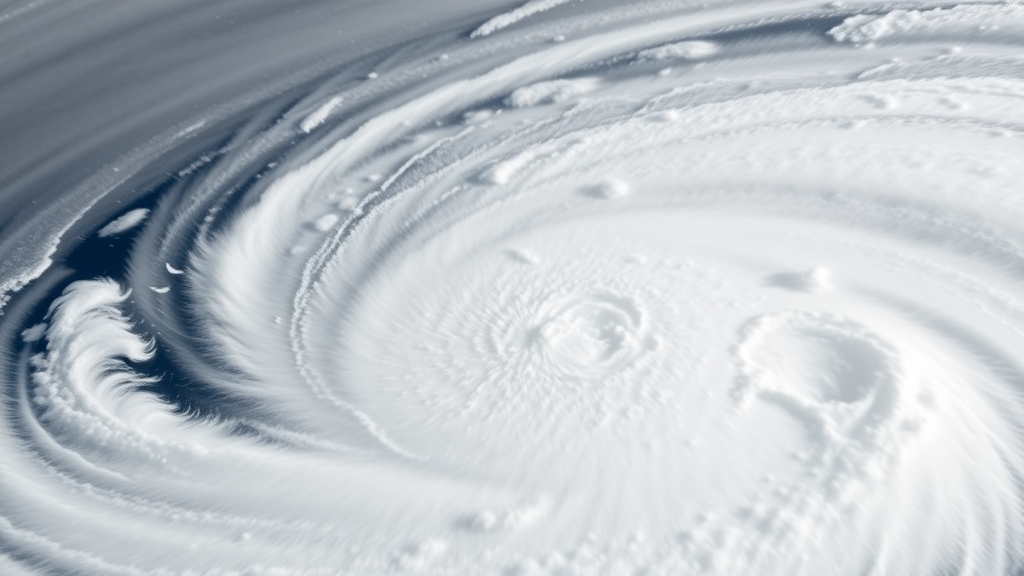
When Tropical Cyclone Shaheen swept across the Arabian Sea and made landfall in northern Oman in October 2021, it became a rare and sobering example of a tropical cyclone striking the Arabian Peninsula directly. Now, a modeling study led by researchers at Sultan Qaboos University has used that storm as a natural laboratory to ask a deceptively simple question: which features of the ocean and landscape matter most when a cyclone threatens a coastline? The answer, published in Scientific Reports, is that sea surface temperature and terrain shape a storm in fundamentally different ways, one governing how strong it becomes and how much rain it dumps on coastal communities, the other governing where it goes and how its internal circulation is organized.
The research team, comprising Badriya Al Mawali, Issam Ali and Alaa Ibrahim from the Physics Department at Sultan Qaboos University, together with Martin Köhler and Maike Ahlgrimm of Deutscher Wetterdienst, the German national weather service, and Sultan Al Yahyai of Code Academy in Muscat, built their investigation around controlled sensitivity experiments. Al Mawali also holds an affiliation with Oman’s Directorate General of Meteorology, a connection that underscores the practical motivation behind the work: understanding how regional weather models respond to environmental conditions is directly relevant to forecasting and hazard assessment in a country that sits at the edge of the cyclone-prone Arabian Sea.
At the heart of the study is the ICON numerical weather prediction model, a state-of-the-art forecasting system run here as a regional ensemble at a spatial resolution of 6.5 kilometers. Ensemble simulations are a cornerstone of modern cyclone research because they generate many slightly perturbed versions of the same forecast, allowing scientists to distinguish robust signals from noise. Rather than trying to predict Shaheen as it happened, the team ran a control simulation of the storm and then systematically modified individual ingredients of the environment: the temperature of the sea surface, the height of Oman’s terrain, and the roughness of the ocean surface as felt by the wind.
The most dramatic response came from the ocean. When the researchers raised sea surface temperature by 2 degrees Celsius, the simulated cyclone intensified and rainfall along the coast increased. This result follows directly from the physics of tropical cyclones, which are heat engines fueled by the flux of energy and moisture from warm water into the atmosphere. A warmer sea surface raises the enthalpy available to the storm, encouraging stronger convection, lower surface pressure and higher wind speeds, and in this case the model translated that extra energy into heavier precipitation concentrated along the coastal zone where the storm interacted with land.
Terrain, by contrast, acted less as an energy source and more as a steering and organizing influence. When the team reduced the height of Oman’s mountains, the simulated cyclone’s track shifted, and the terrain-enhanced rainfall that typically develops when moist winds are forced up over topography weakened over the mountainous interior. The changes rippled through the storm’s vertical structure as well: the low-level flow, the convergence of moisture flux that feeds convective bands, the mid-level ascent that drives cloud formation, and the upper-level divergence that vents air out of the storm’s core were all reorganized when the mountains were lowered. In other words, topography did not simply block the storm; it reshaped the three-dimensional circulation that determines how a cyclone behaves as it approaches land.
The third variable, sea-surface roughness, produced a comparatively muted response. Roughness describes the frictional drag that the ocean surface exerts on the wind, and physically based changes to this parameter altered the simulated cyclone’s intensity and precipitation structure only modestly. This hierarchy of effects is one of the study’s clearest takeaways: of the surface properties tested, temperature dominated the storm’s energy budget and the magnitude of coastal rainfall, while terrain height dominated the storm’s path, its vertical circulation and the geographical distribution of where rain fell. Roughness, though physically important, sat in the background of this particular case.
For Oman and the surrounding region, the distinction between these mechanisms carries real weight. Coastal rainfall magnitude and storm intensity are the quantities that matter most for wind damage and flash flooding along the shore, and those responded most strongly to sea surface temperature. Track and rainfall distribution, which determine which valleys, cities and wadis are actually hit, responded most strongly to terrain. A forecasting system that misrepresents either ingredient could therefore err in different directions: too-warm sea surfaces in a model might inflate the amount of rain a storm delivers, while poorly resolved mountains might misplace the heaviest precipitation or shift the landfall zone. The study suggests that evaluating both of these surface conditions is essential for trustworthy regional cyclone simulation.
The work also speaks to a broader question that looms over the Arabian Sea: what happens as ocean waters warm? The researchers are careful on this point. The 2-degree increase was used as a controlled test of the model’s sensitivity, not as a prediction of how future cyclones will behave. Because the experiments involve a single storm and idealized modifications of the environment, the results should be read as a diagnostic of how the ICON model responds to changed conditions, not as a forecast of a warmer future. That caveat matters, because the relationship between sea surface temperature and cyclone behavior in the real climate involves many competing factors, from atmospheric stability to wind shear, that a single-storm sensitivity study cannot capture.
Even so, the methodology offers a template for future work. By isolating one environmental variable at a time within an ensemble framework, the researchers could attribute specific changes in the simulated storm to specific causes, something that is nearly impossible to do with observations alone. The approach can be extended to other cyclones, other regions and other model configurations, building a picture of which surface conditions regional prediction systems handle well and where they need improvement. The authors suggest the findings may support further evaluation and refinement of regional cyclone simulations and contribute to assessments of heavy-rainfall and flood hazards, capabilities that are increasingly urgent as coastal populations in the Middle East grow and extreme weather draws closer scrutiny.
Tropical Cyclone Shaheen itself remains a benchmark event for the region. Its direct impact on northern Oman in October 2021 was unusual enough that it provides a valuable, well-observed case for testing how models represent cyclones in a basin where such storms are historically infrequent but potentially devastating. By dissecting that storm in the laboratory of a 6.5-kilometer ensemble model, the Sultan Qaboos University team and their collaborators have shown that the ocean’s warmth and the mountains’ height are not interchangeable pieces of the forecast puzzle. One sets the storm’s power and the volume of rain it can deliver to the coast; the other sets its course and the map of where that rain will fall. For forecasters, modelers and hazard planners alike, keeping both in sharp focus may be the key to anticipating the next time warm Arabian Sea waters send a cyclone toward Oman’s shores.
Subject of Research: Sensitivity of regional ensemble simulations of Tropical Cyclone Shaheen to sea surface temperature and terrain-height changes in Oman
Article Title: Could warmer waters bring heavier coastal rain? Insights from Cyclone Shaheen simulations
Article References: Could warmer waters bring heavier coastal rain? Insights from Cyclone Shaheen simulations. (n.d.). Original publication
Image Credits: AI Generated
DOI: Not provided
Keywords: Tropical Cyclone Shaheen, Oman, sea surface temperature, terrain height, ICON model, numerical weather prediction, ensemble simulation, coastal rainfall, Arabian Sea, Scientific Reports, Sultan Qaboos University, flood hazard
Cite Scienmag News
Violet Maxwell. (September 25, 2026). Warmer Seas Intensified Simulated Cyclone Shaheen While Oman’s Mountains Steered Its Rain. Scienmag. https://scienmag.com/warmer-seas-intensified-simulated-cyclone-shaheen-while-omans-mountains-steered-its-rain/
Violet Maxwell. "Warmer Seas Intensified Simulated Cyclone Shaheen While Oman’s Mountains Steered Its Rain." Scienmag, 25 September 2026, https://scienmag.com/warmer-seas-intensified-simulated-cyclone-shaheen-while-omans-mountains-steered-its-rain/. Accessed 25 September 2026.
Violet Maxwell. "Warmer Seas Intensified Simulated Cyclone Shaheen While Oman’s Mountains Steered Its Rain." Scienmag. September 25, 2026. https://scienmag.com/warmer-seas-intensified-simulated-cyclone-shaheen-while-omans-mountains-steered-its-rain/


