


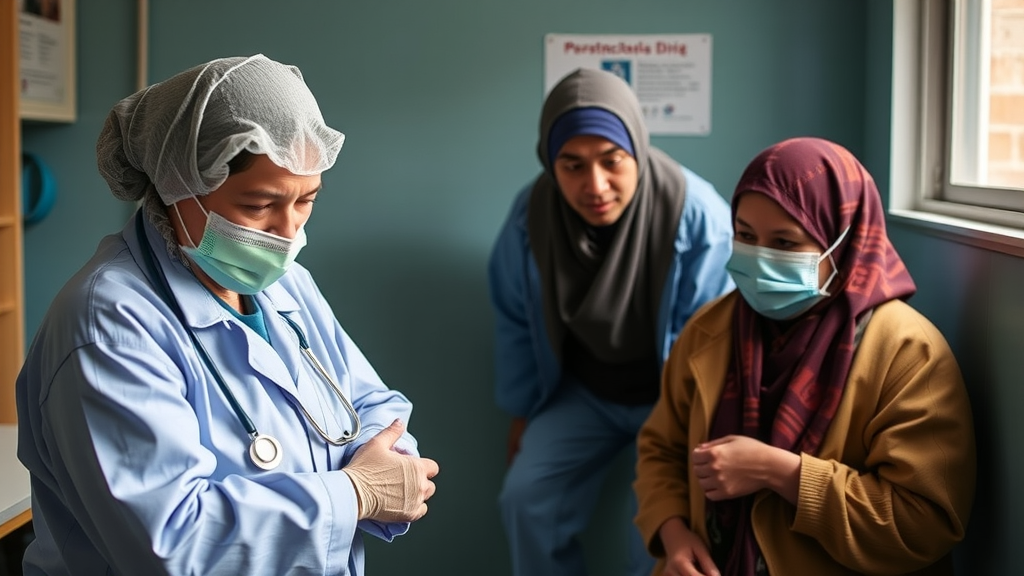
Along the so-called Balkan Route, the overland corridor that carries people from the Middle East, Asia, and Africa toward Western Europe, healthcare is less a right than a lottery. A new qualitative study published in the International Journal for Equity in Health offers one of the most detailed pictures yet of who actually delivers medical support to people in transit, and why the system that is supposed to provide it so often fails. The answer, drawn from the firsthand accounts of civil society workers across eleven countries, is that non-governmental organizations have quietly become the load-bearing structure of migrant healthcare in southeastern Europe, even as they warn that the arrangement is fragile, underfunded, and ethically fraught.
The research team, led by Fabian Link, Zeliha Öcek, and Michaela Coenen of LMU Munich together with Apostolos Veizis of INTERSOS Hellas in Athens, interviewed fifteen staff members of civil society organizations between March and May 2024. Participants were recruited through purposive and snowball sampling, a technique in which initial contacts recommend further interviewees, allowing the researchers to reach workers embedded in local, national, and international organizations across the full length of the route. Semi-structured, in-depth interviews covered healthcare access, service gaps, the roles organizations play, the challenges they face, and their relations with institutions. The transcripts were then analyzed using qualitative content analysis, a method that systematically codes textual data into categories and themes. Ethical approval was obtained from the Ethics Committee of the Faculty of Medicine at LMU Munich, and all participants gave written informed consent.
The analytical engine of the study produced four main categories that structure the findings: the structural and sociopolitical context, the situation of people on the move themselves, national healthcare systems, and civil society organizations. This framework matters because it reframes migrant health not as an individual medical problem but as the output of an interacting system. Whether a person with an infected wound or a chronic illness receives care depends on migration governance, the capacity and willingness of national health services, and the presence or absence of an NGO clinic within walking distance of an informal settlement or a police station.
Participants described a landscape of fragmented migration governance in which responsibility for people in transit is dispersed across states, European Union agencies, and international bodies without any single actor owning the outcome. The Balkan Route is not a single road but a shifting mosaic of border crossings, transit camps, informal settlements, and pushback zones, and the legal status of a person can change overnight as they move from one jurisdiction to another. In this environment, the interviewees reported, legal barriers and discrimination operate as determinants of health in their own right. A person without registration may be formally entitled to emergency care yet practically unable to access it, turned away at reception desks, unable to communicate their symptoms, or afraid to present at a facility that they believe may report them to authorities.
The health risks experienced by people on the move are cumulative rather than episodic, according to the accounts gathered in the study. Exhaustion from weeks of walking, injuries sustained during border crossings, exposure to cold and unsanitary conditions, untreated chronic diseases, and the psychological burden of uncertainty and violence compound one another. Structural, administrative, and communication barriers then stack on top of these vulnerabilities. Language interpretation is often unavailable; paperwork requirements assume a fixed address; and the constant threat of removal discourages people from seeking care at all. The result is a population whose medical needs intensify precisely as their access to formal services diminishes.
Against this backdrop, the study’s central finding is the mediating role of civil society organizations. Although participants consistently viewed states as the actors primarily responsible for healthcare provision, they reported that CSOs fill critical gaps in three distinct ways. First, they deliver health-related services directly, from basic medical care and hygiene support to referrals for specialist treatment. Second, they facilitate access through mediation, accompanying individuals to hospitals, translating, navigating bureaucracy, and vouching for patients who would otherwise fall through the cracks. Third, they advocate for more equitable healthcare, pressing authorities and international agencies to recognize and close the gaps they observe on the ground. This triple function, service provision, brokerage, and advocacy, makes CSOs the connective tissue between a mobile population and health systems that were never designed to receive it.
Yet the study is equally clear that this role is constrained from multiple directions. Unstable funding keeps organizations in a permanent state of short-term planning, with projects that can end when donor priorities shift. Workforce shortages mean that a handful of coordinators, nurses, and cultural mediators must cover enormous geographic and caseload spans. Political pressures add another layer: organizations operating in countries where migration is a charged political issue face suspicion, obstruction, and in some contexts the risk of being accused of facilitating irregular movement. Perhaps most corrosive are the ethical tensions participants described regarding the substitution of state responsibilities. When an NGO clinic becomes the de facto primary care provider for a transit population, it relieves the state of pressure to fulfill its own obligations, and it does so without the mandate, resources, or accountability of a public health system. Workers described the discomfort of propping up a parallel structure they know should not need to exist.
What emerges as the decisive variable separating effective support from failure is trust. The interviewees emphasized that collaboration between civil society organizations, healthcare providers, public authorities, local communities, and people on the move themselves is essential for healthcare to reach those who need it. Trust operates at every interface: a hospital that trusts an NGO’s referral accepts its patients; a local community that trusts a organization tolerates its presence; a person in transit who trusts a cultural mediator discloses symptoms that would otherwise remain hidden. Where these relationships exist, the machinery of care functions despite the structural obstacles. Where they do not, even well-funded interventions stall.
The technical significance of the study lies in its transnational scope and its grounding in the operational perspective of frontline staff rather than in policy documents or patient surveys alone. By sampling across eleven countries and across organizational scales, from small local groups to international humanitarian agencies, the researchers captured the heterogeneity of the route rather than a single national snapshot. Qualitative content analysis allowed them to move from individual anecdotes to system-level categories, showing how the same structural forces, fragmented governance, limited health system capacity, discrimination, and legal exclusion, reproduce themselves at every point along the corridor. The consistency of these themes across such different political contexts is itself a finding: the barriers to healthcare for people on the move are not local anomalies but features of the European migration architecture.
The authors’ conclusions point toward a specific reform agenda rather than a vague call for improvement. Strengthening trust-based collaboration, they argue, must go hand in hand with preserving the independence of civil society organizations and maintaining state accountability for healthcare provision. In other words, the goal is not to formalize the substitution of NGOs for the state but to use their mediating capacity to pull states back into their proper role. As migration pressures persist and the Balkan Route continues to shift with border politics, the study suggests that the health of people in transit will depend less on any single clinic or program than on whether the fragile web of trust connecting volunteers, doctors, officials, and migrants can be strengthened before it frays. For now, along the forests and border towns of southeastern Europe, it is civil society that keeps the promise of healthcare alive, one mediated referral at a time.
Subject of Research: Civil society organizations' roles and obstacles in providing healthcare access to people on the move along the Balkan migration route
Article Title: Health support for people on the move: a qualitative exploration of civil society organizations’ roles and obstacles along the Balkan route
Article References: Link, F., Öcek, Z., Veizis, A., & Coenen, M. (2026). Health support for people on the move: a qualitative exploration of civil society organizations’ roles and obstacles along the Balkan route. International Journal for Equity in Health. https://doi.org/10.1186/s12939-026-03048-x
Image Credits: AI Generated
DOI: 10.1186/s12939-026-03048-x
Keywords: Balkan Route, migration health, civil society organizations, healthcare access, qualitative research, refugees, migrants, health equity, humanitarian aid, public health, Europe, health systems
Cite Scienmag News
Phoebe Ingram. (September 25, 2026). On Europe’s Migration Trail, Volunteers Keep Healthcare Alive Where States Fall Short. Scienmag. https://scienmag.com/on-europes-migration-trail-volunteers-keep-healthcare-alive-where-states-fall-short/
Phoebe Ingram. "On Europe’s Migration Trail, Volunteers Keep Healthcare Alive Where States Fall Short." Scienmag, 25 September 2026, https://scienmag.com/on-europes-migration-trail-volunteers-keep-healthcare-alive-where-states-fall-short/. Accessed 25 September 2026.
Phoebe Ingram. "On Europe’s Migration Trail, Volunteers Keep Healthcare Alive Where States Fall Short." Scienmag. September 25, 2026. https://scienmag.com/on-europes-migration-trail-volunteers-keep-healthcare-alive-where-states-fall-short/


