


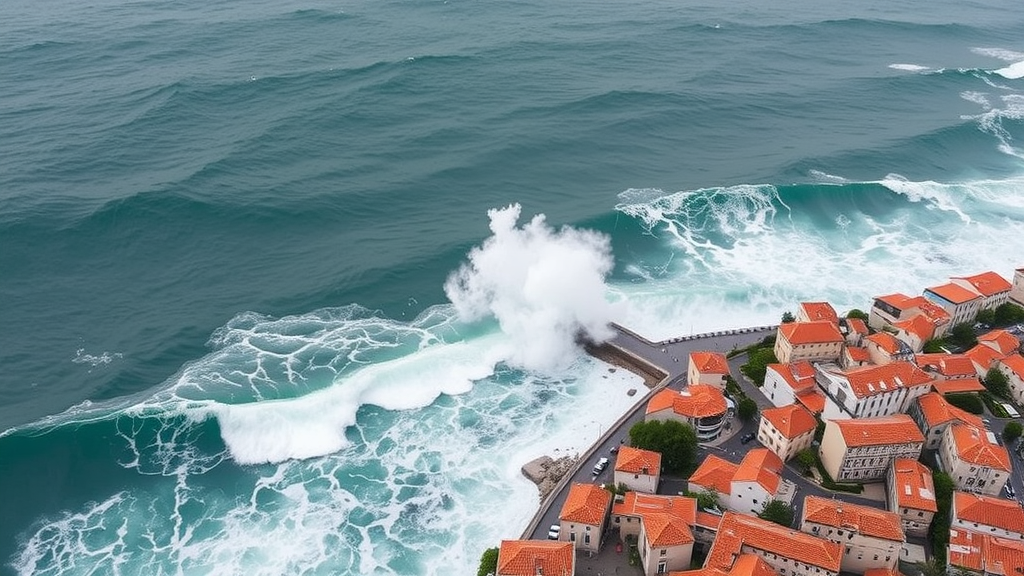
On a narrow gravel beach wedged between the mountains and the sea on Italy’s eastern Ligurian Riviera, the town of Camogli has spent centuries living dangerously close to the water. Its buildings press directly against the shoreline, its tourist facilities sit only metres from the waves, and its history is punctuated by storms that have flooded streets and torn apart seafront structures. A new study published in the journal Natural Hazards has now quantified, with unusual precision, exactly how exposed this densely urbanised coastline is to storm waves, using a modelling framework that could serve as a template for hundreds of similar towns across the Mediterranean and beyond.
The research, led by L. Carpi of the University of Genova together with N. Oneto and M. Ferrari, tackles a deceptively simple question: which parts of a coastal town will waves actually reach during the worst storms? Answering it required reconstructing four decades of wave history. The team drew on a 43-year hindcast database maintained by the Department of Civil, Chemical and Environmental Engineering at Genoa, which contains numerical simulations of offshore wave conditions produced with the WaveWatchIII spectral wave model and the Weather Research and Forecasting atmospheric model. From the period between January 1979 and December 2022, the researchers selected the twenty largest storms arriving from the southeast and the twenty largest from the southwest, the two dominant and most destructive wave directions in the Ligurian Sea.
Simulating what those forty storms did when they reached the coast demanded an equally detailed picture of the seafloor and the land. Bathymetric data out to depths of twenty metres were collected with a multibeam echosounder offering centimetre-level resolution, while the beach and the seafront urban fabric were mapped with a LiDAR system mounted on an unmanned aerial vehicle. Offshore bathymetry came from regional government datasets. All of these sources were merged and interpolated into a high-resolution digital elevation model that captured not only the natural morphology but also the buildings, seawalls and narrow alleys that shape how floodwater moves through the town.
The heart of the modelling chain is XBeach, an open-source model that solves the time-dependent short wave action balance, roller energy equations and nonlinear shallow water equations, allowing it to reproduce wave groups, run-up and morphological change during storms. The researchers ran XBeach in surfbeat mode on a computational grid covering six square kilometres, with cell sizes shrinking to 2.5 metres in the coastal strip, fine enough to resolve the small streets and gaps between buildings through which water can surge. For storms from the southwest, which strike Camogli directly, XBeach alone proved sufficient. For storms from the southeast, however, the Portofino Promontory partially shelters the coast, and waves had to be translated to the offshore boundary of the model domain using D-Waves, the SWAN-based wave module of the Delft3D suite, applied over a grid of 115 square kilometres encompassing the promontory.
Validating the model posed a familiar problem: no field measurements exist for the historical storms of interest. The team therefore compared simulated significant wave heights and directions with measurements from an oceanographic buoy located inside the model domain during two events in May and August 2025. The agreement was strong. For the August event, the model achieved a coefficient of determination of 0.96, a correlation coefficient of 0.98 and a scatter index of just 0.16 for wave height, while wave direction errors, expressed as circular root-mean-square error, ranged from 12.0 to 19.6 degrees across the two events, figures comparable to those reported in other coastal wave-modelling applications. A second, more dramatic validation came from simulating the storm of 3 to 5 November 2023, which was not part of the exposure dataset. That southwest storm destroyed a beach restaurant built on stilts, and the model’s simulated maximum run-up of 2.6 metres reached precisely the location of the collapsed structure.
With the model chain validated, the researchers computed two run-up indicators for every storm along six coastal transects: the run-up exceeded by two percent of the waves, and the maximum run-up. The contrast between wave directions was stark. For the twenty most intense southeast storms, run-up values almost never exceeded 1.8 metres and typically stayed below 1.3 metres, never crossing the two-metre threshold that marks the elevation above which tourism infrastructure begins to be threatened. Camogli is, in effect, only marginally exposed to storms from that quadrant, a consequence of the sheltering geometry of the Portofino Promontory.
Southwest storms told a very different story. Maximum run-up exceeded two metres in nearly every simulated event, and in five storms the two-percent run-up reached between 2.4 and 2.6 metres. The outlier was the storm of 29 October 2018, widely known as the Vaia Storm, which produced run-up values between 3.89 and 5.28 metres for the two-percent parameter and between 4.94 and 5.72 metres for maximum run-up. It was the only event in the entire 43-year record that pushed waves above the three-metre threshold, corresponding roughly to the maximum beach elevation before the urban settlement begins, where flooding of the town itself becomes a concrete possibility. That finding is consistent with the documented damage from the event and underscores a central message of the study: only long-term wave datasets can capture the rare but catastrophic storms that dominate coastal risk.
The spatial pattern of exposure revealed an uncomfortable structural problem. In earlier work on the nearby bay of Bonassola, a medium exposure class had acted as a buffer zone between low and high exposure, allowing authorities to issue graduated warnings and phase in mitigation measures. Along more than half of the Camogli coastline, that buffer is absent. Exposure jumps directly from low to high, because the beach is only ten to fifteen metres wide, has the steep profile typical of gravel and pebble shores, and is backed immediately by seawalls and building walls that leave no room for a wider dissipative beach. Small variations in wave run-up therefore produce abrupt transitions in exposure level, a dynamic that complicates emergency management and increases the likelihood of frequent high-level alerts.
That abruptness carries a human cost that the authors address head-on. Warning systems that cry wolf too often breed alert fatigue, eroding public trust and responsiveness, while overly precautionary closures of commercial activities impose economic costs and damage institutional credibility. The study found that choosing the more conservative maximum run-up indicator over the two-percent parameter would have generated only one additional flood warning across the entire historical record, limiting the fatigue risk in this particular setting, though the authors stress that the choice of indicator must be evaluated case by case. Because risk perception is strongly shaped by direct personal experience, and because the missing buffer zone is rooted in geomorphology and urban form rather than in any fixable technical shortcoming, the researchers argue that targeted risk communication and community preparedness must complement the modelling work.
The implications stretch well beyond one Ligurian town. As sea levels rise, coastlines like Camogli, with narrow beaches, rocky margins, intense urbanisation up to the waterline and no capacity to migrate landward, are likely to face growing storm exposure, making accurate, site-specific hazard assessment increasingly urgent. The study also flags its own limits: reliable results depend on accurate, up-to-date topographic and bathymetric data, which human development can rapidly invalidate, and on long-term offshore wave datasets, which remain scarce where buoy networks are sparse. Hindcast databases fill that gap, but uncertainties in them can propagate through the modelling chain. Even so, the message is clear and broadly applicable: in crowded coastal towns where a single metre of elevation separates safety from flooding, high-resolution modelling of decades of historical storms is not a luxury but a prerequisite for evidence-based warning thresholds, sensible mitigation planning and, ultimately, the protection of lives and livelihoods.
Subject of Research: Storm-induced coastal exposure modelling using hindcast wave data in a densely urbanised coastal area
Article Title: Modelling storm-induced coastal exposure using hindcast wave data in a densely urbanised coastal area
Article References: Carpi, L., Oneto, N., & Ferrari, M. (2026). Modelling storm-induced coastal exposure using hindcast wave data in a densely urbanised coastal area. Natural Hazards, 122(20), Article 649. https://doi.org/10.1007/s11069-026-08420-2
Image Credits: AI Generated
DOI: 10.1007/s11069-026-08420-2
Keywords: coastal exposure, wave run-up, storm hindcast, XBeach, coastal flooding, Ligurian Riviera, wave modelling, risk assessment, alert fatigue, sea-level rise, digital elevation model, Natural Hazards
Cite Scienmag News
Courtney Benton. (September 24, 2026). Forty Years of Storms Reveal Where Waves Will Strike a Crowded Italian Coast. Scienmag. https://scienmag.com/forty-years-of-storms-reveal-where-waves-will-strike-a-crowded-italian-coast/
Courtney Benton. "Forty Years of Storms Reveal Where Waves Will Strike a Crowded Italian Coast." Scienmag, 24 September 2026, https://scienmag.com/forty-years-of-storms-reveal-where-waves-will-strike-a-crowded-italian-coast/. Accessed 24 September 2026.
Courtney Benton. "Forty Years of Storms Reveal Where Waves Will Strike a Crowded Italian Coast." Scienmag. September 24, 2026. https://scienmag.com/forty-years-of-storms-reveal-where-waves-will-strike-a-crowded-italian-coast/


