


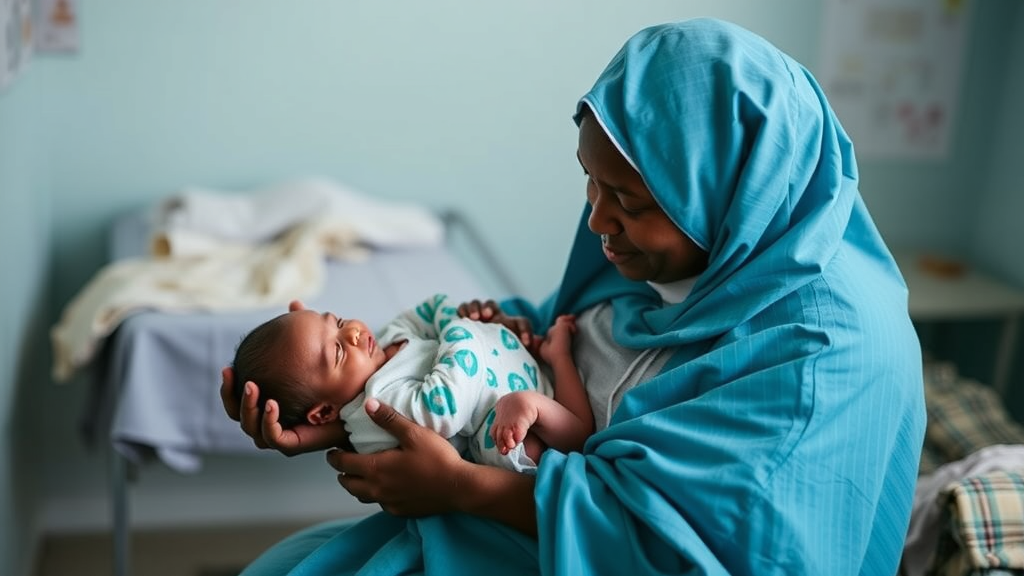
At birth, a newborn leaves the warm, tightly regulated environment of the uterus and enters a room that, by comparison, is cold. In many hospitals in low-income countries, that transition can be perilous: a substantial share of babies, particularly those weighing less than 2000 grams, arrive in the neonatal unit with body temperatures far below the safe range. A new quality improvement study published in the Journal of Perinatology reports that a structured, low-cost bundle of interventions at a Tanzanian referral center cut the rate of hypothermia at birth from an astonishing 99 percent to just 5.7 percent, offering one of the most dramatic demonstrations yet that newborn thermal care can be transformed even in resource-limited settings.
The study, led by Chelsea Hartman and Jeffrey Perlman of Weill Cornell Medicine-NewYork-Presbyterian Hospital together with colleagues at Kilimanjaro Christian Medical Centre (KCMC) in Moshi, Tanzania, set out with what the team calls a SMART aim: to reduce the rate of neonatal hypothermia by 50 percent and to raise the mean delivery room temperature of newborns by 0.6 degrees Celsius. The investigators also set out to explore whether reducing hypothermia would translate into lower early neonatal mortality, defined as death within the first seven days of life. The results exceeded the temperature goal by a wide margin, while the mortality findings delivered a more sobering lesson about the limits of single-intervention quality improvement.
The scale of the baseline problem is striking. Before any intervention, the mean neonatal temperature in the delivery room was 35.9 degrees Celsius, with a standard deviation of 0.24 degrees, well below the World Health Organization’s recommended threshold of at least 36.5 degrees Celsius. Ninety-nine percent of the newborns studied were hypothermic at birth. Sixty-six percent fell into the mild category, with temperatures between 36.0 and 36.4 degrees Celsius, while a full 33 percent were moderately hypothermic, with temperatures between 32.0 and 35.9 degrees Celsius. In other words, essentially every vulnerable baby born at the facility was losing heat faster than it could be replaced, and one in three was cold enough to face clinically significant risk.
Neonatal hypothermia is not a benign inconvenience. Newborns, and especially preterm and low-birth-weight infants, have a large surface-area-to-mass ratio, thin insulating fat layers, and immature mechanisms for generating heat, so they lose warmth rapidly through evaporation of amniotic fluid, conduction, convection, and radiation. Prior research, including systematic reviews and large cohort studies from Europe, Brazil, and South Asia, has linked admission hypothermia in very preterm infants to increased mortality, respiratory distress, and other morbidities. Studies in East Africa have repeatedly documented high prevalence, and a five-year review at Tanzanian centers underscored how gestational age, birth weight, and fetal heart rate abnormalities interact with thermal stress to shape early survival.
To attack the problem, the team applied the Model for Improvement, a widely used quality improvement framework built around iterative Plan-Do-Study-Act (PDSA) cycles. The study population consisted of neonates weighing less than 2000 grams at birth, the group at highest risk of rapid heat loss. Three sequential PDSA cycles were implemented, each refining the approach based on real-time audit data. The core interventions comprised three elements: a hypothermia prevention care bundle, in-person in-service training for delivery room staff, and a systematic audit implementation to track whether the bundle was actually being delivered as intended.
The care bundle drew on established thermal protection practices promoted by the World Health Organization and supported by randomized evidence. These include thorough drying immediately after birth to halt evaporative heat loss, delaying bathing, ensuring skin-to-skin contact where feasible, and the use of occlusive wrapping, approaches that trials in resource-poor settings have shown can meaningfully reduce heat loss even for term infants. Plastic barriers and wraps have proven particularly effective for preterm babies, and immediate kangaroo mother care has been shown in a landmark randomized trial to improve survival of low-birth-weight infants. The Tanzanian team’s contribution was not a novel technology but the disciplined packaging, teaching, and auditing of these known practices in a busy delivery room.
The impact was immediate and sustained. From the very first PDSA cycle onward, statistical process control charts showed a centerline shift in the mean delivery room neonatal temperature, rising from 35.9 degrees Celsius to 36.8 degrees Celsius, a gain of nearly a full degree that comfortably surpassed the 0.6-degree target. Simultaneously, the incidence of hypothermia shifted to 5.7 percent, and critically, all remaining cases were mild. Moderate hypothermia, which had affected a third of newborns at baseline, was eliminated entirely. In quality improvement terms, the intervention did not merely nudge the system; it moved the process to a new, stable level of performance that persisted across subsequent cycles.
The mortality data, however, tell a more complicated story. Despite the near-elimination of hypothermia at birth, early neonatal mortality rates, tracked as deaths within seven days, remained unchanged, with a control chart centerline of 12.3 percent throughout the initiative. The authors are careful and candid about this finding: because overall neonatal mortality did not fall, they conclude that there is insufficient evidence to support a causal relationship between hypothermia and early mortality in this setting. This does not mean hypothermia is harmless; rather, it reflects the reality that early deaths in this population are driven by multiple overlapping factors, including extreme prematurity, low birth weight, intrapartum complications, and fetal heart rate abnormalities, and that correcting one risk factor in isolation may not shift a composite outcome dominated by other forces.
The study nonetheless carries important lessons for the global effort to reduce newborn deaths, which still claims roughly four million lives annually by earlier estimates, with the majority occurring in low- and middle-income countries. Quality improvement initiatives in Ethiopia, India, Malaysia, and elsewhere have reported similar successes in reducing admission hypothermia using bundles, standardization, and PDSA methodology, and a Cochrane systematic review has concluded that interventions to prevent hypothermia at birth in preterm and low-birth-weight infants are effective. The Tanzanian experience adds a rigorous, chart-based demonstration that near-complete elimination of delivery room hypothermia is achievable with training, a defined bundle, and continuous audit, without expensive equipment.
For clinicians and program designers, the message is twofold. First, thermal protection is a solvable problem: a combination of drying, wrapping, warming the delivery environment, and staff engagement can move a facility from universal hypothermia to near-universal normothermia within a single improvement cycle. Second, measuring what matters requires patience and honesty; the unchanged mortality centerline is a reminder that quality improvement must be embedded in broader strategies addressing the many determinants of newborn survival. The work, funded in part by Bloomberg Philanthropies and carried out by midwives and physicians at KCMC alongside their American collaborators, stands as a template for how disciplined, data-driven care redesign can deliver dramatic physiological gains for the most vulnerable newborns, even where the ultimate outcome depends on conquering challenges far beyond the delivery room thermometer.
Subject of Research: A quality improvement initiative to reduce neonatal hypothermia at birth in Tanzania
Article Title: Reducing rates of neonatal hypothermia at birth in Tanzania: a quality improvement initiative
Article References: Hartman, C., Ngowi, E., Ahn, E., Shayo, A., Peter, N., Cypriane, J., Mlay, P., Tiwari, P., & Perlman, J. (2026). Reducing rates of neonatal hypothermia at birth in Tanzania: a quality improvement initiative. Journal of Perinatology. https://doi.org/10.1038/s41372-026-02904-6
Image Credits: AI Generated
DOI: 10.1038/s41372-026-02904-6
Keywords: neonatal hypothermia, quality improvement, Tanzania, delivery room, PDSA cycles, newborn thermoregulation, low birth weight, preterm infants, care bundle, Kilimanjaro Christian Medical Centre, neonatal mortality, Journal of Perinatology
Cite Scienmag News
Harold Sullivan. (September 24, 2026). Simple Bundle of Care Nearly Eliminates Dangerous Newborn Cooling in Tanzanian Delivery Rooms. Scienmag. https://scienmag.com/simple-bundle-of-care-nearly-eliminates-dangerous-newborn-cooling-in-tanzanian-delivery-rooms/
Harold Sullivan. "Simple Bundle of Care Nearly Eliminates Dangerous Newborn Cooling in Tanzanian Delivery Rooms." Scienmag, 24 September 2026, https://scienmag.com/simple-bundle-of-care-nearly-eliminates-dangerous-newborn-cooling-in-tanzanian-delivery-rooms/. Accessed 24 September 2026.
Harold Sullivan. "Simple Bundle of Care Nearly Eliminates Dangerous Newborn Cooling in Tanzanian Delivery Rooms." Scienmag. September 24, 2026. https://scienmag.com/simple-bundle-of-care-nearly-eliminates-dangerous-newborn-cooling-in-tanzanian-delivery-rooms/


