


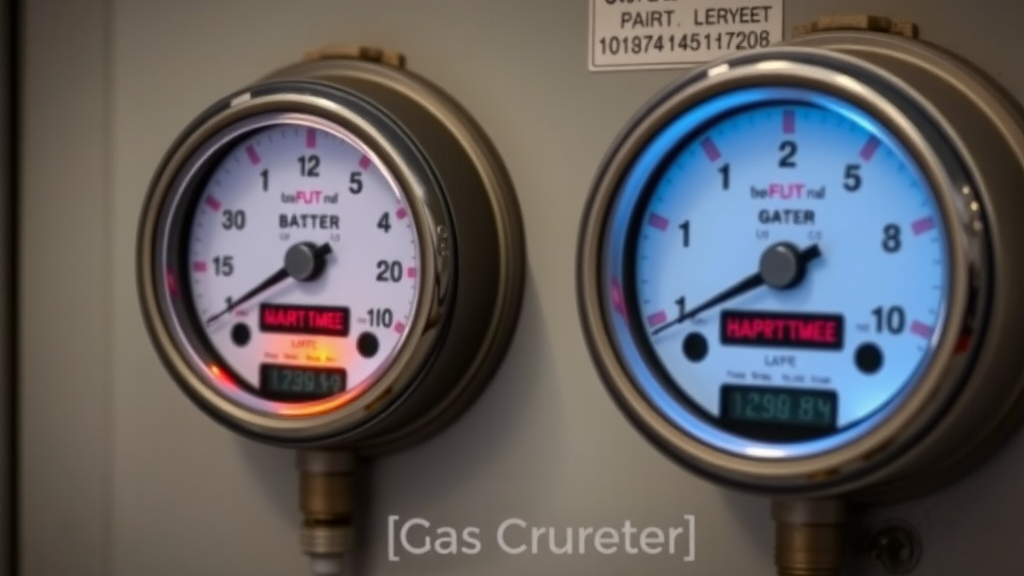
Natural gas still warms millions of homes around the world, and it will keep doing so for years to come as the planet negotiates the slow, uneven transition away from fossil-heavy heating. But the meters that measure that gas have a stubborn legacy problem: while smart meters have rolled out successfully in many regions, vast numbers of older, purely mechanical meters remain bolted to exterior walls, silently churning through dials that no computer can see. A new study published in the International Journal of Data Science and Analytics introduces a deep learning framework called DeepGATE that promises to change that, converting ordinary photographs of analog gas meter dials into precise consumption readings in real time, without touching the hardware at all.
The work, led by Nastaran Enshaei of Concordia University’s Institute for Information Systems Engineering together with Patrick Paul and Stéphane Tremblay of the National Research Council Canada, and corresponding author Ashkan Ebadi, tackles a deceptively simple question: can a camera and a neural network do the job of an expensive meter upgrade? The answer, according to the team, is yes — and with a level of precision that surprises even energy analysts. DeepGATE reads the pointer movements of mechanical dials from real-time images and resolves gas consumption to within 0.001 cubic meters, a thousandfold improvement in resolution over the 1-cubic-meter granularity of a typical dial-based manual read.
Why does that resolution jump matter? Mechanical gas meters accumulate consumption continuously, but the least significant dials creep along slowly, and a human reader or a coarse automated system may only register changes of a cubic meter or more between readings. At that resolution, a household’s short bursts of consumption — a shower, a stove burner igniting, a furnace cycling on a cold morning — simply vanish between snapshots. By reading the fine-grained pointer positions directly, DeepGATE captures those small events, which is exactly the granularity needed for occupancy behavior monitoring, consumption pattern analysis, and personalized efficiency guidance for homeowners.
The technical pipeline behind the framework blends classic computer vision with modern deep learning. The system first processes images of the meter face, where multiple circular dials carry pointers whose angular positions encode digits of cumulative consumption. The researchers devised both conventional and dataset-specific data augmentation strategies to cope with the diverse artifacts that plague outdoor imaging — glare, frost, rain, shadows, and the variable lighting of Canadian weather, since the training imagery comes from real meters mounted outside homes. These augmentation techniques expand the effective diversity of training data, allowing the network to remain robust when real-world conditions diverge from the idealized images it was trained on.
Under the hood, the researchers drew on a lineage of object detection and recognition architectures that the field has refined over the past decade — from Faster R-CNN and SSD through the YOLO family — and on proven backbone networks such as ResNet, VGG, and DenseNet for feature extraction. Crucially, they prioritized a lightweight design. Rather than chasing maximum accuracy with a massive model, the team engineered DeepGATE to run on edge devices: small, low-power computers that can be attached near the meter itself. That means no video has to stream to a cloud server, readings are computed locally and instantly, and the entire retrofit cost amounts to a camera, a compute module, and a power connection rather than a full meter replacement and the utility truck rolls that go with it.
The problem DeepGATE addresses is bigger than convenience. Smart meters and advanced metering infrastructure have documented benefits — leakage detection, demand forecasting, dynamic billing — but upgrading every mechanical meter carries significant cost, and studies of advanced metering infrastructure have flagged technology, security, and governance challenges as well. Meanwhile, accurate consumption data has become an urgent climate tool. Natural gas is positioned as an essential bridge fuel for residential heating in the early stages of the low-carbon transition, and precise monitoring lets utilities forecast demand more accurately, lets regulators understand usage patterns, and lets consumers see exactly how their daily habits translate into cubic meters of fuel burned.
The research also extends a body of computer vision work on automatic meter reading that stretches back more than a decade. Earlier efforts tackled gas meter reading from real-world images with multi-network systems and angle-invariant methods, and more recent approaches have applied convolutional neural networks to water meters, electricity meters, pointer gauges in substations and natural gas stations, and SF6 pressure gauges. Each of those systems fought the same enemy: unconstrained real-world conditions. What distinguishes the new work is its combination of fine pointer-angle precision, explicit handling of weather-induced image degradation, edge-device deployability, and a training resource built for the task. The team built on their own NRC-GAMMA dataset, a large-scale collection of gas meter images that they have made publicly available to the research community via GitHub — an unusually open move in a field where proprietary data is the norm.
Interpretability played a role in the design as well. The study leverages gradient-based localization techniques such as Grad-CAM, which let researchers visualize which regions of an image the network attends to when it makes its reading. That kind of visibility matters in a monitoring application: if a network is going to translate a blurry, frost-covered dial into a billing-relevant number, both engineers and eventual users need confidence that the model is looking at the pointer and not at a shadow or a scratch on the glass. The framework’s cross-validation-driven evaluation, guided by established statistical practice, reinforces that confidence by testing generalization rather than memorization.
The authors are explicit about the framework’s generality. DeepGATE is adaptable to the automated reading of diverse non-smart energy meters — water, electricity, and industrial gauges among them — and the augmentation strategies devised for weather-related artifacts transfer readily to other deep learning applications in outdoor image processing. In effect, the contribution is twofold: a working system for gas consumption monitoring, and a set of reusable techniques for any computer vision task where cameras must survive the elements. The dataset release alone could accelerate research, since robust analog gauge reading has long been hampered by a scarcity of labeled, real-world imagery.
The downstream implications reach into behavior science and energy policy. The researchers point to improved occupant behavior monitoring systems as a key application: with 0.001-cubic-meter resolution, a household’s consumption fingerprint becomes rich enough to distinguish cooking from heating from hot-water use, enabling customized consumption guidance that could nudge households toward measurable efficiency gains. For utilities, real-time edge inference means consumption data without privacy-eroding cloud pipelines, and for the low-carbon transition it means that the installed base of dumb meters — millions of devices with decades of mechanical life left in them — can be drafted into the smart grid revolution rather than scrapped. As deep learning continues its march into infrastructure, DeepGATE offers a quietly compelling vision: sometimes the smartest way to upgrade the grid is to teach a small computer to do what a human reader does, only a thousand times more precisely, every moment of every day.
Subject of Research: Deep learning-based automatic reading of non-smart gas meters for real-time residential energy consumption monitoring
Article Title: DeepGATE: a deep learning-based automatic meter reading framework for real-time gas consumption monitoring
Article References: Enshaei, N., Paul, P., Tremblay, S., & Ebadi, A. (2026). DeepGATE: a deep learning-based automatic meter reading framework for real-time gas consumption monitoring. International Journal of Data Science and Analytics, 22(1), Article 309. https://doi.org/10.1007/s41060-026-01273-9
Image Credits: AI Generated
DOI: 10.1007/s41060-026-01273-9
Keywords: deep learning, automatic meter reading, gas consumption monitoring, computer vision, non-smart gas meters, edge computing, data augmentation, energy analytics, smart meters, NRC-GAMMA dataset, neural networks, energy informatics
Cite Scienmag News
Blake Davidson. (September 24, 2026). AI Turns Dumb Gas Meters Into Smart Meters, Reading Dials in Real Time. Scienmag. https://scienmag.com/ai-turns-dumb-gas-meters-into-smart-meters-reading-dials-in-real-time/
Blake Davidson. "AI Turns Dumb Gas Meters Into Smart Meters, Reading Dials in Real Time." Scienmag, 24 September 2026, https://scienmag.com/ai-turns-dumb-gas-meters-into-smart-meters-reading-dials-in-real-time/. Accessed 24 September 2026.
Blake Davidson. "AI Turns Dumb Gas Meters Into Smart Meters, Reading Dials in Real Time." Scienmag. September 24, 2026. https://scienmag.com/ai-turns-dumb-gas-meters-into-smart-meters-reading-dials-in-real-time/


