


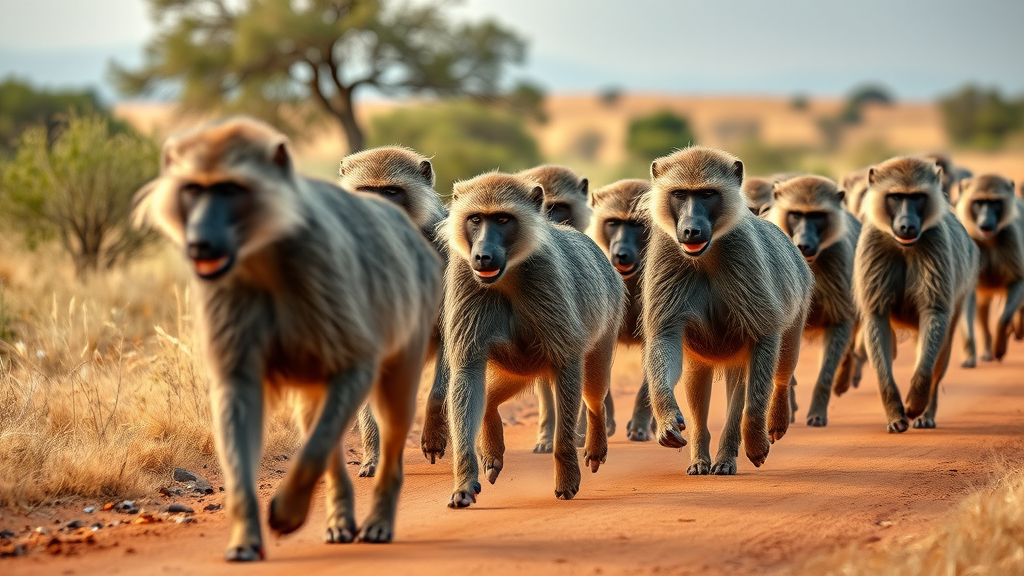
When the rains fail in central Tanzania, baboons do not simply wait out the hardship. They walk. A new study from Swagaswaga Game Reserve reveals that olive and yellow baboons nearly triple their daily travel distances during the dry season, marching an average of 3.01 kilometres per day compared with just 1.06 kilometres when water and food are abundant. The findings, published in Discover Conservation, offer one of the clearest quantitative portraits yet of how seasonality reshapes the movement ecology and social structure of two of Africa’s most widespread primates, and they carry a warning: as the dry season bites, baboons increasingly stray beyond protected borders and into human territory.
The research, conducted by Flora Felix Manyama of the University of Dodoma, focused on four habituated baboon troops, two of olive baboons (Papio anubis) and two of yellow baboons (Papio cynocephalus), within the 871-square-kilometre reserve that straddles the Kondoa and Chemba districts of the Dodoma region. Swagaswaga is a classic semi-arid savannah ecosystem: rolling hills, rocky outcrops and miombo woodlands punctuated by drainage systems such as the Makati River, where annual rainfall of 600 to 1000 millimetres falls almost entirely between November and April. From May to October, the landscape is defined by hot, sunny days, cooler nights and steadily vanishing water sources, an environmental rollercoaster that makes the reserve an ideal natural laboratory for studying how animals respond to resource scarcity.
The fieldwork was demanding in its precision. Across 67 observation days totalling 440 hours, baboon troops were followed on foot from six o’clock in the morning, before they left their sleeping sites, until they settled into a new sleeping site around half past six or seven in the evening. Observers, working at an average distance of five metres, recorded troop movements continuously using hand-held Garmin 520Hcx GPS units, a technique considered among the most reliable for quantifying ranging behaviour in primates. Data collection ran through the wet season from January to March 2024 and the dry season from June to August 2024, allowing direct seasonal comparisons for the same troops under radically different ecological conditions.
The headline result is stark. When both species were pooled, baboons travelled an average of 3.01 plus or minus 0.07 kilometres per day in the dry season, against 1.06 plus or minus 0.03 kilometres in the wet season, a difference that proved statistically significant under a Mann-Whitney U test. The explanation, the study argues, lies in water. During the wet months, ephemeral water sources are replenished and vegetation flourishes, meaning baboons rarely need to venture far for a drink or a meal. When the rains stop, those sources dry up, forcing the troops to expand their search radius and, in doing so, cover three times the ground they would under favourable conditions.
The two species, however, did not respond identically. Olive baboons consistently outwalked their yellow cousins in both seasons, averaging 3.27 kilometres per day in the dry season and 1.17 kilometres in the wet, while yellow baboons logged 2.76 and 0.95 kilometres respectively. Although the overall difference between the species did not reach statistical significance in the Kruskal-Wallis test, the pattern was consistent. The most plausible driver, the study suggests, is group size: olive baboons live in larger troops than yellow baboons at Swagaswaga, and larger groups exhaust food patches faster and face greater within-group feeding competition, which compels them to travel farther and more frequently between resource patches.
Group dynamics themselves shifted with the seasons in ways that illuminate the fundamental trade-offs of social living. Average troop sizes were significantly larger in the wet season, at 16 individuals, than in the dry season, when they dropped to 9. Olive baboons formed the biggest groups, at 18 in the wet season and 11 in the dry, compared with 14 and 7 for yellow baboons. Importantly, the study notes that these fluctuations were not driven by births or deaths but by fission and fusion, the splitting and merging of groups that is common among primates and governed by both social and ecological pressures. When resources are plentiful, the costs of crowding are low and the benefits of group living, including dilution of predation risk and improved vigilance, tip the balance in favour of large aggregations. When water and food grow scarce, smaller groups become energetically advantageous.
This logic follows a well-established framework in behavioural ecology: as time spent travelling increases, a threshold is eventually reached at which the energy cost of moving becomes so high that small groups outcompete large ones. In semi-arid environments like Swagaswaga, where prolonged dry seasons can sharply curtail food and water availability, an increase in group size directly expands the area a troop must cover to meet its collective needs. Individual baboons in larger groups must therefore travel farther and burn more energy than they would in smaller aggregations, a cost that the dry season amplifies to a breaking point. The observed seasonal fissioning is the animals’ solution to that arithmetic.
Perhaps the most consequential finding for conservation is what happens at the reserve’s edge. Although baboons spent roughly 85 percent of their observation time inside Swagaswaga, both species regularly moved beyond the borders, where human settlements and cultivated farms offer alternative food sources. Olive baboons, with their larger troops and longer daily ranges, spent more time outside the reserve than yellow baboons, and both species ventured out most often during the dry season, presumably driven by the same resource shortages that inflated their travel distances. Baboons are omnivorous and opportunistic, and the study notes they will eat cultivated crops and even domesticated animals such as goats, sheep and poultry, behaviour that places them in direct conflict with farmers.
These crop-raiding excursions have tangible costs on both sides. Human-wildlife conflict around Swagaswaga typically centres on baboons raiding farms just beyond the reserve boundary, and prolonged conflict threatens both local livelihoods and the long-term tolerance that conservation depends on. The study argues that quantifying how much time baboons spend outside the protected area, and under which seasonal conditions, gives wildlife managers a practical tool: interventions can be timed and targeted for the dry season, when the risk of encounters peaks. Because baboons are widely regarded as agricultural pests and are classified as a species of least concern, they rarely attract conservation funding, yet their ecology makes them a bellwether for how semi-arid protected areas function.
The broader implications stretch into a warming future. Climate change is expected to make rainfall in semi-arid regions more erratic, potentially prolonging dry seasons and intensifying water shortages, which would push baboons and other wildlife into even longer daily movements and more frequent excursions beyond reserve boundaries. Understanding the precise relationship between seasonality, ranging and group structure, as this GPS-based study does, is therefore a first step toward predicting and managing those pressures. The research calls for further work on human-baboon conflict around Swagaswaga to inform management strategies, and its data are held at the University of Dodoma for future study. For now, the image it leaves is vivid: on the hottest, driest days, when the ephemeral pools have cracked and the acacias stand bare, baboon troops tighten their ranks, shrink their numbers and set out across the savannah on journeys three times longer than any they make in the season of plenty.
Subject of Research: Effects of seasonal variation on daily travel distances and group sizes of olive and yellow baboons in a semi-arid Tanzanian game reserve
Article Title: Effects of seasonality on baboons’ (Papio cynocephalus and Papio anubis) daily movement patterns and group sizes in semi-arid environment at Swagaswaga game reserve, Tanzania
Article References: Effects of seasonality on baboons’ (Papio cynocephalus and Papio anubis) daily movement patterns and group sizes in semi-arid environment at Swagaswaga game reserve, Tanzania. (n.d.). https://doi.org/10.1007/s44353-025-00058-8
Image Credits: AI Generated
DOI: 10.1007/s44353-025-00058-8
Keywords: baboons, seasonality, Swagaswaga Game Reserve, Tanzania, olive baboon, yellow baboon, daily travel distance, group size, semi-arid, human-wildlife conflict, GPS tracking, primatology
Cite Scienmag News
Gavin Prescott. (September 24, 2026). Dry Days Drive Baboons to March Three Times Farther in Tanzanian Reserve. Scienmag. https://scienmag.com/dry-days-drive-baboons-to-march-three-times-farther-in-tanzanian-reserve/
Gavin Prescott. "Dry Days Drive Baboons to March Three Times Farther in Tanzanian Reserve." Scienmag, 24 September 2026, https://scienmag.com/dry-days-drive-baboons-to-march-three-times-farther-in-tanzanian-reserve/. Accessed 24 September 2026.
Gavin Prescott. "Dry Days Drive Baboons to March Three Times Farther in Tanzanian Reserve." Scienmag. September 24, 2026. https://scienmag.com/dry-days-drive-baboons-to-march-three-times-farther-in-tanzanian-reserve/


