


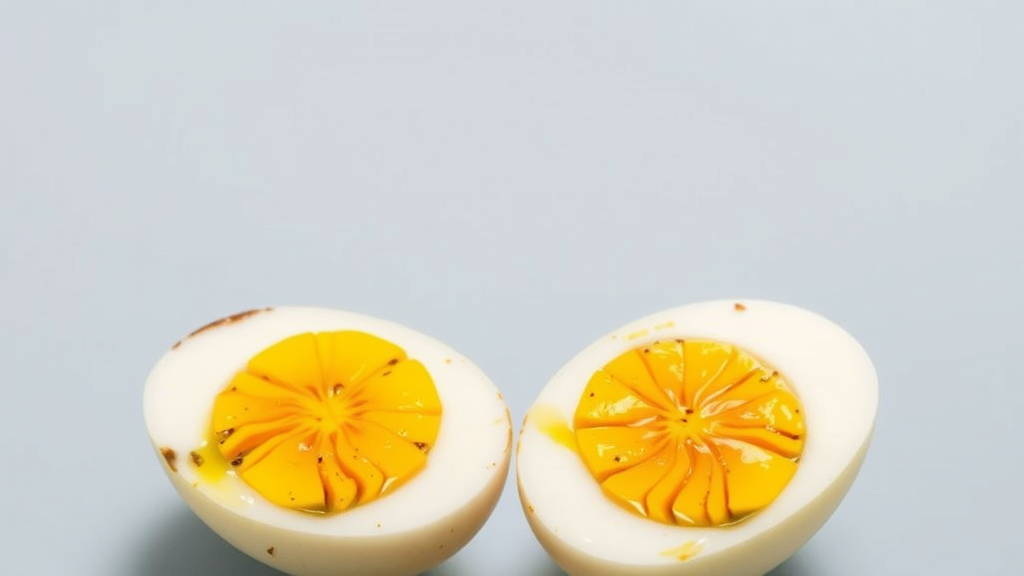
Few foods provoke as much fascination and revulsion as the century egg, the Chinese delicacy in which fresh duck eggs are transformed by an alkaline bath into amber, jelly-like orbs with a pungent, complex aroma. Now a team of Chinese and Irish researchers has tracked, molecule by molecule, exactly how that signature smell develops over a 36-day pickling cycle, revealing a choreographed sequence of protein breakdown, lipid oxidation, and Maillard chemistry that unfolds differently in the egg white and the yolk. The work, published in Food Chemistry: X, offers the most detailed spatiotemporal map yet of flavor formation in preserved eggs and could help manufacturers fine-tune the process to eliminate off-notes and standardize quality.
The research team, led by Xiaoqian Chen of Beijing Technology and Business University together with colleagues including Maurice O’Sullivan of University College Cork, immersed fresh duck eggs in a pickling solution containing 4.5 percent sodium hydroxide, 4.0 percent sodium chloride, and 0.4 percent copper sulfate at 25 degrees Celsius. Over 36 days, they sampled the eggs at seven time points, carefully separating white and yolk, and subjected each compartment to an arsenal of analytical techniques: gas chromatography coupled to mass spectrometry (GC–MS), gas chromatography–ion mobility spectrometry (GC-IMS), an electronic nose with ten metal oxide sensors, liquid chromatography–mass spectrometry metabolomics, and a trained human sensory panel scoring six odor attributes.
The first thing the team documented was the dramatic chemical shift that sets everything else in motion. Egg white pH surged from 9.78 to 11.43 within just six days, driven by rapid alkali penetration through osmotic pressure, before easing slightly in later stages, possibly because copper ions block pores and limit further alkali diffusion. The yolk, shielded by the surrounding white, lagged behind: its pH climbed more slowly from 6.40 to 10.28 over 18 days and then leveled off as a dense protein gel network formed, restricting alkali movement. This pH gradient is the engine of the entire transformation, because strongly alkaline conditions unfold proteins, expose reactive side chains, and accelerate both hydrolysis and oxidation.
Protein degradation indeed followed the pH curve closely. Egg white protein content dropped sharply from 18.58 to 12.94 milligrams per milliliter in the early phase, while yolk proteins declined steadily throughout, indicating that yolk lipoproteins were being dismantled under the alkaline assault. Protein oxidation, measured as carbonyl content, rose continuously in both compartments, with egg white consistently more oxidized than yolk, peaking at 1.15 nanomoles per milligram of protein at day 24. Lipid oxidation told a different story: confined almost entirely to the yolk, whose unsaturated fatty acids make it the fat-rich heart of the egg, thiobarbituric acid reactive substances increased nearly thirteenfold, with the bulk of that rise, from 0.15 to 1.68 milligrams per kilogram, occurring within the first 24 days before the reaction plateaued.
Against this backdrop of molecular upheaval, the volatile aroma compounds emerged in distinct waves. In egg white, GC-IMS detected 56 volatile compounds and GC–MS found 61, spanning aldehydes, ketones, alcohols, esters, furans, and nitrogen-containing species. The early pickling phase was dominated by ketones and furans, but as the weeks passed, alcohols and nitrogen-containing compounds steadily accumulated and became the dominant contributors. Mid-stage samples acquired fruity and floral notes from esters such as ethyl acetate, while late-stage egg white was characterized by cumulative aldehydes, ketones, and pyrazines, the roasted, nutty heterocycles born of Maillard chemistry. Electronic nose data confirmed this staged evolution, with principal component analysis showing early samples clearly separated from one another while day-30 and day-36 samples converged, signaling that egg white aroma stabilizes near the end of pickling.
To pinpoint which of these compounds actually matter to the human nose, the researchers calculated odor activity values, the ratio of each compound’s concentration to its odor threshold. Only 16 volatiles in egg white crossed the OAV threshold of 1, and just three combined high OAVs with high statistical importance in the discriminant models: nonanal, which lends waxy, citrus-like notes; phenethyl alcohol, a rose-scented product of phenylalanine degradation that appears only after day 24; and above all 1-octen-3-ol, the mushroom-smelling alcohol derived from linoleic and arachidonic acid oxidation, whose OAV of 1302 made it the single greatest contributor to egg white aroma. Sensory panelists corroborated the chemistry: fishy notes faded over time, ammonia intensity rose to dominate by day 36, and the overall character shifted from fresh to mature and pickled.
The yolk, as the team expected, was a far richer and more complicated story. GC-IMS identified 77 volatile compounds in yolk and GC–MS found 86, including 23 aldehydes, 19 ketones, and 14 alcohols. Because yolk lipids fuel extensive oxidation, yolk samples produced stronger electronic nose signals than white throughout the process. Aldehydes such as hexanal, which reached the highest measured concentration at 308 nanograms per gram, along with nonanal, octanal, and a suite of unsaturated alkenals, delivered green, fatty, and fruity aromas. Ketones like 1-octen-3-one, with an extraordinarily low odor threshold of 0.003 nanograms per gram, added herbal and mushroom nuances, while esters from active esterification contributed fruity top notes. Sulfur- and nitrogen-containing compounds, including thiazoles, dimethyl sulfide, and various pyrazines, arose from sulfur amino acid degradation and Maillard reactions, imparting the sulfurous, roasted, meaty character that defines a ripe preserved egg yolk.
In total, 39 yolk volatiles exceeded their odor thresholds, and 23 were flagged as key aroma compounds on day 36, ten of them aldehydes. The trained panel rated yolk higher than white on ammonia, fatty, rotten egg, and salted egg attributes, consistent with its heavier load of lipid oxidation products and sulfur compounds. The researchers are careful to note the limits of their semi-quantitative approach: concentrations were estimated with a single internal standard, and odor thresholds drawn from the literature may vary with the food matrix, so the key compound lists should be viewed as strong candidates rather than definitive verdicts, pending confirmation by gas chromatography-olfactometry and aroma recombination experiments.
Perhaps the most forward-looking part of the study is its attempt to connect the volatile end products to their non-volatile precursors. Untargeted metabolomics identified 144 non-volatile compounds in egg white and 539 in yolk, dominated by lipids, amino acids, and their derivatives. Correlation network analysis revealed striking associations: in yolk, 17 non-volatile metabolites correlated strongly with 15 aroma compounds, with glycerophospholipids, particularly phosphatidylcholine and phosphatidylethanolamine species, most tightly linked to aldehyde formation. The data suggest a plausible pathway in which alkali-driven phospholipid hydrolysis releases unsaturated fatty acids that oxidize into hydroperoxides and then fragment into aldehydes, ketones, and alcohols, while amino acids released from protein degradation feed Strecker degradation and Maillard reactions that generate pyrazines and Strecker aldehydes. The authors emphasize that these are correlations, not proven causation, and that isotope-labeling experiments will be needed to confirm the routes.
For a product with two thousand years of history and roughly 40 percent of China’s duck egg harvest devoted to it, preserved eggs have remained surprisingly opaque at the molecular level. This study shows that the critical window is the first 24 days, when pH shifts, protein degradation, and lipid oxidation do most of the work that determines final flavor, and that white and yolk follow fundamentally different aromatic trajectories, the white shaped by a handful of potent compounds and the yolk by a dense, layered chorus of oxidation and Maillard products. By defining which molecules matter and when they appear, the researchers have given the industry a mechanistic and analytical foundation for steering flavor deliberately, whether the goal is taming the ammonia bite, amplifying the savory depth, or ensuring that every batch of century eggs tastes exactly as tradition demands.
Subject of Research: Aroma compound formation in preserved eggs during alkaline pickling
Article Title: Spatiotemporal evolution of aroma compounds in egg white and yolk of preserved eggs during pickling
Article References: Chen, X., Yue, Z., Li, Y., Yang, W., Li, S., Ma, X., O'Sullivan, M., Zeng, H., & Wang, Y. (2026). Spatiotemporal evolution of aroma compounds in egg white and yolk of preserved eggs during pickling. Food Chemistry: X, 39, Article 104483. https://doi.org/10.1016/j.fochx.2026.104483
Image Credits: AI Generated
DOI: 10.1016/j.fochx.2026.104483
Keywords: preserved eggs, century eggs, pidan, aroma compounds, lipid oxidation, Maillard reaction, GC-MS, GC-IMS, metabolomics, flavor chemistry, duck eggs, pickling
Cite Scienmag News
Bethany Barker. (September 24, 2026). Century Eggs Decoded: Scientists Map the 36-Day Chemistry That Builds Their Signature Aroma. Scienmag. https://scienmag.com/century-eggs-decoded-scientists-map-the-36-day-chemistry-that-builds-their-signature-aroma/
Bethany Barker. "Century Eggs Decoded: Scientists Map the 36-Day Chemistry That Builds Their Signature Aroma." Scienmag, 24 September 2026, https://scienmag.com/century-eggs-decoded-scientists-map-the-36-day-chemistry-that-builds-their-signature-aroma/. Accessed 24 September 2026.
Bethany Barker. "Century Eggs Decoded: Scientists Map the 36-Day Chemistry That Builds Their Signature Aroma." Scienmag. September 24, 2026. https://scienmag.com/century-eggs-decoded-scientists-map-the-36-day-chemistry-that-builds-their-signature-aroma/


