


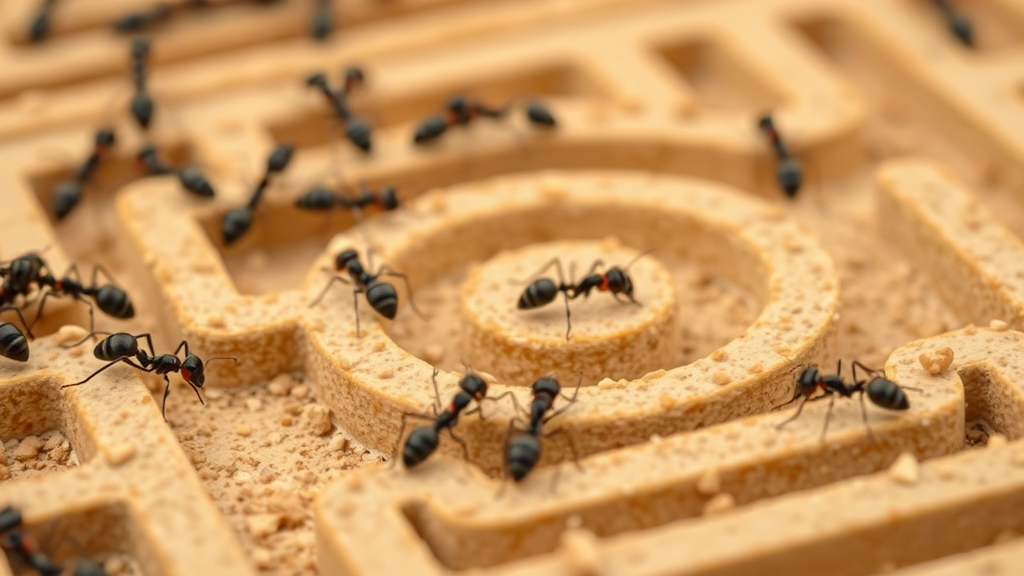
Ants are famous for their industriousness, but a new study suggests that some of their most impressive mental work happens when there is nothing to gain at all. Researchers report that the Mediterranean ant Aphaenogaster senilis can learn the layout of a maze without any reward or punishment, and that this hidden knowledge later helps them find food faster and race back to the nest more quickly. The finding, published in the journal The Science of Nature, provides some of the clearest evidence yet that a form of learning long associated with vertebrates also shapes the daily foraging decisions of a tiny-brained insect.
The phenomenon at the heart of the study is called latent learning, a concept with a storied history in psychology. Unlike classical conditioning or trial-and-error learning, latent learning requires no immediate payoff. Information about the environment is acquired and stored quietly during mere exposure, remaining invisible until a relevant incentive appears and suddenly reveals that the animal had been paying attention all along. The idea was famously demonstrated in the early twentieth century by Edward Tolman and colleagues, who showed that rats allowed to wander a maze unrewarded later performed nearly as well as rats trained with food rewards once food was finally introduced.
Latent learning has since been documented in humans, fish, and other vertebrates, and modern neuroscientists often connect it to the construction of cognitive maps, internal representations of spatial relationships that allow flexible navigation. Insects, with brains containing far fewer neurons than a rat’s, have historically been viewed as less likely candidates for such sophisticated learning, although decades of research on bee and ant navigation have steadily eroded that assumption. Desert ants, for example, learn visual landmarks during elaborate learning flights and walks, and honeybees integrate multiple navigational cues into surprisingly robust guidance systems. Whether unrewarded exploration genuinely improves later foraging performance in ants, however, remained a question in need of direct experimental testing.
Bastien Wagner of Sorbonne Paris Nord University and the University of Strasbourg, working with Patrizia d’Ettorre and István E. Maák, designed an elegantly simple experiment to address that gap. Their subject, Aphaenogaster senilis, is a ground-dwelling species that forages in open, sunny habitats where food resources appear unpredictably in space and time. That ecological context matters: when a scout cannot rely on predictable resource locations, any mechanism that extracts useful information from routine exploration could confer a substantial survival advantage, turning aimless wandering into a form of low-cost reconnaissance.
The team compared two groups of ants navigating an artificial maze to reach food. One group, the experienced ants, had previously been allowed to explore the very same maze when it was completely empty, with no food anywhere in it and no reward waiting at the end. The other group, the controls, encountered the maze for the first time only when food was present. If the ants were learning nothing during their unrewarded exposure, both groups should have performed identically once food appeared. Instead, the experienced ants located the food significantly faster than their naive nestmates, exactly the pattern predicted if they had absorbed spatial information during their earlier, reward-free visits.
The differences did not end at food discovery. After finding food for the first time, experienced ants also returned to the nest more rapidly than control ants. This second result is particularly revealing, because it shows that the benefits of prior exposure extended beyond simply finding the reward. An ant that knows the maze’s layout does not need to retrace or stumble through it when the goal shifts from food to home. The knowledge acquired during unrewarded exploration, in other words, was later deployed for flexible, goal-directed behavior, which is precisely the functional signature that defines latent learning rather than simpler stimulus-response habits.
The researchers then asked a subtler question about the individual ants themselves. Among the ants placed in the maze, some solved it and some did not, and the team wanted to know whether these successful navigators differed in their general behavioral style. Using an open-field test, a standard assay originally developed to measure exploration and anxiety-like behavior, they characterized the exploratory activity of each ant. The outcome was counterintuitive: the ants that managed to solve the maze were actually less exploratory in the open field than those that failed. Rather than the boldest adventurers being the best navigators, the more cautious individuals appeared to be the ones that cracked the spatial puzzle.
The authors interpret this pattern as a potential example of a speed-accuracy trade-off, a well-known concept in behavioral ecology describing how fast decisions often come at the cost of precision, while careful, deliberate processing yields better accuracy. Highly exploratory ants may rush through environments, sampling widely but shallowly, whereas less exploratory individuals may attend more closely to spatial details as they move. Similar results have emerged in earlier work on social insects, including studies reporting that highly active explorer ants show poorer learning performance, suggesting that a trade-off between exploration and careful information acquisition may be a recurring theme in insect cognition.
The study also adds to a growing appreciation of inter-individual variability in insect societies. Ant colonies have long been treated as superorganisms in which workers are interchangeable cogs, but research over the past two decades has revealed consistent personality-like differences among individuals in exploration, boldness, sucrose responsiveness, and task specialization. These differences can matter at the colony level; diverse colonies have been shown to be more productive in some contexts. In the case of A. senilis, a colony containing a mixture of cautious spatial learners and restless explorers may be ideally configured, with one subset solving navigational problems efficiently while the other scouts broadly for novel opportunities.
The broader implications reach into one of the liveliest debates in animal cognition: whether insects possess cognitive maps, internal spatial representations that permit novel shortcuts and flexible route planning, or whether their navigation relies on collections of simpler guidance modules such as path integration, landmark matching, and scene familiarity. Proponents of the cognitive map hypothesis point to findings like these as evidence that unrewarded experience builds genuine spatial knowledge, while critics urge caution in attributing map-like representations without stronger tests of flexible shortcutting. What the new results establish firmly, independent of that debate, is that ants benefit cognitively from exploration alone, without reinforcement, and that this benefit translates directly into measurable foraging efficiency. For an animal whose fitness depends on shuttling calories back to a colony, the ability to bank spatial information during every uneventful walk may be one of evolution’s quietest but most valuable bargains, hidden in plain sight until the moment a reward appears and the memory shows its worth.
Subject of Research: Latent learning and foraging efficiency in the ant Aphaenogaster senilis
Article Title: Latent learning improves foraging efficiency in ants
Article References: Wagner, B., d’Ettorre, P., & Maák, I. E. (2026). Latent learning improves foraging efficiency in ants. The Science of Nature, 113(5), Article 112. https://doi.org/10.1007/s00114-026-02163-7
Image Credits: AI Generated
DOI: 10.1007/s00114-026-02163-7
Keywords: latent learning, ants, Aphaenogaster senilis, foraging, navigation, maze learning, spatial learning, insect cognition, behavioral ecology, exploratory activity, speed-accuracy trade-off, animal personality
Cite Scienmag News
Gavin Prescott. (September 23, 2026). Ants Learn Mazes Without Rewards, Revealing Hidden Memory That Speeds Up Foraging. Scienmag. https://scienmag.com/ants-learn-mazes-without-rewards-revealing-hidden-memory-that-speeds-up-foraging/
Gavin Prescott. "Ants Learn Mazes Without Rewards, Revealing Hidden Memory That Speeds Up Foraging." Scienmag, 23 September 2026, https://scienmag.com/ants-learn-mazes-without-rewards-revealing-hidden-memory-that-speeds-up-foraging/. Accessed 23 September 2026.
Gavin Prescott. "Ants Learn Mazes Without Rewards, Revealing Hidden Memory That Speeds Up Foraging." Scienmag. September 23, 2026. https://scienmag.com/ants-learn-mazes-without-rewards-revealing-hidden-memory-that-speeds-up-foraging/


