


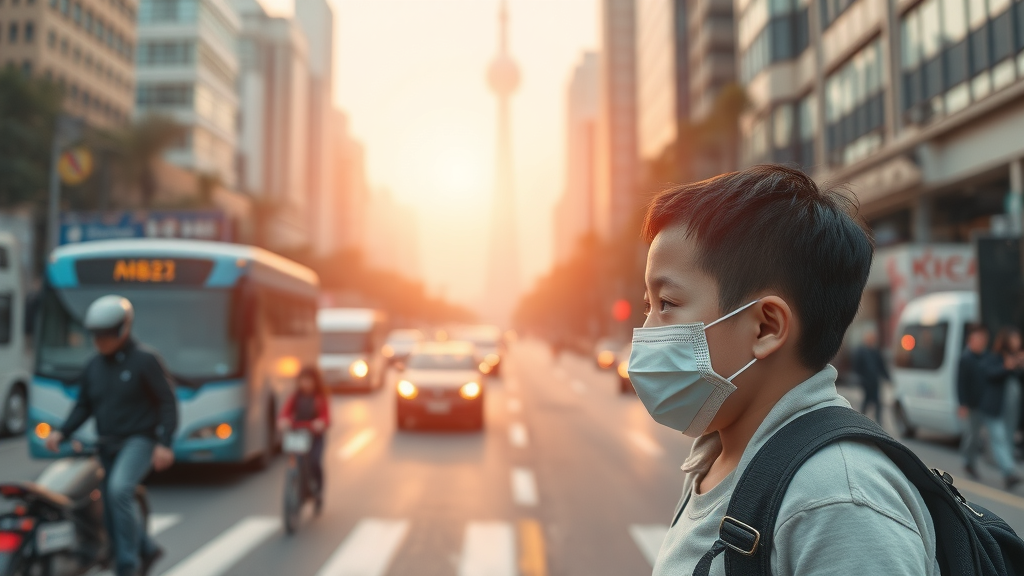
Every winter, pediatric clinics across the world fill with children coughing, wheezing, and feverish with acute respiratory infections, and public health officials have long suspected that the air those children breathe plays a role in driving them to the doctor’s door. A new time-series study from Shanghai’s Baoshan District, published in the journal Air Quality, Atmosphere & Health, adds fresh and technically detailed evidence to that suspicion. A team of researchers from the Shanghai Municipal Center for Disease Control and Prevention and the Baoshan District Center for Disease Control and Prevention examined how six criteria air pollutants and the chemical constituents of fine particulate matter relate to daily pediatric outpatient visits for respiratory illness, and their results point squarely at traffic-related pollution and specific water-soluble components of particulate matter as the culprits most consistently associated with children’s respiratory complaints.
The research team, led by co-first authors Duo Wang and Chunyang Dong under the supervision of Jianghua Zhang and Tian Chen, focused on a distinction that is often blurred in everyday conversation but is clinically meaningful: the difference between acute upper respiratory infections, abbreviated AURI, and acute lower respiratory infections, or ALRI. Upper respiratory infections encompass the common cold, pharyngitis, and similar ailments of the nose and throat, while lower respiratory infections include bronchitis and pneumonia, conditions that carry far greater global disease burden. According to recent analyses from the Global Burden of Disease Study 2021, both categories rank among the leading infectious causes of illness in children worldwide, which makes identifying modifiable environmental triggers a matter of considerable public health urgency.
Methodologically, the study harnessed the statistical machinery of generalized additive models, a flexible regression framework that has become a workhorse of air pollution epidemiology. The approach allows researchers to model daily counts of outpatient visits as a function of pollutant concentrations while simultaneously controlling for smooth, nonlinear trends in time, day of the week, and weather variables such as temperature and humidity. This matters because respiratory disease incidence follows strong seasonal rhythms driven by viral circulation and meteorology, and any credible analysis must disentangle those rhythms from the independent contribution of pollution. The team applied the framework to daily data from 2018 to 2019, linking pollutant measurements to outpatient visit counts classified by ICD-10 diagnostic codes for total respiratory diseases, AURI, and ALRI.
The findings on gaseous and particulate pollutants were striking in their specificity. Nitrogen dioxide and carbon monoxide, both hallmarks of combustion sources and especially of vehicular traffic, showed statistically significant positive associations with outpatient visits for total respiratory diseases and for acute upper respiratory infections. Particulate matter with an aerodynamic diameter of ten micrometers or less, known as PM10, was significantly associated with visits for both upper and lower respiratory infections, whereas the finer PM2.5 fraction, particles smaller than 2.5 micrometers, was significantly associated only with upper respiratory infections. Sulfur dioxide and ozone, by contrast, did not emerge as significant predictors in the main analysis, a pattern that may reflect the moderate concentration ranges typical of a coastal Chinese city that has implemented aggressive air quality controls over the past decade.
What elevates this study beyond many of its predecessors is its attention to the chemical anatomy of PM2.5. Fine particulate matter is not a single substance but a heterogeneous mixture whose toxicity depends on what, exactly, the particles are made of. The researchers analyzed water-soluble ions, including nitrate, ammonium, and sulfate, along with metal and metalloid components, and tested whether each constituent tracked with pediatric respiratory visits. In analyses based on a limited, non-continuous sampling framework comprising 174 sampling days, two ions stood out: nitrate and ammonium were significantly associated with outpatient visits for both total respiratory diseases and acute lower respiratory infections, while sulfate was significantly associated with lower respiratory infections alone. Notably, none of the measured metal or metalloid components showed statistically significant associations.
The identity of the significant ions is itself informative. Nitrate and ammonium in fine particles are largely secondary pollutants, formed in the atmosphere when nitrogen oxides from vehicle exhaust and industrial combustion react with ammonia, and their prominence in this study reinforces the signal already suggested by nitrogen dioxide and carbon monoxide. In other words, two independent lines of evidence, the gaseous tracer pollutants and the secondary inorganic aerosol constituents, converge on the same source category: combustion, and traffic in particular. Sulfate, which arises primarily from sulfur dioxide emissions associated with coal combustion and industrial processes, showed a narrower association restricted to lower respiratory infections, consistent with laboratory evidence that acidic and sulfate-rich particles provoke deeper lung inflammation.
Biologically, these results fit a coherent mechanistic picture. Fine particles penetrate deep into the respiratory tract, with the smallest fractions depositing in the bronchioles and alveoli, where they can trigger oxidative stress and inflammatory cascades. Experimental work has shown that acute nitrogen dioxide exposure enhances airway inflammation by modulating the balance between Th1 and Th2 immune responses and activating the JAK-STAT signaling pathway, effectively priming the airways for the viral infections that cause most acute respiratory illness. Children are particularly vulnerable because their airways are narrower, their immune systems are still maturing, and they breathe a greater volume of air per unit of body weight than adults, so a given ambient concentration delivers a proportionally larger dose to developing lungs.
The study’s authors are appropriately candid about its limitations, and the most important one concerns the constituent data. Because PM2.5 chemical speciation was available only on 174 non-continuous sampling days rather than every day of the study period, the component analyses rest on a smaller and less statistically powerful foundation than the pollutant analyses. The researchers also note that the study period of 2018 to 2019 predates the COVID-19 pandemic, and that outpatient visit records reflect healthcare-seeking behavior as well as underlying disease incidence, a factor that can vary with parental habits and access to care. Sensitivity analyses were conducted to probe the robustness of the main findings, and the core associations with nitrogen dioxide, carbon monoxide, and particulate matter held up under those checks.
Even with those caveats, the implications for policy are reasonably direct. The authors conclude that evaluations of the short-term respiratory health effects of ambient air pollution in children should consider PM2.5 chemical composition, not merely PM2.5 mass concentrations and gaseous pollutant levels. That recommendation carries weight for regulatory design: if nitrate and ammonium, both products of nitrogen oxide and ammonia chemistry, are the constituents doing much of the harm, then strategies targeting vehicle emissions, such as tighter exhaust standards, electrification of fleets, and control of ammonia from agricultural and industrial sources, may yield respiratory health dividends that a mass-based standard alone would fail to capture. Baoshan District, an industrial and port area of Shanghai, offers a telling test case for such interventions.
For parents and clinicians, the study adds to a growing body of evidence that bad air days and sick-child days are connected, particularly for the upper respiratory infections that account for the bulk of pediatric clinic visits. It joins a chorus of recent time-series analyses from Chinese cities and beyond, including work linking fine particles to childhood pneumonia emergency visits in Taiwan, to lower respiratory infection hospitalizations in Korea, and to respiratory syncytial virus hospitalizations in Poland. As monitoring networks expand to measure particle chemistry alongside particle mass, the picture of which pollutants sicken children, and where the most effective control levers lie, will only sharpen. In Shanghai’s case, the answer emerging from the data is clear: the traffic-sourced gases and the secondary particles they seed are the components most tightly woven into the fabric of children’s respiratory illness.
Subject of Research: Associations between ambient air pollutants, PM2.5 chemical components, and pediatric outpatient visits for acute respiratory infections in Shanghai
Article Title: Association of air pollutants and PM2.5 components with pediatric outpatient visits for acute respiratory infections in Baoshan District, Shanghai
Article References: Wang, D., Dong, C., Yang, C., Shi, Y., Chen, F., Wu, Z., Liu, M., Shen, X., Chen, T., & Zhang, J. (2026). Association of air pollutants and PM2.5 components with pediatric outpatient visits for acute respiratory infections in Baoshan District, Shanghai. Air Quality, Atmosphere & Health, 19(10), Article 212. https://doi.org/10.1007/s11869-026-02106-1
Image Credits: AI Generated
DOI: 10.1007/s11869-026-02106-1
Keywords: air pollution, PM2.5, nitrogen dioxide, carbon monoxide, PM2.5 components, children, acute respiratory infections, upper respiratory infection, lower respiratory infection, time-series analysis, Shanghai, public health
Cite Scienmag News
Russell Cooper. (September 23, 2026). Traffic Gases and Particle Chemistry Linked to Children’s Respiratory Infections in Shanghai Study. Scienmag. https://scienmag.com/traffic-gases-and-particle-chemistry-linked-to-childrens-respiratory-infections-in-shanghai-study/
Russell Cooper. "Traffic Gases and Particle Chemistry Linked to Children’s Respiratory Infections in Shanghai Study." Scienmag, 23 September 2026, https://scienmag.com/traffic-gases-and-particle-chemistry-linked-to-childrens-respiratory-infections-in-shanghai-study/. Accessed 23 September 2026.
Russell Cooper. "Traffic Gases and Particle Chemistry Linked to Children’s Respiratory Infections in Shanghai Study." Scienmag. September 23, 2026. https://scienmag.com/traffic-gases-and-particle-chemistry-linked-to-childrens-respiratory-infections-in-shanghai-study/


