


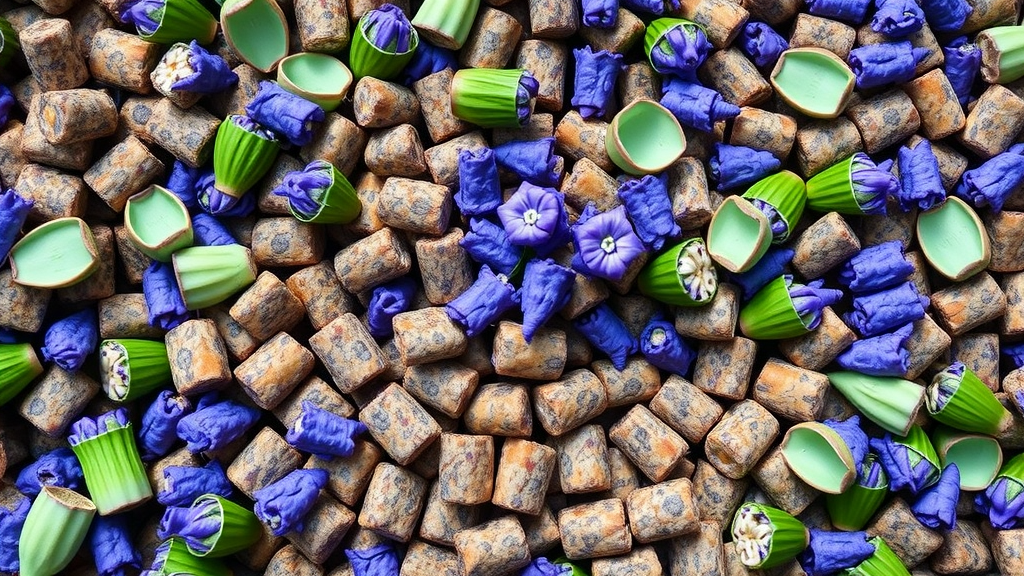
On the shorelines of Lake Abaya and Lake Chamo in southern Ethiopia, a fast-growing aquatic invader is being transformed from an ecological menace into household fuel. A team of researchers at Arba Minch University has shown that water hyacinth, one of the world’s most destructive invasive aquatic plants, can be harvested, carbonized, and pressed into briquettes that burn with promising efficiency, offering a dual solution to a stubborn environmental problem and a pressing energy need. The findings, published in BMC Environmental Science, suggest that the very weed choking these Rift Valley lakes could become a renewable alternative to firewood and charcoal for communities that depend on them.
Water hyacinth, Eichhornia crassipes, is a free-floating perennial macrophyte native to the Amazon Basin, and it is widely ranked among the ten worst weeds on the planet. In nutrient-enriched tropical and subtropical freshwater bodies, its growth is explosive: dense mats spread across the surface, blocking sunlight from penetrating to submerged vegetation and destabilizing entire aquatic food webs. As the enormous biomass dies and decomposes, microbial consumption of oxygen drives waters toward hypoxia, suffocating fish populations and eroding biodiversity. The plant also accelerates water loss through evapotranspiration and creates breeding grounds for mosquitoes and snails, the vectors of malaria, filariasis, and schistosomiasis, placing heavy public health burdens on lakeside communities.
The socioeconomic toll is equally severe. Infestations hinder fishing, obstruct irrigation canals, clog hydropower turbines, and restrict boat transport, while tourism suffers as scenic waterways disappear beneath a green carpet. In Ethiopia, the problem has become acute at Lake Abaya and Lake Chamo, where the weed threatens both aquatic biodiversity and the livelihoods of people who rely on the lakes. Decades of mechanical, chemical, and biological control have failed to deliver sustainable management, prompting researchers to reframe the invader as a potential bioresource. Its rapid growth, large biomass yield, and stress resilience make it attractive for phytoremediation, and studies have demonstrated its ability to accumulate heavy metals from industrial wastewater, including effluents from pulp and paper, textile, and dairy operations. That bioremediation capacity, combined with its potential for carbon sequestration and renewable energy generation, has fueled renewed interest in converting the weed into something useful.
The research team harvested mature water hyacinth stems from the shorelines of both lakes, with species identity confirmed by a plant taxonomist at Arba Minch University’s Botany Laboratory using standard botanical references. Roots and leaves were removed, the stems were chopped into small pieces, and the material was sun-dried for three weeks at the Abaya campus before being reduced to fragments less than one centimeter long and half a centimeter wide, ready for carbonization. The dried biomass was then carbonized in a barrel carbonizer maintained at an average temperature of 425 degrees Celsius, with surface temperatures monitored using a digital thermometer. The resulting charcoal was retrieved into a sealed steel container to cool, a step designed to prevent ash formation and preserve charcoal quality for the briquetting stage.
To shape the charcoal into usable fuel, the team built a manually operated piston-press briquette machine from metal, incorporating wrought iron, cast iron, and galvanized iron components. The device comprises a main stand, four compaction chambers where pistons compress the pulverized feedstock, a perforated base plate that drains excess water, pressure-transmitting piston cylinders welded to the plate, and a handle and bearing assembly that drives the screw shaft. Two organic binders were tested against the carbonized hyacinth: molasses obtained from the Wonji Shoa Sugar Factory of the Ethiopian Sugar Corporation, dissolved in water to the desired concentration, and plantain peel powder collected from the local community, washed, sun-dried for two weeks, and ground before mixing. Six formulations were produced at blending ratios of 60:40, 70:30, and 80:20 of water hyacinth to binder, labeled samples A through F.
The briquettes were then subjected to a battery of standardized tests following ASTM D1762-84 protocols, covering moisture content, volatile matter, ash content, and fixed carbon, alongside measurements of bulk density, compressive strength, burning rate, and emissions of fine and coarse particulate matter, carbon monoxide, hydrogen sulfide, and oxygen. Elemental composition was determined by X-ray fluorescence spectroscopy using an ORTEC multichannel analyzer with a silicon-lithium semiconductor detector and a plutonium-238 radionuclide source, with acquisition times fixed at 2000 seconds. Statistical analysis with XLSTAT software applied non-parametric Kruskal-Wallis tests followed by Dunn’s multiple pairwise comparisons, with significance set at P ≤ 0.05.
The results delivered a clear verdict on binder choice. Molasses-bound briquettes, samples A, B, and C, showed substantially lower moisture content, ranging from 30.97 to 37.12 percent, compared with the plantain peel formulations, which ranged from 66.54 to 87.48 percent. Ash content followed the same pattern: molasses briquettes registered 27.09 to 28.83 percent, while plantain peel briquettes climbed to 34.97 to 36.38 percent. Because moisture and ash act as impurities in solid biofuel, absorbing heat during combustion and physically obstructing oxygen flow, their reduction translated directly into better burning performance. The molasses-bound samples achieved fixed carbon levels of 20.48 to 25.75 percent and burning rates of 101.61 to 133.14 grams per minute, dwarfing the plantain peel counterparts, which managed only 3.75 to 7.57 percent fixed carbon and burning rates between 4.85 and 10.52 grams per minute. Sample A, with 60 percent water hyacinth and 40 percent molasses, posted the highest burning rate and the highest bulk density at 0.59 grams per cubic centimeter, while sample F, at 80 percent hyacinth with plantain peel, recorded the lowest values across the board.
Emissions testing in a closed room using a QRAE II multi-gas detector revealed important nuances. Sample D, rich in plantain peel, produced the highest concentrations of PM2.5 at 86.33 micrograms per cubic meter, PM10 at 251.00 micrograms per cubic meter, and carbon monoxide at 34 parts per million, while sample C, 80 percent hyacinth with 20 percent molasses, was the cleanest performer. The elevated particulate loads in the plantain peel formulations correlated strongly with their higher concentrations of inorganic elements. X-ray fluorescence analysis showed that calcium, iron, potassium, and sulfur were all more abundant in samples D, E, and F, with calcium reaching tens of thousands of parts per million in the plantain peel briquettes compared with roughly 1,200 to 2,200 ppm in the molasses samples. The researchers traced a strong positive relationship between potassium and calcium levels and particulate emissions: potassium volatilizes during combustion and condenses as fine particles that contribute heavily to PM2.5, while less volatile calcium generates fly ash and coarser PM10 fractions as its minerals decay. Encouragingly, carbon monoxide levels across all samples remained well below the Occupational Safety and Health Administration’s permissible exposure limit of 50 ppm over an eight-hour workday, oxygen concentrations stayed within the safe indoor combustion threshold of 19.5 percent, and no hydrogen sulfide was detected in any sample, marking the briquettes as comparatively clean and health-friendly fuels.
The elemental chemistry also shaped the study’s practical recommendations. Moderate calcium content may improve thermal reflectivity and combustion efficiency, but excessive calcium signals ash formation that complicates residue management and stove maintenance. Elevated iron in the plantain peel samples, peaking at 5,873.73 ppm in sample D, may further correlate with the higher particulate emissions recorded for that group, since metals in fly ash influence both the physicochemical properties of emissions and their potential health impacts. Sulfur, which can generate sulfur dioxide during combustion, was lowest in sample A and highest in sample F, again favoring the molasses-bound formulations. The findings align with prior literature showing that high concentrations of alkali and alkaline earth metals in biomass can degrade combustion performance and increase emissions, and they echo earlier work on water hyacinth molasses blends and on briquettes derived from banana peels, pineapple peels, and other agricultural residues.
Taken together, the study positions water hyacinth briquetting as a strategy that attacks an invasive species problem from two directions at once. Removing biomass from Lake Abaya and Lake Chamo directly combats blooming and its ecological and public health consequences, while the harvested material displaces conventional wood fuel, easing pressure on forests and providing an affordable energy option for developing regions. The superior performance of molasses-bound briquettes underscores that binder selection is as decisive as feedstock in densified biofuel design, and the researchers emphasize that continued advances in this area could deliver energy that is affordable, environmentally sound, and socially responsible while simultaneously addressing waste management concerns. For the communities around Ethiopia’s Rift Valley lakes, the message is striking: the weed that has long defined their waterways may yet become a resource that helps restore them.
Subject of Research: Conversion of invasive water hyacinth biomass from Ethiopian lakes into charcoal briquettes as an alternative energy source
Article Title: Utilization of water hyacinth briquette as an alternative energy source to combat blooming in Abaya and Chamo Lakes, Ethiopia
Article References: Debel, G. L., Ibrahim, R., Mamo, A., Zewdie, Y., Lema, N. K., Syraji, Y., Fetane, S., & Fekadu Andeta, A. (2026). Utilization of water hyacinth briquette as an alternative energy source to combat blooming in Abaya and Chamo Lakes, Ethiopia. BMC Environmental Science, 3(1), Article 5. https://doi.org/10.1186/s44329-025-00044-4
Image Credits: AI Generated
DOI: 10.1186/s44329-025-00044-4
Keywords: water hyacinth, briquettes, invasive species, bioenergy, Lake Abaya, Lake Chamo, Ethiopia, carbonization, molasses binder, particulate matter, combustion, renewable energy
Cite Scienmag News
Sloane Callahan. (September 23, 2026). Turning Water Hyacinth Into Fuel Briquettes to Save Ethiopian Lakes. Scienmag. https://scienmag.com/turning-water-hyacinth-into-fuel-briquettes-to-save-ethiopian-lakes/
Sloane Callahan. "Turning Water Hyacinth Into Fuel Briquettes to Save Ethiopian Lakes." Scienmag, 23 September 2026, https://scienmag.com/turning-water-hyacinth-into-fuel-briquettes-to-save-ethiopian-lakes/. Accessed 23 September 2026.
Sloane Callahan. "Turning Water Hyacinth Into Fuel Briquettes to Save Ethiopian Lakes." Scienmag. September 23, 2026. https://scienmag.com/turning-water-hyacinth-into-fuel-briquettes-to-save-ethiopian-lakes/


