


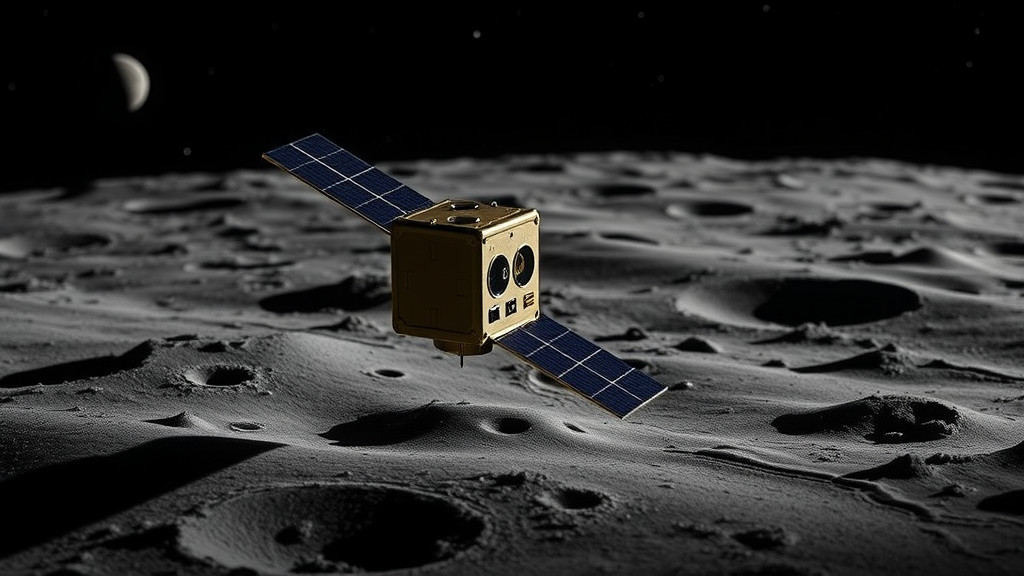
When NASA announced in March its plans to build humanity’s first long-term base at the lunar South Pole, the agency highlighted an engineering problem that has haunted lunar mission planners for decades: keeping the lights on. The polar region, chosen for its promising deposits of water ice, sees stretches of nearly two weeks of continuous darkness at a time. During those long lunar nights, surface solar panels become useless, and any interruption to power could be catastrophic for life support systems, right down to the oxygen supply that would keep a crew alive. A team of undergraduates led by the New Jersey Institute of Technology believes it has an answer, and NASA has just rewarded the idea with one of its newest and most competitive student prizes.
The six-member team, known as Star Maker, traveled to Houston in July to pitch at NASA’s first-ever ORBIT Challenge, a student competition designed to crowdsource fresh ideas for the agency’s exploration goals. The competition drew hundreds of university entries nationwide, from which 20 teams were selected as finalists across two tracks. Star Maker competed in the Space Track and walked away with a $15,000 prize for its Orbital Solar Energy Harvesting Swarm, or OSEHS, a constellation of autonomous satellites that would collect solar energy in space and relay it to receivers on the lunar surface using microwave beams. The concept deliberately moves the power source off the Moon entirely, sidestepping the two-week darkness problem that makes surface solar power untenable at the pole.
Tatiana Mejia, an NJIT mechanical engineering student in the class of 2027 who conceived the project, argues that the idea sounds more futuristic than it actually is. In her view, the individual pieces of the system already exist in some form, and the real challenge lies in pushing them forward and integrating them at scale. She points to swarm robotics as the key enabling technology, noting that a distributed swarm can complete its mission even when individual units fail. In the space environment, she emphasizes, that kind of resilience is not a luxury but a requirement, because a single fault can endanger everyone involved. It is a philosophy she knows well: Mejia previously developed a swarm robotics concept that earned a $10,000 NASA grant, and she had spent three years working in NJIT’s Swissler Innovative Robotics Lab before the lunar power idea began taking shape in fall 2025.
The team assembled organically around that seed of an idea. Mejia began working with fellow NJIT mechanical engineering student Natalie Kiwanian and Jennifer Salto, a mechanical engineering student at Stevens Institute of Technology, after Salto discovered the newly announced ORBIT Challenge. The trio then recruited specialists to fill the technical gaps. Kevin Gutama, an NJIT electrical engineering alumnus now working at GE Aerospace, took on power distribution. KesUranNu Baylor, an NJIT physics student with orbital mechanics experience from a NASA Goddard internship, handled the trajectories. Andrea Yanez Soto, also from NJIT, modeled how the swarm would communicate. The result was an unusually complete undergraduate team, pairing mechanical, electrical and physics expertise with hands-on robotics experience.
Their proposed architecture is ambitious in scale. The team envisions a network of roughly 1,100 autonomous satellites, each about six feet wide, operating in an agile formation. Some units would orbit closer to the Sun, harvesting sunlight where the solar flux is far more intense than in Earth’s neighborhood, while others would relay that collected energy inward, beaming it by microwave to receivers on the lunar surface to provide continuous power regardless of the Moon’s day-night cycle. The physics behind the choice of location is straightforward: capturing even a tiny fraction of the Sun’s raw output dwarfs humanity’s entire energy consumption. As Mejia puts it, harnessing just 0.01 percent of the Sun’s raw power would exceed current global energy demands by a factor of roughly two billion.
Crucially, the team did not stop at concept sketches. They built simulations and physical prototypes to demonstrate that their swarm could survive the harsh realities of deep space operations. In one simulation, 12 units orbiting the Sun in a formation the team describes as a pearl necklace showed how the constellation could recover from individual satellite failures without any intervention from Earth, redistributing tasks among the surviving units. Gutama notes that much of this work went beyond what NASA actually required of entrants. The simulation, the prototypes and the elaborate presentation display were all self-imposed efforts, driven by the team’s desire to show that they could genuinely compete and that their vision was technically grounded rather than merely aspirational.
The run-up to the competition tested the team’s endurance as much as its engineering. The day before their flight to Houston, members were at NJIT past midnight applying final touches to their materials, and Kiwanian recalls going almost two days without sleep. Once at NASA’s Johnson Space Center, the finalists spent a week touring the facilities and meeting space scientists, engineers and entrepreneurs before presentation day arrived. At the Pitch Showcase on the final day, each team had 15 minutes to present everything they had built since February. Kiwanian remembers Baylor explaining how the swarm could use the gravity of Venus to bring the constellation closer to the Sun, a gravitational assist maneuver of the kind mission designers have used for decades to reshape spacecraft orbits without expending propellant. Midway through the explanation, she noticed the chief scientist of the International Space Station Program nodding along, a moment she took as a very good sign.
For Baylor, the experience was as much about personal and intellectual growth as it was about the prize. He describes how his applied understanding of everything he had learned at NJIT, particularly how physical bodies move in space, accelerated dramatically through the project, and how bringing the work to NASA and discussing it with the people there made him feel he had truly grown as a physicist. That sense of validation extended to the judging panel itself. Mejia recalls that the judges, who ranged from JPMorgan representatives to NASA engineers, encouraged the team not to treat OSEHS as just a paper concept for the agency but to actually make it happen after the competition. That advice appears to have landed.
Back from Houston, the six members split the $15,000 prize evenly, $2,500 apiece, but the project is far from over. Star Maker intends to turn OSEHS into a startup venture, and interestingly, the team’s first market may not be the Moon at all. Kiwanian suggests the technology could help data center developers power new sites by reducing their burden on the electrical grid, addressing the enormous and rapidly growing energy appetite of generative artificial intelligence. The team is applying to the National Science Foundation’s I-Corps program for customer discovery training and has set its sights on NASA TechLeap, a prize program that could provide up to $500,000 to build and test actual hardware. Mejia says the ORBIT Challenge made the idea real for the team, and the next step is raising money to create a prototype and launch the startup.
Behind the technical ambition lies a broader motivation that the team returns to repeatedly. For Mejia, space exploration has always been about looking at the big picture, not continents and not skin color, but bringing humanity together. She argues that if humanity wants to avoid exhausting Earth’s resources, collaboration as one species is essential, and that conviction is what continues to inspire the team’s work together. Whether OSEHS satellites eventually beam power across cislunar space or first help terrestrial data centers lighten their load on the grid, the Star Maker team has demonstrated something that competitions like the ORBIT Challenge were designed to find: a bold idea, validated by simulation and prototype, carried forward by students determined to see it through from concept to hardware.
Subject of Research: A student-designed orbital solar energy harvesting satellite swarm for supplying continuous microwave-beamed power to a lunar base
Article Title: NJIT students’ plan to power the moon with swarm robots wins NASA prize
Article References: NJIT students’ plan to power the moon with swarm robots wins NASA prize. (n.d.). Original publication
Image Credits: AI Generated
DOI: Not provided
Keywords: NASA ORBIT Challenge, lunar South Pole, space solar power, swarm robotics, microwave power beaming, NJIT, satellite constellation, orbital mechanics, lunar base power, OSEHS, NASA TechLeap, student aerospace competition
Cite Scienmag News
Grant Pearson. (September 23, 2026). Student-built satellite swarm wins NASA prize for beaming solar power to the Moon. Scienmag. https://scienmag.com/student-built-satellite-swarm-wins-nasa-prize-for-beaming-solar-power-to-the-moon/
Grant Pearson. "Student-built satellite swarm wins NASA prize for beaming solar power to the Moon." Scienmag, 23 September 2026, https://scienmag.com/student-built-satellite-swarm-wins-nasa-prize-for-beaming-solar-power-to-the-moon/. Accessed 23 September 2026.
Grant Pearson. "Student-built satellite swarm wins NASA prize for beaming solar power to the Moon." Scienmag. September 23, 2026. https://scienmag.com/student-built-satellite-swarm-wins-nasa-prize-for-beaming-solar-power-to-the-moon/


