


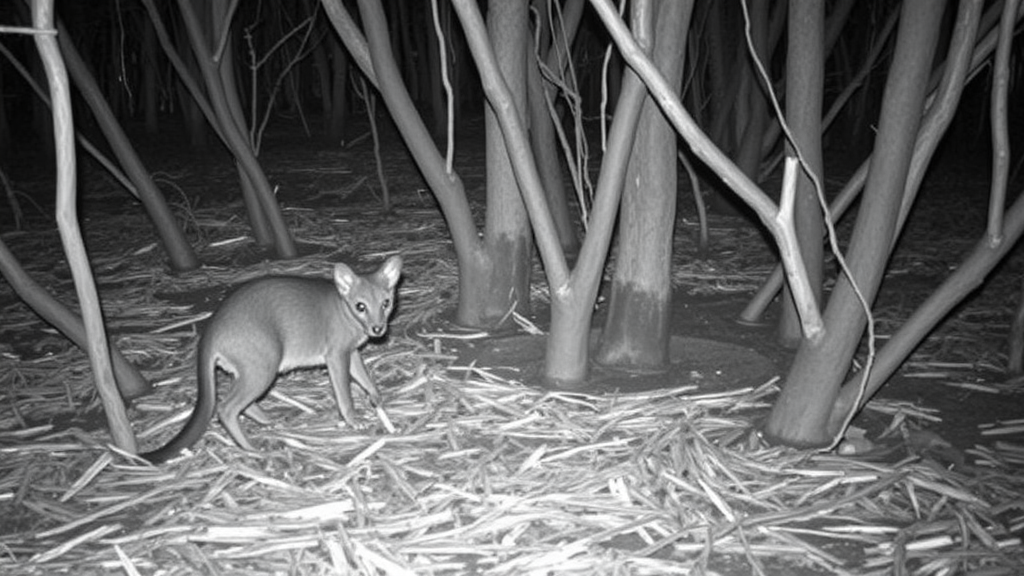
Deep in the mangrove forests of coastal Cambodia, some of Southeast Asia’s most threatened and least understood mammals are quietly disappearing from parts of a landscape that was supposed to be their refuge. A new seven-year camera-trap study has produced the first rigorous occupancy baselines and temporal trends for a community of elusive species in the mangroves of Peam Krasop Wildlife Sanctuary and the Koh Kapik Ramsar Site, and the results are sobering: four threatened species—the long-tailed macaque, large-spotted civet, fishing cat and smooth-coated otter—showed measurable declines in occupancy between 2017 and 2023.
The research, published in Ecology and Evolution, combined more than 26,000 camera-trap nights of continuous monitoring with a hierarchical multi-species occupancy model capable of extracting reliable information even for species that are so rare or cryptic that they are barely caught on camera. The study targeted a suite of globally threatened mammals for which ecological information remains extremely limited: the Critically Endangered Sunda pangolin, the Endangered hairy-nosed otter, large-spotted civet and long-tailed macaque, and the Vulnerable fishing cat and smooth-coated otter. Two more common species, the leopard cat and common palm civet, were included to represent the full mangrove mammal community and to strengthen inference for the rarer species through information sharing in the statistical model.
Peam Krasop and Koh Kapik, located in Koh Kong province in southwest Cambodia, harbor one of the largest and densest remaining mangrove forests in Southeast Asia. The protected areas together cover roughly 357 square kilometers of fringe, back and mixed mangrove, along with adjacent Melaleuca swamp forest and semi-evergreen forest. The study focused on approximately 150 square kilometers of this coastal and riverine habitat. Local communities depend heavily on fishing, crabbing and historically charcoal production, and the landscape faces pressures from overexploitation of wildlife and forest products, land clearance, illegal hunting and fishing. This mosaic of relatively intact habitat interspersed with human activity made the area an ideal natural laboratory for examining how threatened mammals respond to varying levels of human disturbance.
Between February 2017 and December 2023, the research team deployed between 20 and 30 cameras each year, at an average of 111 days of sampling per year, at a total of 156 geographically independent locations arranged on an approximate 1.5-kilometer grid designed around the home range of a fishing cat. Cameras recorded photographic captures at 24-hour intervals, generating detection and nondetection histories for each species at each site in each year. Every photograph of a person or dog was also tallied, providing a direct measure of human activity on the landscape while remaining sensitive to the privacy of people captured in the images.
The analytical heart of the study was a multi-species site-occupancy model, a Bayesian framework that jointly estimates two hidden quantities: whether a species truly occupies a site, and the probability of detecting it if it does. This distinction matters enormously for rare species. A Sunda pangolin photographed at only two sites across seven years almost certainly occurs more widely than the raw records suggest, and the hierarchical model allows information from the whole community to correct for imperfect detection. The team compared candidate model structures using leave-one-out cross-validation, standardized all continuous covariates, log-transformed distances, and guarded against spurious associations by excluding redundant predictor pathways. The final model ran three Markov chain Monte Carlo chains for one million iterations, producing 285,000 posterior samples per parameter, with convergence confirmed by standard diagnostics. All data and code were released in a public Zenodo repository.
The resulting estimates painted a detailed portrait of the community. Long-tailed macaques, detected at 101 of the 156 camera locations, showed the highest occupancy at roughly 0.61, followed by intermediate values for the fishing cat, common palm civet, smooth-coated otter and leopard cat. Large-spotted civets, hairy-nosed otters and Sunda pangolins had low occupancy, with the pangolin’s estimate the lowest and most uncertain of all. Detection probabilities varied even more dramatically: smooth-coated otters were by far the most detectable species, while the fishing cat and Sunda pangolin had detection probabilities so low—and so uncertain—that only long-term monitoring could hope to track their populations reliably.
Habitat associations emerged as a central finding. All eight species showed increasing occupancy probability with greater tree cover, a community-level effect indicating that structurally complex forest benefits multiple species simultaneously. Beyond that shared pattern, each species told its own story. The two otter species were more likely to occupy sites closer to water, but they used the landscape differently: smooth-coated otters occupied both fringe and mixed mangroves, while the hairy-nosed otter showed a stronger association with riverine mixed mangrove habitat. Fishing cats and long-tailed macaques favored back-mangrove areas without necessarily hugging watercourses. Large-spotted civets showed their strongest association with Melaleuca swamp forest, reinforcing evidence from elsewhere in Cambodia that the species depends on large blocks of undisturbed natural habitat.
Perhaps the most counterintuitive result concerned distance to villages. Fishing cats, smooth-coated otters and long-tailed macaques were all more likely to occupy sites near human settlements, a pattern the authors interpret as spatial tolerance rather than attraction, noting that the effects were modest and carried wide credible intervals. These species are known from other studies to persist, and even thrive, in human-modified landscapes. By contrast, the hairy-nosed otter, large-spotted civet and Sunda pangolin were more likely to occur farther from villages, consistent with their rarity and apparent sensitivity to human presence. For these three species, the results point directly to where conservation surveys and protections should be focused.
The temporal trends are where the study delivers its most urgent message. Over the seven survey years, occupancy declined for the Endangered long-tailed macaque and large-spotted civet, and for the Vulnerable fishing cat and smooth-coated otter. The leopard cat, hairy-nosed otter and Sunda pangolin remained statistically stable, while the common palm civet—an adaptable generalist—increased. The authors suggest the civet’s rise alongside the fishing cat’s fall may reflect mesopredator release, a well-documented ecological phenomenon in which smaller carnivores expand when larger predators that kill or intimidate them decline. The study period also overlapped the COVID-19 pandemic, when deforestation and poaching increased across Cambodia and other tropical countries as urban migrants returned to rural areas, and indiscriminate snaring remains an acute threat to wildlife nationwide.
The authors are careful about what occupancy can and cannot show. These estimates describe patterns of site use, not demographic viability, and the analysis cannot attribute declines to specific causes. They also caution that coexistence with people in space does not guarantee safety: during the study, an otter cub and a fishing cat were killed in confrontations with dogs, which roam from villages into the mangroves and may accompany poachers, and dogs can transmit diseases to otters and other carnivores.
Conservation implications flow directly from the findings. Because threatened species rely on the full spectrum of mangrove-associated habitats, protecting Melaleuca swamp forests and riverine mixed mangroves is as important as safeguarding the mangroves themselves. The researchers call for effective habitat protection and restoration, stronger anti-poaching enforcement, responsible dog ownership policies that limit dogs’ access to mangroves, and greater financial and technical support for Cambodia’s protected areas. They highlight community-based approaches—engaging local organizations in patrolling, promoting sustainable livelihoods, community ecotourism, and innovative financing such as a Conservation Basic Income funded through carbon credits or payments for ecosystem services—as pathways to durable conservation. Mechanisms such as REDD+ or Blue Carbon initiatives, they argue, could provide a sustainable finance framework linking habitat protection with local wellbeing.
Above all, the study demonstrates the irreplaceable value of long-term monitoring for species that are simply too rare and too elusive to study any other way. Baselines like these—quantitative, peer-reviewed, and grounded in seven years of field data—provide the yardstick against which future conservation interventions in one of Southeast Asia’s most important mangrove landscapes can finally be measured. Follow-up monitoring conducted annually, the authors say, will reveal whether the declines they documented can be reversed, or whether these mangrove refuges will continue to quietly lose their most vulnerable residents.
Subject of Research: Occupancy and population trends of threatened mammal communities in Southeast Asian mangrove forests
Article Title: Occupancy Baselines and Temporal Trends of Threatened Mammal Communities in Southeast Asian Mangroves
Article References: Herranz Muñoz, V., Sophatt, R., Roth, V., Tantipisanuh, N., Gale, G. A., & Jiménez, J. (2026). Occupancy Baselines and Temporal Trends of Threatened Mammal Communities in Southeast Asian Mangroves. Ecology and Evolution, 16(9), Article e74391. https://doi.org/10.1002/ece3.74391
Image Credits: AI Generated
DOI: 10.1002/ece3.74391
Keywords: mangroves, Cambodia, camera-trap, occupancy modeling, Sunda pangolin, fishing cat, hairy-nosed otter, large-spotted civet, multi-species model, tree cover, poaching, conservation
Cite Scienmag News
Margaret Porter. (September 23, 2026). Seven-Year Camera-Trap Study Reveals Declining Threatened Mammals in Cambodian Mangroves. Scienmag. https://scienmag.com/seven-year-camera-trap-study-reveals-declining-threatened-mammals-in-cambodian-mangroves/
Margaret Porter. "Seven-Year Camera-Trap Study Reveals Declining Threatened Mammals in Cambodian Mangroves." Scienmag, 23 September 2026, https://scienmag.com/seven-year-camera-trap-study-reveals-declining-threatened-mammals-in-cambodian-mangroves/. Accessed 23 September 2026.
Margaret Porter. "Seven-Year Camera-Trap Study Reveals Declining Threatened Mammals in Cambodian Mangroves." Scienmag. September 23, 2026. https://scienmag.com/seven-year-camera-trap-study-reveals-declining-threatened-mammals-in-cambodian-mangroves/


