


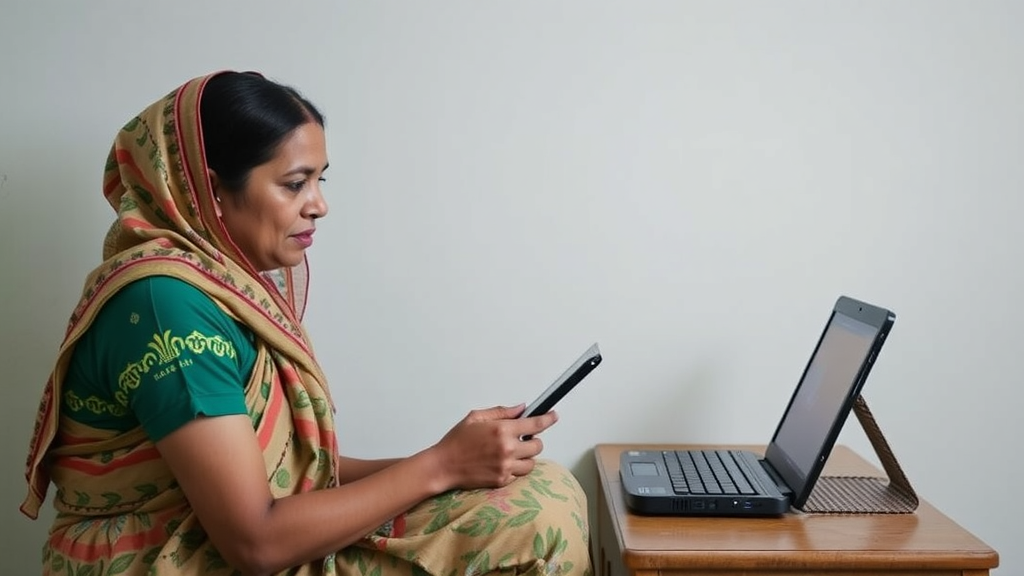
The rapid spread of mobile phones and internet access across South Asia has transformed daily life for millions of women, but the mental health consequences of this digital revolution remain poorly understood, particularly in low- and middle-income countries where most of the world’s internet growth is now occurring. A new nationally representative study from Bangladesh offers one of the most detailed portraits yet of how digital connectivity relates to depression and anxiety among women, and its findings challenge the simple assumption that being online is uniformly beneficial or uniformly harmful. Instead, the research reveals a complicated picture in which the risks and protections of digital life shift dramatically depending on whether a woman lives in a rural village or a dense urban neighborhood, and even on which administrative division of the country she calls home.
The study, published in Discover Mental Health, was conducted by Md Salek Miah and Md Jamal Uddin of the Biostatistics, Epidemiology, and Public Health Research Team in the Department of Statistics at Shahjalal University of Science and Technology in Sylhet, Bangladesh. The researchers drew on data from the 2022 Bangladesh Demographic and Health Survey, one of the most methodologically rigorous household surveys conducted in the developing world. Their analytical sample included 18,987 ever-married women between the ages of 15 and 49 years, a population chosen because reproductive-age women in Bangladesh face well-documented pressures ranging from early marriage and childbearing to intimate partner violence, all of which intersect with mental health. By anchoring their analysis in a survey of this scale and quality, the authors were able to move beyond the small convenience samples that dominate the digital mental health literature.
Methodologically, the study is notable for its use of two validated clinical screening instruments. Symptoms of depression were measured with the nine-item Patient Health Questionnaire, widely regarded as a reliable and feasible tool for population-based screening, while anxiety symptoms were captured with the seven-item Generalized Anxiety Disorder scale. Both instruments categorize respondents according to symptom severity, allowing the researchers to identify women whose scores crossed clinically meaningful thresholds. Digital connectivity was operationalized along three distinct dimensions: internet use, broader information and communication technology usage, and ownership of ICT devices such as mobile phones. This distinction matters, the authors argue, because access to technology is not a single variable but a bundle of exposures, and different forms of access may carry different psychological implications for women navigating constrained social environments.
The headline prevalence figures provide important context for interpreting the associations. Overall, 4.8 percent of the women surveyed showed symptoms of depression, while 4.1 percent exhibited symptoms of anxiety. These population-level rates appear modest compared with high-income countries, but the researchers emphasize that the burden is far from evenly distributed. To estimate the relationship between digital connectivity and mental health symptoms, the team fitted survey-weighted multivariable logistic regression models, adjusting for potential confounding factors and checking for multicollinearity using variance inflation factors. Survey weighting ensured that the estimates reflected the national population rather than the composition of the sample, and stratified analyses by place of residence allowed rural and urban patterns to be compared directly.
The results revealed striking geographic heterogeneity. Among rural women, ICT use was significantly associated with higher odds of depression symptoms, with an adjusted odds ratio of 1.38 and a 95 percent confidence interval of 1.12 to 1.69. In plain terms, rural women who engaged with information and communication technology were roughly 38 percent more likely to screen positive for depression than comparable rural women who did not, after accounting for other measured factors. The confidence interval excludes the null value, indicating a statistically robust association, though the cross-sectional design means the direction of causality cannot be established. It is equally plausible that women experiencing depressive symptoms turn to technology in different ways than women without symptoms, or that unmeasured social circumstances drive both technology use and mental distress.
In urban Bangladesh, the pattern shifted from use to ownership. Among city-dwelling women, higher ICT ownership was associated with depression symptoms, with an adjusted odds ratio of 1.81 and a confidence interval of 1.01 to 3.25, and with anxiety symptoms, with an adjusted odds ratio of 2.11 and a confidence interval of 1.14 to 3.92. Urban women who owned more digital devices thus faced roughly twice the odds of anxiety symptoms compared with their peers. The authors suggest that in urban environments, where connectivity is nearly universal, the mere fact of device ownership may mark deeper stratification in social comparison, economic pressure, or exposure to online stressors. In rural areas, by contrast, where connectivity remains a scarcer resource, the act of using technology itself may differentiate women in ways that correlate with psychological strain.
Perhaps the most visually compelling aspect of the study is its spatial analysis at the divisional level. Bangladesh is divided into eight administrative divisions, and the researchers found that mental health burdens clustered in specific regions. The digitally connected divisions of Dhaka, Chattogram, Sylhet, and Barishal showed high mental health burden, while Rangpur stood out as a region with both low digital access and a lower mental health burden. Rajshahi also displayed lower digital access and distinct mental health patterns. This inverse geography, in which the most connected parts of the country carry the heaviest psychological load, adds a provocative dimension to debates about digital development. The authors argue that these patterns reveal significant rural-urban and geographic inequities and underscore the need for region-specific, equity-oriented digital mental health interventions rather than one-size-fits-all national policies.
The findings arrive at a moment when global health policy is increasingly framing digital access as a development goal in its own right. The researchers connect their work to the United Nations Sustainable Development Goals, particularly SDG 3 on health and well-being, and argue that combining mental health progress with gender-sensitive and geographically targeted digital strategies is essential for advancing women’s mental well-being. Their analysis situates digital access within broader negotiations of women’s health, noting that in Bangladesh, as in much of South Asia, women’s technology use is mediated by household power dynamics, education, income, and, in some contexts, exposure to intimate partner violence. A woman’s phone can be a lifeline, a surveillance tool wielded against her, or both at once, and population surveys can only partially disentangle these dynamics.
Several limitations temper the conclusions, and the authors are appropriately measured in their framing. The data are cross-sectional, so associations cannot be interpreted as causal effects; women with depression or anxiety may use or own technology differently because of their symptoms rather than the reverse. The BDHS instruments capture symptoms through screening questionnaires rather than clinical diagnosis, and the study population was restricted to ever-married women, leaving unmarried women outside the analytical frame. Residual confounding by socioeconomic status, marital quality, and exposure to violence cannot be excluded. Nevertheless, the sheer sample size, the national representativeness, the use of validated screening tools, and the explicit rural-urban stratification make this study a valuable benchmark for South Asian digital mental health research, a field that has long been dominated by evidence from wealthier nations.
For policymakers in Bangladesh and beyond, the message is not that connectivity harms women, but that the mental health implications of digital life are unevenly distributed across geography, gender, and social position. As governments invest in broadband expansion and smartphone adoption accelerates, the authors contend that digital strategies must be designed with women’s specific vulnerabilities and contexts in mind. The paradox highlighted by this research, that the most digitally saturated divisions of Bangladesh show the greatest mental health burden while the least connected regions show less, should serve as a caution against assuming that technological progress automatically translates into psychological well-being. What is needed, the study concludes, is a new generation of interventions that treat digital access as one strand within the wider fabric of women’s health, equity, and social change.
Subject of Research: Digital connectivity and mental health symptoms among ever-married women in Bangladesh
Article Title: Digital connectivity and mental health symptoms among women in Bangladesh: a rural–urban perspective
Article References: Miah, M. S., & Uddin, M. J. (2026). Digital connectivity and mental health symptoms among women in Bangladesh: a rural–urban perspective. Discover Mental Health. https://doi.org/10.1007/s44192-026-00591-5
Image Credits: AI Generated
DOI: 10.1007/s44192-026-00591-5
Keywords: digital connectivity, mental health, Bangladesh, depression, anxiety, women's health, ICT, rural-urban disparities, spatial inequality, BDHS 2022, public health, SDG 3
Cite Scienmag News
Glenn Wilkins. (September 22, 2026). Screens and Strain: How Digital Life Shapes Women’s Mental Health in Bangladesh. Scienmag. https://scienmag.com/screens-and-strain-how-digital-life-shapes-womens-mental-health-in-bangladesh/
Glenn Wilkins. "Screens and Strain: How Digital Life Shapes Women’s Mental Health in Bangladesh." Scienmag, 22 September 2026, https://scienmag.com/screens-and-strain-how-digital-life-shapes-womens-mental-health-in-bangladesh/. Accessed 22 September 2026.
Glenn Wilkins. "Screens and Strain: How Digital Life Shapes Women’s Mental Health in Bangladesh." Scienmag. September 22, 2026. https://scienmag.com/screens-and-strain-how-digital-life-shapes-womens-mental-health-in-bangladesh/


