Every leaf faces a dilemma. The microscopic pores called stomata that dot the plant epidermis are simultaneously the gateways for carbon dioxide intake and the entry points for bacterial and fungal invaders. When pathogens attack, plants slam these pores shut to block infection, but prolonged closure starves the leaf of carbon dioxide and creates the humid, water-saturated conditions inside the leaf apoplast that many microbes actually exploit. A study published in Nature Plants has now revealed, at near-atomic resolution, how a family of small secreted peptides helps plants resolve this standoff, showing that an unusual three-dimensional fold of the peptide is the key that unlocks stomatal reopening.
The research, led by Xiaobin Wei, Mengyi Yao and Pingping Zhao of Henan University together with colleagues at the Shanghai Institute of Materia Medica and Guangzhou Medical University, focused on the signalling module formed by the SCREW/CTNIP peptide family, their receptor NUT/HSL3 and the co-receptor BAK1/SERK3. Earlier work had established that SCREW-type peptides, sometimes described as phytocytokines, promote the reopening of stomata that have closed in response to the stress hormone abscisic acid or to microbe-associated molecular patterns, thereby restoring photosynthesis and gas exchange while lowering apoplast water saturation to inhibit pathogen proliferation. What remained unknown was precisely how the receptor recognizes these peptides and assembles the active signalling complex on the cell surface.
To answer that question, the team turned to cryo-electron microscopy. They determined the structure of the extracellular domain of the Arabidopsis receptor AtNUT on its own and, more importantly, the structure of the ternary complex in which AtNUT binds the peptide SCREW2 and recruits the co-receptor AtBAK1. The resulting maps, deposited in the Electron Microscopy Data Bank under accession codes EMD-65054 and EMD-65053, with atomic coordinates in the Protein Data Bank as entries 9VH3 and 9VH2, provide the first three-dimensional portrait of this immune-modulating receptor assembly.
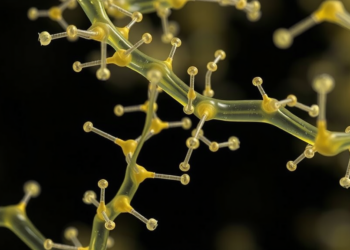
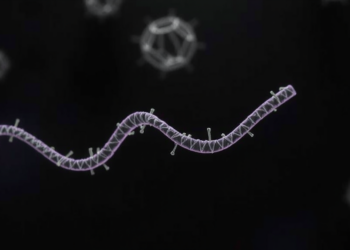
The most striking discovery concerns the shape of the peptide itself. Most plant peptides that bind leucine-rich repeat receptor kinases adopt one of two well-characterized conformations: an omega-like, hairpin-shaped fold seen in complexes such as HAESA–IDA–SERK1, HSL1–CLE9–SERK1 and PXY–CLE41–SERK2, or a fully extended configuration seen in the immune complexes MIK2–SCOOP12–BAK1 and FLS2–flg22–BAK1. SCREW2 does neither. Instead, it adopts what the authors call a cross-ribbon conformation, an inverted arrangement in which the peptide’s termini cross over in a way that has not been observed for any other LRR receptor-binding peptide. This distinctive fold is stabilized by intramolecular interactions, including conserved disulfide bonds and hydrogen-bonding networks that tie the N- and C-terminal regions together and lock the central loop into place.
The cross-ribbon architecture is not merely a structural curiosity; it is the molecular basis of specificity. Because the peptide presents its recognition surfaces in an arrangement unique to the SCREW family, only AtNUT possesses a binding surface complementary to it. The structure shows how conserved residues of SCREW2, including the completely conserved serine and asparagine residues near the N-terminus and the highly conserved CTNIP motif within the central loop, dock into a matching pocket on AtNUT. Once the peptide is seated in its receptor, its spatial configuration creates the platform needed to recruit AtBAK1, the promiscuous SERK-family co-receptor that participates in a wide range of plant receptor kinase signalling pathways, from brassinosteroid perception to innate immunity.
One of the most unexpected findings involves a sugar. The structure revealed an N-linked glycan attached to asparagine 449 of AtNUT, positioned directly within the peptide-binding interface. The glycan forms a hydrogen bond with the arginine 63 residue of SCREW2, effectively acting as a molecular handhold that helps grip the peptide. Biochemical assays using surface plasmon resonance confirmed that mutating the N449 glycosylation site significantly weakens SCREW2 binding. Sequence alignments across Brassicaceae species show that the N449 site and the surrounding N-X-S/T glycosylation motifs are conserved, suggesting that this sugar-assisted recognition mechanism is a general feature of NUT-family receptors rather than an idiosyncrasy of Arabidopsis.
The structural insights translated directly into functional predictions. When the researchers mutated the SCREW2 recognition sites on AtNUT, the consequences rippled through the entire downstream signalling cascade. Mitogen-activated protein kinase activation, a hallmark early response of pattern-triggered immunity, was significantly attenuated, as was the expression of PTI marker genes measured by RT-qPCR. These experiments demonstrate that the precise peptide-receptor contacts visualized in the cryo-EM maps are not incidental; they are load-bearing elements of the signalling pathway that counteracts abscisic acid- and MAMP-triggered stomatal closure.
The work also clarifies how the SCREW/NUT module fits into the broader logic of stomatal immunity. Pathogen attack triggers closure through well-mapped pathways involving abscisic acid receptors of the PYR/PYL/RCAR family, the SLAC1 anion channel and calcium-permeable channels such as OSCA1.3. Reopening, by contrast, requires actively counteracting these closure signals. The new structures suggest a model in which SCREW peptide binding induces heterodimerization of AtNUT and AtBAK1, initiating a transphosphorylation cascade that pushes guard cells back toward the open state. In this view, the plant does not simply reverse closure passively but deploys a dedicated peptide-receptor system whose activation is gated by the unique cross-ribbon geometry of its ligand.
From an applied perspective, the findings open concrete avenues for crop improvement. Stomatal dynamics sit at the heart of the trade-off between drought tolerance, photosynthetic productivity and disease resistance, and engineering this balance has long been hampered by incomplete knowledge of the underlying receptors. Because the SCREW recognition surface, the N449 glycan dependence and the co-receptor recruitment interface are now defined at the residue level, breeders and synthetic biologists have a structural template for tuning stomatal reopening without broadly disabling immune signalling. Sequence comparisons across angiosperms, from wheat and rice to grapevine and tomato, indicate that SCREW homologs and their conserved cysteine scaffolds are widespread, raising the prospect that the mechanism characterized here in Arabidopsis can be translated to staple crops.
The study also adds a new chapter to the structural biology of plant receptor kinases. For years, the field has recognized that leucine-rich repeat receptors rely on a common architectural principle: a peptide ligand bridges the receptor and a SERK co-receptor, with the peptide’s C-terminus typically engaging the co-receptor’s recruitment loop. The SCREW2 structure breaks that pattern, demonstrating that peptide geometry itself can be the determinant of receptor identity and that glycans can participate directly in ligand recognition rather than merely assisting protein folding and quality control. As cryo-EM continues to expose the extracellular signalling complexes of plant membranes, cases like SCREW/NUT are likely to multiply, revealing a molecular vocabulary far richer than the canonical models anticipated. For now, the cross-ribbon peptide stands as a vivid reminder that in biology, shape is often the message.
Subject of Research: Cryo-EM structural mechanism of SCREW/CTNIP peptide recognition by the NUT/HSL3–BAK1 receptor complex in plant stomatal immunity
Article Title: Cross-ribbon conformation defines peptide recognition in SCREW/CTNIP–NUT/HSL3 signalling
Article References: Wei, X., Yao, M., Zhao, P., Zhang, X., Zhang, K., Hu, W., Shi, J., Guo, S., Li, R., Wang, W., Xu, Y., Guo, S., Xu, H. E., & Song, C.-P. (2026). Cross-ribbon conformation defines peptide recognition in SCREW/CTNIP–NUT/HSL3 signalling. Nature Plants, 12(9), 1769-1781. https://doi.org/10.1038/s41477-026-02376-8
Image Credits: AI Generated
DOI: 10.1038/s41477-026-02376-8
Keywords: SCREW/CTNIP peptides, NUT/HSL3 receptor, BAK1/SERK3 co-receptor, cryo-EM structure, cross-ribbon conformation, stomatal immunity, N-glycosylation, pattern-triggered immunity, plant receptor kinases, stomatal reopening, Arabidopsis, Nature Plants
Cite Scienmag News
Kristina Jarvis. (September 22, 2026). Twisted Peptide Shape Reveals How Plants Reopen Stomata After Immune Alarm. Scienmag. https://scienmag.com/twisted-peptide-shape-reveals-how-plants-reopen-stomata-after-immune-alarm/
Kristina Jarvis. "Twisted Peptide Shape Reveals How Plants Reopen Stomata After Immune Alarm." Scienmag, 22 September 2026, https://scienmag.com/twisted-peptide-shape-reveals-how-plants-reopen-stomata-after-immune-alarm/. Accessed 22 September 2026.
Kristina Jarvis. "Twisted Peptide Shape Reveals How Plants Reopen Stomata After Immune Alarm." Scienmag. September 22, 2026. https://scienmag.com/twisted-peptide-shape-reveals-how-plants-reopen-stomata-after-immune-alarm/