


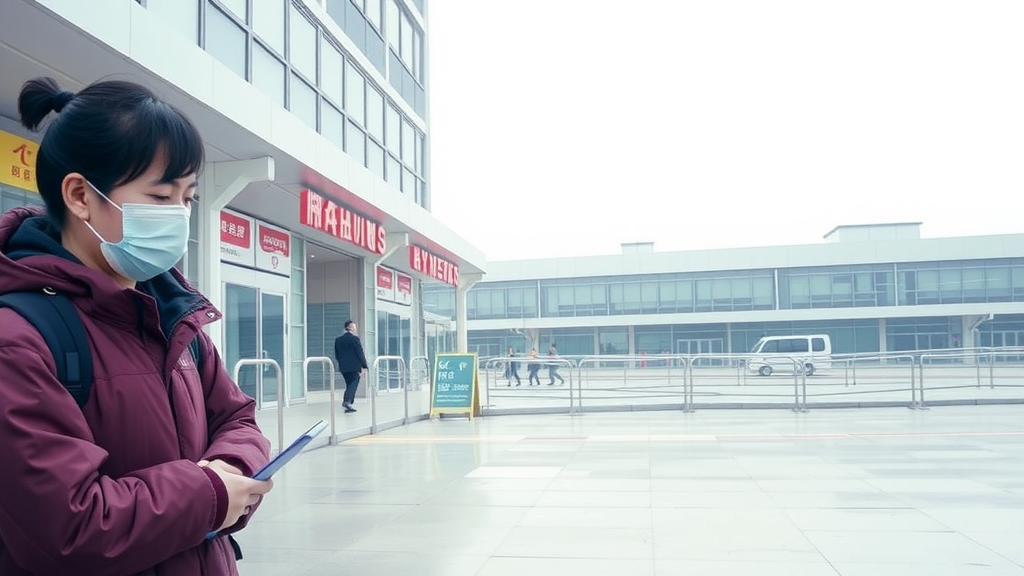
When a cold spell grips a city, the danger is not only icy roads and shivering commutes. For millions of people living with cardiovascular vulnerability, a sharp drop in temperature can be a physiological trigger, constricting blood vessels, raising blood pressure, and increasing the likelihood of a stroke. In Tianjin, a sprawling municipality of more than 13 million people in northern China, public health authorities have turned that meteorological insight into an operational tool: China’s first stroke meteorological risk warning system, which issues alerts when daily minimum temperatures and 24-hour temperature declines cross thresholds associated with elevated stroke risk. A new study now provides the most rigorous accounting yet of whether those warnings actually work, and what they are worth in monetary terms, and the answer is strikingly positive on both counts.
The research, published in the International Journal of Disaster Risk Science, was led by Congkai Hong of Tsinghua University together with colleagues from the Tianjin Institute of Meteorological Science, the China Meteorological Administration, the Beijing Institute of Technology, and Beihang University. The team examined the period from January 2021 to September 2022, during which four cold-spell-related stroke risk warnings were issued in Tianjin. Their analysis found that during warning periods, stroke hospital admissions fell by an average of 6.92 percent. Scaled to the entire city, that translates into roughly 1,593 avoided stroke hospitalizations over the study window, a figure the authors link to more than USD 2.66 million in savings for government medical insurance funds and USD 849.9 thousand in reduced out-of-pocket costs for residents.
What distinguishes this evaluation from earlier attempts to judge the value of weather-based health alerts is its statistical architecture. Previous studies often relied on simple comparisons of disease rates before and after warnings, or on regression models that captured only the average effect of temperature. Both approaches stumble over the fact that the relationship between meteorological conditions and health outcomes is neither linear nor immediate. Cold can elevate stroke risk for days after the temperature drop, and the dose-response curve bends in complicated ways across the thermal spectrum. To handle this, the team employed a distributed lag nonlinear model, or DLNM, a framework originally developed by epidemiologists to disentangle exactly these exposure-lag-response relationships. The model builds a cross-basis function that simultaneously characterizes how temperature affects admissions and how that effect is distributed over a 21-day lag window, using natural cubic splines with knots placed at the 75th and 90th percentiles of the temperature distribution.
Into this temperature-lag structure, the researchers inserted a binary warning variable, allowing the regression to separate the effect of the alert itself from the underlying weather. Controls included daily average relative humidity and air pressure, adjusted with splines, along with terms for the sequential day number within the year, interannual variation, the weekday, public holidays, and a dummy variable capturing the peaks of COVID-19 control measures, which visibly depressed hospital admissions during the study period. The estimated warning coefficient was negative and statistically significant at the 1 percent level, and the corresponding 6.92 percent reduction in admissions survived an unusually thorough battery of robustness checks.
Those checks matter because the study had only four warning events to work with, a small sample by any standard. The team re-ran the model replacing average temperature with maximum and minimum values, altering lag windows of 7, 14, and 30 days, adjusting spline degrees of freedom, and swapping in alternative knot placements. They also iteratively excluded each single warning event, and every combination of two and three events, to confirm the result was not driven by one outlier alert. The estimated effect varied by an average of only 11.2 percent across these specifications and retained significance throughout the single-event exclusions. Power analysis returned a value of 0.9, above the conventional 0.8 threshold, and 1,000 bootstrap resamples produced a 95 percent confidence interval for the warning coefficient that excluded zero. The researchers also tested for a so-called hospital admissions displacement effect, in which warnings merely postpone admissions rather than preventing them, and found no evidence of such harvesting among stroke patients, plausibly because stroke is acute enough that patients cannot delay care for long.
Having established effectiveness, the study moved into economic territory where earlier evaluations had gone shallow. Most prior work on heat and cold health warning systems counted only direct healthcare savings, such as avoided emergency visits and hospitalizations. That accounting ignores the enormous downstream costs of stroke, particularly the labor lost when survivors live with disability or die prematurely. The Tianjin team combined the human capital method with the disability-adjusted life year, or DALY, framework, dividing the population into eight age groups and calculating how many productive working years the avoided admissions preserved. Each avoided stroke hospitalization represents not only a medical expense dodged but a potential loss of earnings, workplace continuity, and household income averted. By this broader measure, the four warnings generated an additional USD 1.61 million in economic benefit through avoided labor losses alone.
The authors then pushed the analysis one step further, asking what happens when those saved expenses ripple through the wider economy. Using Tianjin’s 2017 input-output table covering 42 industrial sectors, they modeled how government insurance savings and resident out-of-pocket savings, if redirected to other forms of consumption, would propagate through supply chains via the Leontief model, while avoided labor losses entered the Ghosh model as restored employee compensation. Under a baseline redistribution scenario, the combined effects suggested a potential increase in economic gross output of USD 5.76 million across the warning periods. An optimized scenario, in which saved funds are steered toward sectors with stronger backward linkage coefficients, meaning industries whose demand stimulates production more powerfully throughout the economy, raised the plausible output gain to as much as USD 1.32 million from out-of-pocket savings alone, a sum comparable to the annual profits of Tianjin’s entire culture and arts industry.
The financial case for the warning system itself is unusually favorable. The initial investment by the Tianjin Environmental Meteorological Center in developing the system was approximately USD 607.1 thousand. Against the combined medical insurance and out-of-pocket savings, the benefit-cost ratio reached 4.39, a figure the authors note is comparable to annual benefit-cost ratios reported for tobacco cessation programs targeting cardiovascular disease in Massachusetts. Counting avoided labor losses separately yielded a benefit-cost ratio of 2.66, in the range reported for flood early warning systems in Europe. The high returns reflect a basic asymmetry: information is cheap to produce and distribute, while stroke treatment and long-term care are extraordinarily expensive, so even a modest reduction in admissions translates into substantial savings.
The mechanisms behind the reduction are straightforward to describe even if they are hard to observe directly. Cold-weather stroke warnings likely work through two channels. First, alerts prompt high-risk individuals, particularly the elderly and those with hypertension or other chronic conditions, to limit outdoor exposure, bundle up, and adhere strictly to their medication regimens during dangerous conditions. Second, warnings give healthcare providers a window to act proactively, intensifying patient education and preparing clinical resources before the surge in cases that typically follows a cold snap. Similar logic underpins heat-health warning systems now operating in many countries, but stroke adds a distinctive challenge because its onset is rapid and its outcomes, from paralysis to death, generate some of the largest disability burdens of any disease worldwide, ranking fourth among global risk factors for disability-adjusted life years in 2021.
The study’s authors are candid about its limits. The admission data covered seven major hospitals, which together handle roughly half of Tianjin’s stroke cases but cannot resolve differences between districts and communities. Only four warning events fell within the study window, constrained by the system’s November 2021 launch and by pandemic disruptions, and the analysis relied on aggregate daily counts rather than individual patient records, which may understate protective effects for the most vulnerable groups. The input-output modeling rests on static assumptions and hypothetical redistribution, so the macroeconomic figures should be read as theoretical potential rather than realized gains. Even so, the framework is designed to travel. The authors argue it offers a replicable blueprint for evaluating meteorological health warning systems across regions and diseases, from asthma to heat-related illness, and they urge governments to count labor losses and cross-sector effects, not just hospital bills, when deciding whether to invest. As climate change intensifies extreme weather and the United Nations pushes its Early Warnings for All initiative toward full global coverage by 2027, the Tianjin experience suggests that a modest investment in telling people when the weather threatens their health can return its cost several times over, in hospitals, households, and the broader economy alike.
Subject of Research: Evaluation of the effectiveness and economic benefits of a meteorological stroke risk warning system in Tianjin, China
Article Title: Evaluating Effectiveness and Economic Benefits of Meteorological Health Warning Systems: A Case Study of Stroke Warnings in Tianjin, China
Article References: Hong, C., Han, S., Shang, J., Zhang, S., Zhao, M., Xia, C., Hao, T., Yao, Q., & Cai, W. (2026). Evaluating Effectiveness and Economic Benefits of Meteorological Health Warning Systems: A Case Study of Stroke Warnings in Tianjin, China. International Journal of Disaster Risk Science. https://doi.org/10.1007/s13753-026-00768-0
Image Credits: AI Generated
DOI: 10.1007/s13753-026-00768-0
Keywords: meteorological health warning system, stroke, early warning, cold spell, hospital admissions, distributed lag nonlinear model, economic benefits, DALY, input-output analysis, climate change adaptation, Tianjin, public health
Cite Scienmag News
Cassandra Pierce. (September 22, 2026). Weather Warnings Cut Stroke Hospital Admissions in China and Paid Off Fourfold. Scienmag. https://scienmag.com/weather-warnings-cut-stroke-hospital-admissions-in-china-and-paid-off-fourfold/
Cassandra Pierce. "Weather Warnings Cut Stroke Hospital Admissions in China and Paid Off Fourfold." Scienmag, 22 September 2026, https://scienmag.com/weather-warnings-cut-stroke-hospital-admissions-in-china-and-paid-off-fourfold/. Accessed 22 September 2026.
Cassandra Pierce. "Weather Warnings Cut Stroke Hospital Admissions in China and Paid Off Fourfold." Scienmag. September 22, 2026. https://scienmag.com/weather-warnings-cut-stroke-hospital-admissions-in-china-and-paid-off-fourfold/


