


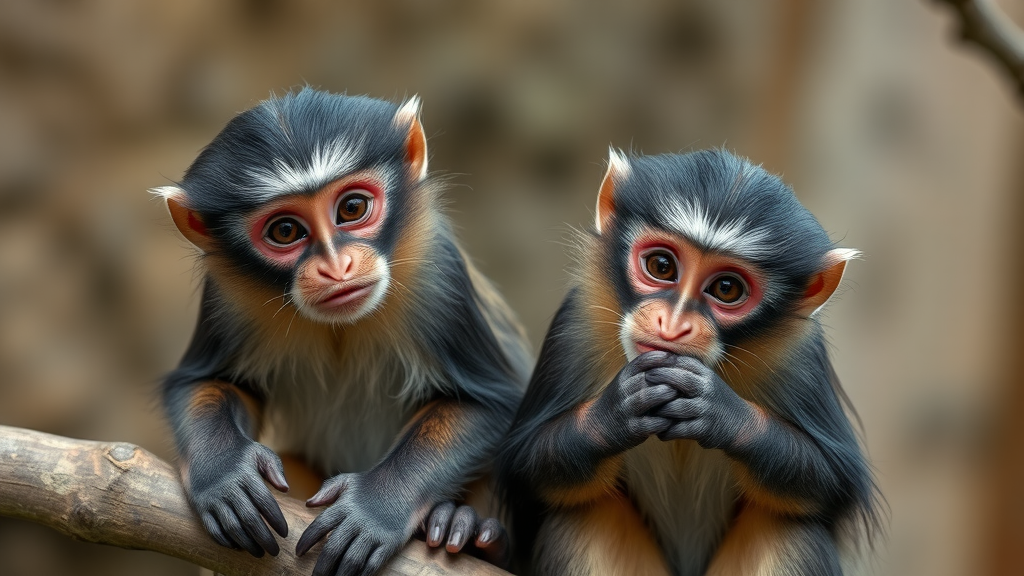
Cooperation is one of the most striking behaviors in the animal kingdom, yet teasing apart why some individuals cooperate successfully while others fail has proven remarkably difficult. A new study of brown capuchin monkeys offers fresh insight by letting the animals do something most laboratory experiments deny them: freely choose whether, with whom, and how to cooperate. The research, conducted by Kaustabh M. Baruah, Josep Call, and Amanda M. Seed at the University of St Andrews and published in the journal Animal Cognition, used a purpose-built apparatus to implement a classic game-theoretic scenario known as the Stag Hunt, in which two individuals must coordinate to secure a rich reward that neither could obtain alone.
The experimental design was elegantly simple in concept but rich in the behavioral data it generated. Two groups of captive brown capuchin monkeys, one containing 22 individuals and the other 18, were given access to an apparatus featuring five distinct options. At the center stood the Stag box, a cooperative device that required two monkeys to press levers simultaneously to release high-value rewards. Surrounding it were four Hare boxes, individually operable devices that dispensed lower-value rewards to any single monkey willing to work alone. Because the animals could move freely among all five options and select any partner they wished across six testing sessions, the setup captured the genuine social dynamics of partner choice rather than forcing arbitrary pairings on unwilling participants.
The results were striking in their breadth. Most individuals in both groups engaged in successful cooperative bouts at the Stag box, demonstrating that the majority of capuchins in the study were both willing and able to coordinate their actions with a partner when the payoff justified the effort. At the same time, the monkeys did not neglect the safer alternative, regularly obtaining rewards on their own from the Hare boxes. This pattern mirrors the fundamental tension built into the Stag Hunt paradigm: cooperating with a partner promises a bigger prize but carries the risk of failure if the partner does not pull their weight, while working alone guarantees a modest but reliable return.
To disentangle the factors driving cooperative decisions, the researchers turned to generalized linear mixed models, a statistical framework well suited to behavioral data in which many observations are nested within individuals and dyads. The analysis revealed that dyadic tolerance, a measure of how comfortably two particular monkeys could share space and resources without conflict, significantly predicted the likelihood of cooperation in both groups. In other words, capuchins were not choosing partners at random. They were systematically more likely to attempt the demanding joint task with partners they tolerated well, suggesting that the quality of a social relationship acts as a gatekeeper for cooperative ventures in this species.
Individual characteristics mattered as well. The models showed that more exploratory monkeys, those that readily investigated novel objects and environments, participated in more cooperative interactions than their less adventurous groupmates. Dyads involving juveniles also engaged in more cooperative bouts, hinting that younger animals may be especially motivated to experiment with the apparatus or that their playful dispositions make them attractive or available partners. These findings underscore that cooperation is not solely a property of relationships; the personalities and life stages of the individuals involved shape how often cooperative opportunities are taken up in the first place.
Perhaps the most technically intriguing results came from a finer-grained analysis of pressing behavior, which examined how the mere presence of a partner influenced how hard monkeys worked at each type of box. Here the two groups diverged in unexpected ways. In the East Group, the presence of a partner increased pressing at the Stag box while simultaneously lowering pressing at the Hare boxes, a pattern consistent with genuine social facilitation of cooperation and a devaluation of the solo option when a collaborator was available. In the West Group, by contrast, Stag-box pressing increased steadily across sessions regardless of whether a partner was present or absent, suggesting that learning and familiarity with the apparatus, rather than partner presence, drove much of the cooperative effort in that group.
This group-level divergence carries important methodological implications for the field of comparative cognition. It demonstrates that ostensibly identical experimental conditions can produce different behavioral signatures in different social groups, and that conclusions about partner sensitivity drawn from a single group may not generalize. The authors argue that this variability is precisely why paradigms allowing free partner choice are so valuable: they reveal the social dynamics underlying cooperation rather than smoothing them away under the constraints of forced pairing. When animals can vote with their feet, researchers gain access to the decision processes that matter in the real world where cooperation evolved.
The study also speaks to a long-standing debate about the evolutionary foundations of mutualism. Mutualistic cooperation with free partner choice is widely considered a key pillar in the evolution of cooperative behavior, including in humans, because it allows individuals to shop for reliable partners and abandon unreliable ones, creating selection pressure for trustworthiness and coordination. Yet many experimental studies of animal cooperation have restricted partner choice or offered few alternatives, limiting insight into the factors that actually shape cooperative decisions. By combining a cooperative option with multiple solo alternatives in an open social setting, the Stag Hunt apparatus used here brings experimental designs closer to the ecological realities in which cooperative psychology took shape.
The ethical design of the research deserves note as well. The study was entirely non-invasive and relied exclusively on voluntary participation: no animal was food-deprived, socially separated, restrained, or physically handled for the purposes of the experiment. Multiple apparatuses were installed simultaneously to reduce monopolization by dominant individuals, and zoo staff implemented scattered feeding during testing to maintain naturalistic foraging dispersion and minimize competition. All rewards formed part of the animals’ regular diet, and no violent or injurious interactions were observed in connection with the procedures. The work was approved by the School of Psychology and Neuroscience Ethics Committee at the University of St Andrews and conducted in close collaboration with zoo authorities at Living Links, Edinburgh Zoo.
Taken together, the findings highlight the importance of integrating social relationships and individual traits into any account of cooperative decision-making in primates. Tolerance between partners determines whether cooperation is attempted at all; exploratory tendencies and youth shape how often individuals engage; and the influence of a partner’s presence on effort can vary from group to group. For capuchins, at least, the road to the big prize runs through social tolerance, and the willingness to take that road depends on who is standing beside you. As researchers continue to probe the roots of cooperation across species, studies like this one demonstrate that the richest answers emerge not from forcing animals into prescribed partnerships, but from letting them choose for themselves.
Subject of Research: Cooperative behavior and partner choice in brown capuchin monkeys tested with a Stag Hunt cooperation task
Article Title: Cooperation in brown capuchin monkeys: social tolerance, individual traits, and partner sensitivity in a Stag Hunt task
Article References: Baruah, K. M., Call, J., & Seed, A. M. (2026). Cooperation in brown capuchin monkeys: social tolerance, individual traits, and partner sensitivity in a Stag Hunt task. Animal Cognition. https://doi.org/10.1007/s10071-026-02107-8
Image Credits: AI Generated
DOI: 10.1007/s10071-026-02107-8
Keywords: capuchin monkeys, cooperation, Stag Hunt, partner choice, social tolerance, animal cognition, primates, mutualism, exploration, behavioral ecology, comparative psychology, social behavior
Cite Scienmag News
Glenn Wilkins. (September 21, 2026). Capuchin Monkeys Choose Cooperative Partners Based on Tolerance, Study Finds. Scienmag. https://scienmag.com/capuchin-monkeys-choose-cooperative-partners-based-on-tolerance-study-finds/
Glenn Wilkins. "Capuchin Monkeys Choose Cooperative Partners Based on Tolerance, Study Finds." Scienmag, 21 September 2026, https://scienmag.com/capuchin-monkeys-choose-cooperative-partners-based-on-tolerance-study-finds/. Accessed 21 September 2026.
Glenn Wilkins. "Capuchin Monkeys Choose Cooperative Partners Based on Tolerance, Study Finds." Scienmag. September 21, 2026. https://scienmag.com/capuchin-monkeys-choose-cooperative-partners-based-on-tolerance-study-finds/


