


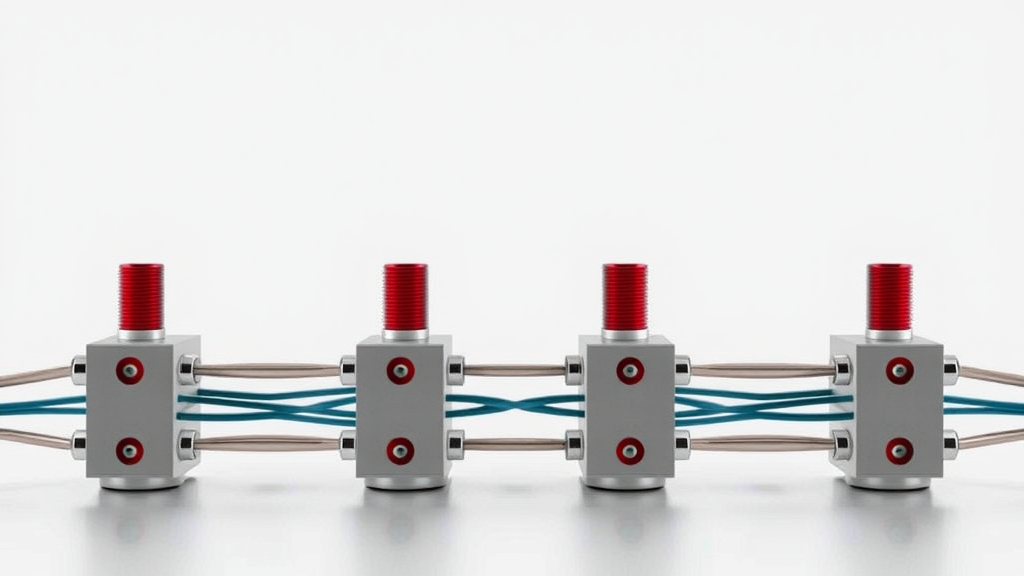
Researchers have demonstrated a parallelized four-qubit entangling gate operating on a spin register at room temperature, a result that could reshape how practical quantum processors are built. Reported in Nature Nanotechnology, the work shows that a single control operation can entangle multiple qubits at once, replacing the long chains of pairwise gates that dominate conventional quantum computing architectures. The team reports that the parallel gate runs roughly ten times faster than an equivalent sequence of two-qubit gates, while also accumulating fewer errors along the way. For a field where every microsecond of coherence time counts, that combination of speed and fidelity is significant.
Quantum computers derive their power from entanglement, the uniquely quantum correlation that links the states of qubits so that they can no longer be described independently. In most of today’s architectures, creating entanglement among many qubits is a serial affair: a two-qubit gate links one pair, then another pair, then another, with each operation taking time and introducing its own quota of imperfection. For a register of even modest size, the number of sequential gates required to generate a genuinely multipartite entangled state grows quickly, and every additional step eats into the fragile window before decoherence destroys the quantum information altogether.
The new experiment tackles this bottleneck at its root. Instead of stitching together pairwise interactions, the researchers engineered a single gate that acts on four qubits simultaneously within a spin register that functions at ambient conditions. Room-temperature operation is itself a notable achievement, because most leading quantum computing platforms, including superconducting circuits and trapped ions, demand elaborate cryogenic or ultra-high-vacuum environments. A register that can be manipulated on a benchtop, without dilution refrigerators, dramatically lowers the barrier to scaling and integration, and opens the door to quantum devices that resemble conventional electronics far more closely than the laboratory behemoths of current-generation hardware.
Spin registers of the kind used here rely on well-protected quantum states associated with electron or nuclear spins in solid-state defects. These systems have long been attractive to quantum engineers because their spin states can be initialized, manipulated with microwave or optical pulses, and read out with laser-based techniques, all while remaining comparatively insensitive to thermal noise. The central challenge has always been the coupling between qubits: interactions in such registers are often mediated through a shared resource, which makes it difficult to address pairs selectively without disturbing the rest of the register. The demonstration of a clean, parallelized multi-qubit gate shows that this mediation can be turned from a liability into an asset, with the shared interaction structure harnessed to entangle several qubits in one stroke.
The speed advantage reported by the team is not merely a matter of convenience. In quantum error correction and in most quantum algorithms, the ratio of gate time to coherence time is one of the fundamental figures of merit that determines whether a computation can be completed before the quantum states decay. A four-qubit gate executed in the time of roughly a single pairwise operation, and ten times faster than the equivalent four-gate sequence, means that substantially deeper circuits can be run within the same coherence budget. The reduction in accumulated errors compounds this benefit: if each two-qubit gate carries even a small error probability, replacing four sequential operations with one parallel operation cuts the total error budget nearly in half before improvements in the gate itself are even considered.
Multipartite entanglement, in which three or more qubits share correlations that cannot be reduced to pairwise links, is a resource in its own right. It underlies measurement-based quantum computing, in which a large entangled state is prepared in advance and computation proceeds by single-qubit measurements, as well as quantum error-correcting codes, quantum teleportation networks, and metrology schemes that squeeze below the standard quantum limit. Generating such states efficiently, and at room temperature, could therefore benefit far more of the quantum technology stack than computation alone. A scalable source of multipartite entanglement that does not require cryogenic hardware would be directly relevant to quantum sensors deployed in the field and to compact quantum communication nodes.
The parallelized approach also speaks to a broader architectural question in quantum engineering: whether future processors should be built from networks of pairwise-coupled qubits or from registers whose qubits interact collectively through a common mediator. The two strategies carry different trade-offs. Pairwise architectures offer fine-grained control and map naturally onto established gate models, but they demand ever more elaborate wiring and calibration as systems grow. Collectively mediated registers, by contrast, can offer intrinsically parallel operations and simpler connectivity graphs, at the cost of more complex pulse engineering to ensure that unwanted crosstalk is suppressed. By demonstrating a high-fidelity four-qubit gate in the collective setting, the new work strengthens the case that register-based architectures deserve a central place in the scaling roadmap.
Room-temperature operation carries particular weight for real-world deployment. Cryogenic infrastructure is expensive, power-hungry, and bulky, and it constrains where quantum processors can be physically located. Systems that operate at ambient conditions can be miniaturized more aggressively, integrated into photonic or electronic packages, and deployed in settings ranging from data centers to medical imaging suites to autonomous platforms. Spin-based registers have already been proposed as quantum memories that link flying qubits such as photons, and a fast, parallel entangling gate makes such memories far more capable, since entanglement between memory qubits can be established on demand without consuming the register’s limited coherence time on long gate sequences.
As with any first demonstration, the path from a four-qubit parallel gate to fault-tolerant computation remains long. Scaling to larger registers will require maintaining gate fidelity as more qubits share the mediator, refining pulse sequences to suppress crosstalk, and integrating high-efficiency readout. Nevertheless, the result establishes a concrete benchmark: a single gate producing genuine multipartite entanglement, faster and more cleanly than the serial alternative, on hardware that needs no cooling. If the parallel-gate paradigm can be extended to larger registers and combined with error correction, it may prove to be one of the key simplifications that finally brings room-temperature quantum processors out of the laboratory and into everyday technological use.
Subject of Research: A parallelized four-qubit entangling gate demonstrated on a room-temperature quantum spin register
Article Title: Single-gate, multipartite entanglement on a room-temperature quantum register
Article References: Minnella, J. D., Ouellet, M., Klein, A. R., & Bassett, L. C. (2026). Single-gate, multipartite entanglement on a room-temperature quantum register. Nature Nanotechnology. https://doi.org/10.1038/s41565-026-02254-6
Image Credits: AI Generated
DOI: 10.1038/s41565-026-02254-6
Keywords: quantum computing, entanglement, spin register, room temperature, multipartite entanglement, quantum gates, quantum error correction, qubits, quantum nanotechnology, coherence time, quantum sensors, solid-state spins
Cite Scienmag News
Katie Riggs. (September 21, 2026). One Gate, Four Qubits: Room-Temperature Quantum Register Achieves Parallel Entanglement. Scienmag. https://scienmag.com/one-gate-four-qubits-room-temperature-quantum-register-achieves-parallel-entanglement/
Katie Riggs. "One Gate, Four Qubits: Room-Temperature Quantum Register Achieves Parallel Entanglement." Scienmag, 21 September 2026, https://scienmag.com/one-gate-four-qubits-room-temperature-quantum-register-achieves-parallel-entanglement/. Accessed 21 September 2026.
Katie Riggs. "One Gate, Four Qubits: Room-Temperature Quantum Register Achieves Parallel Entanglement." Scienmag. September 21, 2026. https://scienmag.com/one-gate-four-qubits-room-temperature-quantum-register-achieves-parallel-entanglement/


