


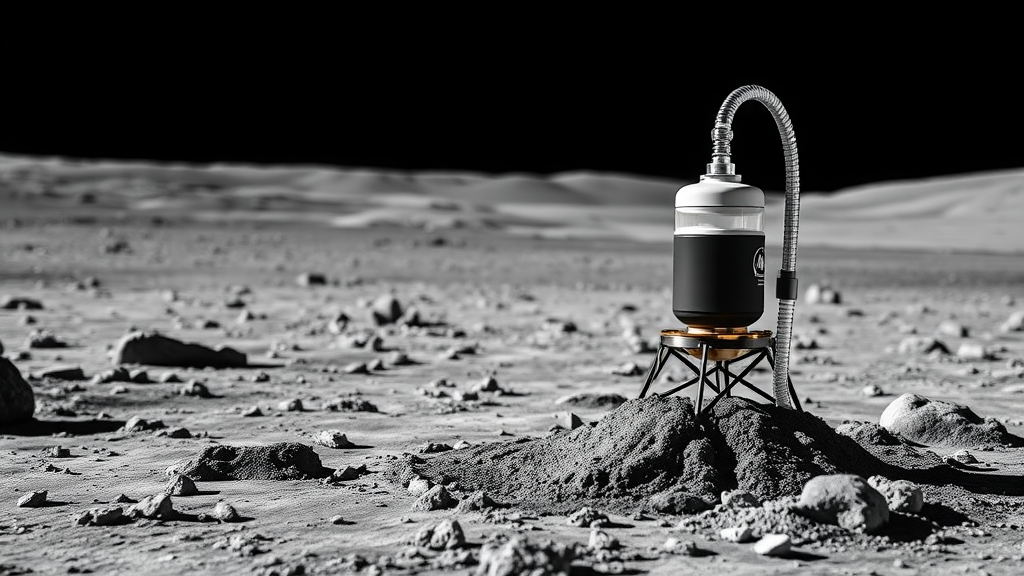
When Firefly Aerospace’s Blue Ghost lander touched down in Mare Crisium on March 2, 2025, it carried with it a device that would quietly change how future spacecraft gather material from alien worlds. Lunar PlanetVac, a pneumatic regolith sampling system developed by Honeybee Robotics, became the first tool of its kind to acquire and transport lunar soil using nothing more than jets of gas. According to results published in the journal Space and Planetary Resources, the system captured approximately 7 cubic centimeters of regolith during its first five-second firing and roughly 11 cubic centimeters cumulatively across four operations, all while operating in an off-nominal configuration that should have compromised it. The demonstration is being hailed as a milestone for low-cost planetary sampling, and its implications stretch from the Moon to Phobos and Titan.
Sample acquisition has long been one of the most expensive and failure-prone elements of planetary missions. The Mars Curiosity rover, for example, relied on a sophisticated Sample Acquisition, Sample Processing and Handling system that required a choreographed series of robotic arm motions to move drilled or scooped material through a sieve and into pre-measured cups. The rover’s orientation, including its pitch, tilt, and yaw, dictated different arm commands, and sticky samples demanded a mechanical thwacker to dislodge material clinging to interior walls. The Mars Phoenix lander faced an even thornier problem: icy soil warmed by sunlight thawed and refroze inside the scoop, adhering to its walls so stubbornly that nothing fell into the Thermal and Evolved-Gas Analyzer when the arm attempted delivery. Engineers had to improvise on the fly, shielding the scoop from the Sun while preserving precious water ice for analysis.
Those experiences illustrate why Honeybee Robotics spent more than two decades developing an alternative. PlanetVac replaces complex articulation with a principle familiar from industrial powder handling on Earth: pneumatic transport. Gas jets pointed downward inside a sampling head loft regolith into a transfer hose, where it is swept along to a capture system that separates sample from gas flow. When high-pressure gas is released into vacuum and directed at a surface, it reaches supersonic velocities, efficiently lifting both fine and coarse particles. In sealed laboratory systems with minimal gas losses, the team measured lofting efficiencies of up to 5000, meaning a single gram of gas could move 5000 grams of regolith. The approach is gravity-agnostic, works with cohesive and non-cohesive materials alike, and completes a full sampling cycle within seconds using only a few watts of power, with no motors, closed-loop control, or elaborate avionics required.
The flight unit that rode to the Moon consisted of four subsystems: a machined aluminum sampling head with downward- and upward-pointing nozzles, a braided stainless steel transfer hose with a smooth PTFE core, a Sample Sorting System mounted in the lander’s temperature-controlled mid-deck, and avionics managing power and thermal control. The Sample Sorting System contained separate chambers for fine and coarse material divided by a 1-millimeter screen, a 0.38-millimeter exhaust sieve that let gas escape while retaining larger particles, and a camera to document the captured soil. Two infrared beam breaker sensors near the chamber entrance provided an inexpensive, camera-free method of verifying that material had arrived, a deliberate pathfinder for future missions. The entire payload weighed just 8.46 kilograms, a full 30 percent below its not-to-exceed mass, and drew between 3.5 and 24.1 watts depending on the operating mode, comfortably inside its power allocations.
Operationally, the system was mounted on Firefly’s Surface Access Arm, a single-degree-of-freedom arm designed to press the sampling head flush against the lunar surface with about 100 newtons of downforce. That preload mattered because PlanetVac acts, in effect, as a cold gas thruster; without it, the arm would simply lift off the ground during firing. The gas tank held 126 grams of nitrogen at 5000 pounds per square inch, enough for more than 30 seconds of sampling at flow rates exceeding one gram per second. But when Blue Ghost settled onto uneven terrain near a small crater, the footpad closest to the arm failed to fully contact the ground, leaving the sampling head angled toe-down rather than flush. Telemetry and imagery from the lander’s SCALPSS payload and ARGUS camera confirmed the tilt, which produced an asymmetric excavation crater roughly 350 by 400 millimeters in size.
Despite the compromised geometry, the device performed. During the primary five-second operation, a solenoid valve opened and nitrogen surged through the nozzles, lofting regolith up the transport tube in under a second. The beam breaker pair, spaced 10 millimeters apart, recorded particle transit times indicating a velocity of about 3.3 meters per second, with the majority of the sample arriving within the first second. Correlating flight images with computer-aided design models and extensive pre-flight vacuum chamber testing, the team estimated that roughly 3.6 cubic centimeters of soil settled at the bottom of the collection chamber while about 3.4 cubic centimeters of dust coated interior surfaces, a layer estimated at 50 microns across 680 square centimeters. That first haul alone exceeded the mission’s minimum capture requirement of one cubic centimeter. Three auxiliary operations, including a 24-second purge fired on March 15 as lunar sunset approached, brought the cumulative total to approximately 11 cubic centimeters.
The exterior camera footage delivered some of the most striking imagery of the mission. Millimeter-scale particles were ejected horizontally at speeds up to 10 meters per second, and one 15-millimeter rock, affectionately nicknamed Dwayne, was propelled an estimated 61 centimeters high before the radial gas plume deflected it sideways on descent. More serendipitously, the pneumatic blast visibly cleaned the lens of the ARGUS camera mounted about 70 centimeters above the surface, and even cleared cameras on the far side of the lander. The team suggests that charge dissipation by gas-borne charge carriers, rather than direct momentum transfer, may explain the distant cleaning effect, a phenomenon that could prove genuinely useful for future landers that need clear exterior imagery after touchdown. Onboard, a sieving operation separated the sample into size fractions and simultaneously blew fine dust off the internal camera window and the mounted material coupons.
That dust mitigation was no accident. Attached to the back wall of the collection chamber were coupons of candidate lunar surface materials, including polyimide, titanium alloy, a chromium carbide nickel chromium coating applied by high-velocity oxygen fuel spraying, and a proprietary work-function matched inorganic coating, some surfaces patterned by picosecond laser ablation to test how topography influences dust adhesion. Because the imaging setup lacked a bright internal reference standard, the team could not quantify dust accumulation directly, but grayscale brightness analysis of regions of interest revealed measurable changes across sampling sequences, with accumulation patterns differing between the two chambers. The researchers note that a brighter LED and a redesigned coupon arrangement would strengthen the experiment on future flights, and that further image analysis and laboratory work may clarify how laser-ablated surfaces perform against the relentless lunar dust.
The broader significance of the demonstration extends well beyond Mare Crisium. Because gravitational effects are secondary in pneumatic mining operations, PlanetVac-style systems can function on Mars, on comets, and in the microgravity of small bodies. The technology has already been selected for JAXA’s Martian Moons eXploration mission, where a variant called the P-Sampler will capture Phobos surface material for return to Earth, and similar pneumatic approaches will fly on NASA’s Dragonfly rotorcraft bound for Titan. The successful lunar flight provides critical risk reduction for those missions while offering the Commercial Lunar Payload Services program the cheap, simple sampling architecture it was designed to encourage. As the team concludes, the combination of low mass, low power, fast operation, and freedom from gravity-dependent mechanics makes pneumatic sampling a foundational capability for the next era of planetary exploration, in situ resource utilization, and sample return.
Subject of Research: Pneumatic lunar regolith sampling demonstrated by Lunar PlanetVac on Blue Ghost Mission 1
Article Title: Results of Lunar PlanetVacTM, a pneumatic regolith sampling system deployed to the moon on Blue Ghost Mission 1
Article References: Zacny, K., Fitzgerald, Z., Vendiola, V., Carrington, K., Jung, H., Wang, A., Misra, R., Ngo, P., Sanasarian, L., Bailey, J., Ng, P., Seto, E., Paulsen, G., Chow, P., Chu, P., Naclerio, N., Hernandez, J., King, I., Sabahi, D., … Watts-Shepherd, S. (2026). Results of Lunar PlanetVacTM, a pneumatic regolith sampling system deployed to the moon on Blue Ghost Mission 1. Space and Planetary Resources, 2(1), Article 11. https://doi.org/10.1007/s44461-026-00012-z
Image Credits: AI Generated
DOI: 10.1007/s44461-026-00012-z
Keywords: Lunar PlanetVac, pneumatic sampling, lunar regolith, Blue Ghost Mission 1, Mare Crisium, Honeybee Robotics, Firefly Aerospace, sample acquisition, ISRU, Phobos, dust adhesion, sample return
Cite Scienmag News
Grant Pearson. (September 21, 2026). Pneumatic Sampler Scoops Lunar Soil in First Moon Test of PlanetVac Technology. Scienmag. https://scienmag.com/pneumatic-sampler-scoops-lunar-soil-in-first-moon-test-of-planetvac-technology/
Grant Pearson. "Pneumatic Sampler Scoops Lunar Soil in First Moon Test of PlanetVac Technology." Scienmag, 21 September 2026, https://scienmag.com/pneumatic-sampler-scoops-lunar-soil-in-first-moon-test-of-planetvac-technology/. Accessed 21 September 2026.
Grant Pearson. "Pneumatic Sampler Scoops Lunar Soil in First Moon Test of PlanetVac Technology." Scienmag. September 21, 2026. https://scienmag.com/pneumatic-sampler-scoops-lunar-soil-in-first-moon-test-of-planetvac-technology/


