


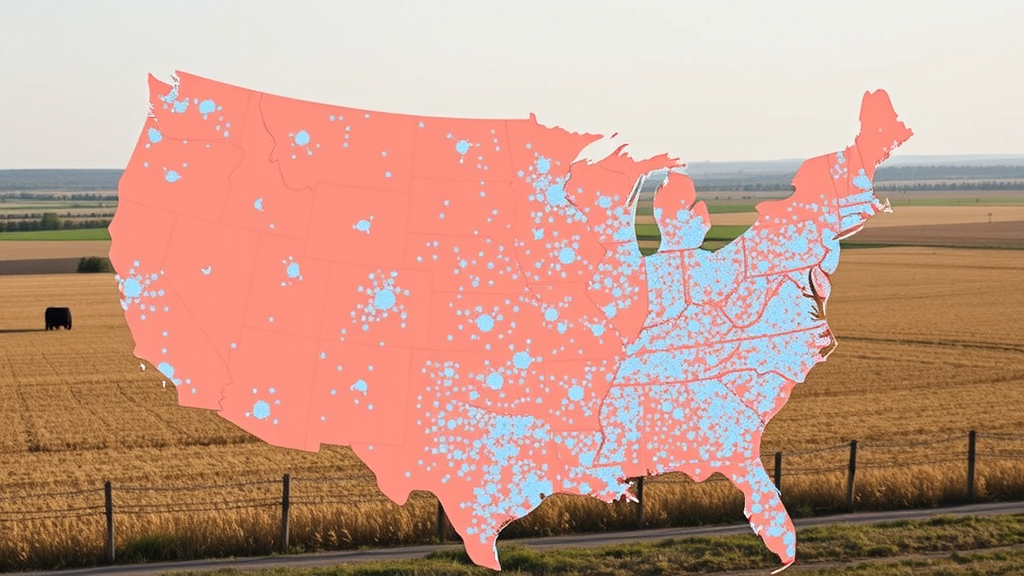
For more than a decade, social scientists have puzzled over a seemingly simple question: do American workers in rural areas feel as good about their jobs as workers in cities? Traditional surveys have never offered a clear answer, largely because fine-grained, nationwide data on job satisfaction simply do not exist. A new study published in Social Indicators Research by Stefano M. Iacus of Harvard University and Giuseppe Porro of the University of Insubria takes a strikingly different route to the answer. Instead of asking workers what they think, the researchers listened to what they spontaneously said, analyzing approximately 2.6 billion geolocated tweets posted across the United States between January 2013 and June 2023. What emerges is a portrait of American working life that conventional labor statistics have never been able to capture, revealing a deep and widening divide between metropolitan America and its most rural corners.
The backbone of the study is a novel indicator called jobsat, one of 46 measures in the broader Human Flourishing Geographic Index, a county-level dataset conceptually grounded in Harvard’s Human Flourishing Program. To build it, the researchers fine-tuned an open-source large language model, Llama 3.2 with 3 billion parameters, to classify every tweet in the Harvard CGA Geotweet Archive according to whether it expressed job satisfaction or dissatisfaction, and with what intensity. Human coders first manually annotated thousands of tweets to teach the model the task. Each tweet was then assigned a score: minus one for clear dissatisfaction, plus one-half for moderately positive sentiment, plus one for strongly positive expression, and zero for tweets with no job-related content. Averaging these scores within county-month cells produced an indicator ranging from minus one to plus one, capturing both how often people voiced job-related feelings and the direction of those feelings at an extraordinarily fine spatial and temporal resolution.
The methodological challenge of extracting reliable signals from social media is formidable, and the authors confront it directly. Twitter users, they acknowledge, skew younger, wealthier, more educated, and more urban than the general population, and geolocated users are even more concentrated in cities and coastal areas. The researchers do not claim their data represent the American workforce as a whole. Instead, they argue that their conclusions rest on relative comparisons: whether the rural-urban gap in expressed sentiment co-moves with local unemployment rates. For platform-level demographic selection to distort those estimates, the composition of Twitter users within counties would need to shift differently in rural versus metropolitan areas as unemployment changes, conditional on statistical controls for state, year, and month. The strong consistency of their findings with independent, survey-based evidence on labor-market dynamics lends additional credibility to the approach, even as the authors flag residual uncertainties about self-selection into employment and into expressing sentiment publicly.
With the indicator in hand, the researchers turned to official statistics for context. They used the U.S. Department of Agriculture’s 2023 Rural-Urban Continuum Codes to sort counties into three groups: metropolitan counties, semi-urban non-metropolitan counties with urban populations of at least 2,500, and completely rural counties with fewer than 2,500 urban residents. Monthly unemployment rates and labor-force figures came from the Bureau of Labor Statistics’ Local Area Unemployment Statistics program, while household income estimates came from the American Community Survey. The study period, 2013 to 2023, was one of steady economic expansion, with unemployment falling almost continuously except for the pandemic shock. It was also a decade in which rural-urban inequality widened across income, employment opportunity, and poverty, making it an ideal window for examining how perceived job quality moved alongside these structural shifts.
The statistical analysis, based on five nested logistic regression models estimated on more than 282,000 county-month observations, yields three findings that stand out sharply. First, the disadvantage in expressed job satisfaction is confined to the most rural counties. Semi-urban counties actually displayed sentiment levels slightly above those of metropolitan counties, undermining the familiar image of a smooth rural-urban gradient. Completely rural counties, by contrast, sat far below: at a typical unemployment rate of 5 percent, their log-odds gap relative to metro counties was minus 0.739, which translates into a predicted gap of about 7.6 percentage points in the probability of positive job-satisfaction sentiment at the median unemployment rate.
Second, and most strikingly, this deep-rural gap is not fixed. It is procyclical, meaning it moves with the business cycle. When labor markets were tight and unemployment low, the gap ballooned: at the 10th percentile of the observed unemployment distribution, roughly 2.7 percent, the rural-metro gap reached about 10.5 percentage points. As unemployment rose toward the 90th percentile, around 8.3 percent, the gap shrank to roughly 2.7 percentage points, a narrowing of about three quarters. The data overwhelmingly supported this interaction between unemployment and rurality, and the pattern proved robust when the researchers re-estimated their models using the full nine-code rural-urban classification and an alternative ordinary least squares specification that achieved an R-squared of 0.647.
Third, the sign of the unemployment relationship itself flips across the rural-urban divide, revealing that perceived job quality moves in opposite directions in different kinds of places. In metropolitan counties, each additional percentage point of unemployment lowered the probability of positive sentiment by about 0.59 percentage points on average, with semi-urban counties behaving nearly identically. In completely rural counties, the same increase in unemployment raised the probability of positive sentiment by about 1.01 percentage points. In other words, expressed job satisfaction is procyclical in metropolitan America and countercyclical in its most rural reaches. As unemployment rises, sentiment in metro areas deteriorates while deep-rural sentiment improves, and the two converge from above. Income, meanwhile, showed a consistent positive association: a 10,000 dollar increase in median household income raised the probability of positive sentiment by roughly 1.7 percentage points.
What explains this counterintuitive rhythm? The authors point to well-documented mechanisms in the subjective well-being literature. Aggregate unemployment tends to depress the well-being of the employed largely through perceived job insecurity, and metropolitan labor markets, concentrated in cyclically sensitive service sectors, amplify those signals: when local unemployment moves in a city, it carries strong information about individual job risk. In completely rural counties, employment is anchored in less cyclical activities, so local unemployment is a weaker signal of personal danger. A social-norm channel may also operate, since the well-being cost of unemployment is smaller where being out of work is more common or less stigmatizing. The countercyclical pattern in deep-rural sentiment also dovetails with economist David Autor’s account of job polarization: dense urban labor markets have experienced sharper wage dispersion and greater sensitivity to cyclical disruption, while rural areas have retained a higher share of middle-skill occupations less exposed to that turbulence. The subjective experience of work in rural America, the study suggests, moves counter to, rather than merely independently of, the local business cycle, a nuance invisible to official statistics reported at coarser geographic or temporal scales.
The broader implications are sobering. The decade covered by the study saw tight labor markets fail to close either objective income gaps or the divide in perceived job quality; convergence, such as it was, happened only in slack labor markets and came from metro sentiment falling rather than rural sentiment rising. Tight labor markets, the authors conclude, appear to amplify rural-urban disparities in perceived job quality, compounding the well-documented widening of income disparities between places. The researchers are careful about the limits of their design: the indicator describes expressed sentiment within a self-selected population of Twitter users and cannot serve as a direct estimate of satisfaction levels across the whole workforce, and survivorship bias among remaining employed workers in downturns leaves some uncertainty about the deep-rural countercyclical response. Yet the consistency of the pattern with independent survey evidence, its robustness across model specifications, and its sheer granularity, county by county, month by month, over eleven years, make a compelling case that the big-data approach has uncovered something official statistics have missed. As rural-urban political and economic divides continue to shape American life, knowing not just where working life feels worse but precisely when the gap opens widest may prove essential for policymakers seeking to understand, and eventually narrow, the split between metropolitan and deep-rural America.
Subject of Research: Rural-urban differences in expressed job satisfaction in the United States measured through social media sentiment analysis
Article Title: Job Satisfaction Through the Lens of Social Media: Rural–Urban Patterns in the U.S.
Article References: Iacus, S. M., & Porro, G. (2026). Job Satisfaction Through the Lens of Social Media: Rural–Urban Patterns in the U.S.. Social Indicators Research, 184(2), Article 45. https://doi.org/10.1007/s11205-026-03934-5
Image Credits: AI Generated
DOI: 10.1007/s11205-026-03934-5
Keywords: job satisfaction, rural-urban divide, social media, subjective well-being, large language models, Twitter data, unemployment, labor market, county-level analysis, social indicators, rural sociology, economic inequality
Cite Scienmag News
Courtney Benton. (September 20, 2026). Billions of Tweets Reveal a Hidden Rural Job-Satisfaction Divide in America. Scienmag. https://scienmag.com/billions-of-tweets-reveal-a-hidden-rural-job-satisfaction-divide-in-america/
Courtney Benton. "Billions of Tweets Reveal a Hidden Rural Job-Satisfaction Divide in America." Scienmag, 20 September 2026, https://scienmag.com/billions-of-tweets-reveal-a-hidden-rural-job-satisfaction-divide-in-america/. Accessed 20 September 2026.
Courtney Benton. "Billions of Tweets Reveal a Hidden Rural Job-Satisfaction Divide in America." Scienmag. September 20, 2026. https://scienmag.com/billions-of-tweets-reveal-a-hidden-rural-job-satisfaction-divide-in-america/


