


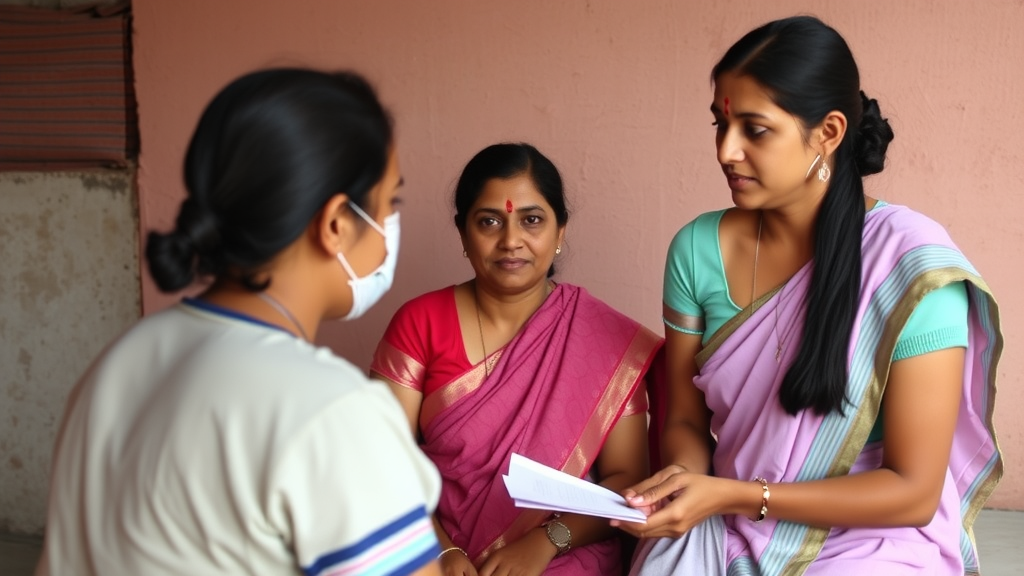
In a tertiary care hospital in South India, a twenty-minute conversation is changing how families care for adolescent girls with cerebral palsy. A pilot study published in Public Health in Practice reports that a brief, one-on-one reproductive health education session, delivered to caregivers during routine cerebral palsy clinic visits, produced dramatic gains in both knowledge and caregiving intention. The findings offer a rare, practical answer to a question that has long been neglected in low- and middle-income countries: how to equip the families of girls with disabilities to manage menstruation, hygiene, safety and reproductive rights without additional infrastructure or specialist staff.
The scale of the underlying need is considerable. The United Nations estimates that 240 million children worldwide live with some form of disability, and cerebral palsy is among the most common, affecting an estimated 2 to 2.5 per 1,000 live births globally. In India, the burden is even heavier, with a pooled prevalence of 2.95 per 1,000 children. Cerebral palsy is a lifelong neurodevelopmental condition caused by damage to the developing brain, primarily affecting movement and posture, and it is frequently accompanied by speech difficulties, feeding problems, sensory impairments and intellectual or behavioural challenges that complicate daily self-care.
Adolescence brings a distinct set of challenges for girls with cerebral palsy. Menstruation and pubertal changes can be difficult to manage when physical limitations interfere with hygiene, and communication barriers may make it hard for caregivers to recognise menstrual pain or other reproductive health concerns. These girls are also more vulnerable to abuse, and many depend entirely on their caregivers during menstruation. Yet previous research, including earlier qualitative work by some of the same authors in Indian tertiary hospital settings, has documented significant caregiver anxiety, discomfort in discussing reproductive health, and the absence of any formal support system. Caregivers often turn to informal social networks for guidance, channels that can circulate incomplete or inaccurate information.
The new study, led by Chithra Babu, Anusree Prabhakaran, Hitesh Shah and Arathi P. Rao, was designed to test whether a structured educational intervention could be woven into existing clinical workflows. Conducted between January and June 2025 at the cerebral palsy clinic of the Department of Paediatric Orthopaedics at a tertiary care referral hospital, the single-arm pretest-posttest pilot recruited 25 caregivers through consecutive sampling during weekly outpatient visits. All were primary caregivers, most were mothers, and all had been caring for their child for more than a decade. Written informed consent was obtained from every participant, and the study was approved by an institutional ethics committee and registered with the Clinical Trial Registry of India.
The intervention itself was deliberately simple. Each caregiver received a single face-to-face session lasting approximately 20 to 25 minutes, delivered by a trained public health professional in a designated room within the clinic. The session covered menstruation, menstrual hygiene, menstrual pain management, pubertal body changes, reproductive safety and the reproductive rights of girls with cerebral palsy. A validated Information, Education and Communication booklet, originally published in English and translated into the local languages Kannada and Malayalam, guided the sessions with visual illustrations and simple text. Delivery followed a strict protocol, with identical content, sequence and duration for every participant, and only participant-initiated questions addressed, to minimise researcher-related bias. Each caregiver left with a printed copy of the booklet for future reference.
Outcomes were measured with a structured questionnaire aligned to the booklet, comprising 13 knowledge items and 12 caregiving intention items rated on five-point Likert scales, content-validated by experts in public health and disability care. Baseline data were collected immediately before the session, and follow-up data were gathered by telephone three months later. Statistical analysis in JAMOVI used paired t-tests to compare pre- and post-intervention scores, with Cohen’s d calculated as the effect size and significance set at p < 0.05.
The results were striking. Mean knowledge scores rose from 41.2 to 62.3 on a scale running from 0 to 65, a change of 21.1 points that was highly statistically significant and corresponded to a very large effect size of Cohen’s d = 5.43. Caregiving intention scores climbed from 41.2 to 57.6 on a 0-to-60 scale, with an effect size of 5.22. Every one of the 25 participants completed the three-month follow-up, most reported consulting the booklet repeatedly, and no dropouts or adverse experiences were recorded. Item-level analysis showed that caregivers came to understand, among other things, that regular menstruation supports bone and heart health, that severe menstrual pain warrants a doctor’s consultation, and that irregular bleeding can be managed with medication. The intervention also corrected persistent misconceptions, including the beliefs that cerebral palsy is hereditary or that it prevents a girl from having healthy children.
Perhaps most notably, the sessions shifted caregivers’ intentions in ways that touch daily practice and long-term outlook. After the intervention, caregivers expressed stronger commitments to helping their daughters use sanitary pads independently, avoiding cotton cloth to reduce infection risk, seeking medical advice for heavy or irregular bleeding, and teaching personal safety skills such as raising an alarm in response to inappropriate behaviour. Caregivers also reported more supportive attitudes toward their daughters’ futures, including marriage, pregnancy and motherhood, domains in which pre-intervention scores were notably low. The authors suggest that the use of local-language materials and personalised one-on-one interaction may have fostered the engagement that made these gains possible.
The authors are careful to frame the findings as preliminary. Because the study had a single-arm design with no concurrent control group, causality cannot be firmly established, and the small sample of 25 participants, recruited without an a priori power calculation, may partly explain the unusually large effect sizes. Self-reported outcomes leave room for social desirability bias, the same researcher delivered the intervention and collected the data, and the questionnaire’s pre-test reliability fell below the commonly recommended threshold of 0.70, while post-test reliability could not be estimated because several items showed zero variance, a ceiling effect. The intervention was also not explicitly grounded in a theoretical framework, which the authors acknowledge may have limited its systematic development. Improvements in knowledge and intention, they note, do not automatically translate into behaviour change; health behaviour theories such as the theory of planned behaviour suggest that attitudes, subjective norms and perceived behavioural control all shape actual practice.
Even with those caveats, the policy implications are compelling. The intervention required minimal time, no additional infrastructure, and was delivered during routine cerebral palsy consultations, meaning it could be carried out by nurses, community health workers or other trained personnel under task-sharing approaches. The authors propose that community-based adaptation through special school staff or Anganwadi workers, India’s grassroots community health workers, could extend the model’s reach. Future research, they write, should employ a randomised controlled design with a larger sample, formal psychometric evaluation of the instrument, separate personnel for intervention delivery and outcome assessment, objective behavioural measures and longer follow-up. If confirmed, a brief reproductive health education session integrated into routine cerebral palsy care could become a scalable, low-cost way to close a long-standing information gap for caregivers of girls with disabilities across low-resource settings worldwide.
Subject of Research: A reproductive health education intervention for caregivers of girls with cerebral palsy in India
Article Title: Disability-inclusive reproductive healthcare: A reproductive health education intervention for caregivers of girls with cerebral palsy in India
Article References: Babu, C., Prabhakaran, A., Shah, H., & Rao, A. P. (2026). Disability-inclusive reproductive healthcare: A reproductive health education intervention for caregivers of girls with cerebral palsy in India. Public Health in Practice, 12, Article 100855. https://doi.org/10.1016/j.puhip.2026.100855
Image Credits: AI Generated
DOI: 10.1016/j.puhip.2026.100855
Keywords: cerebral palsy, reproductive health education, caregivers, menstrual hygiene management, disability-inclusive healthcare, India, pilot study, adolescent girls, public health, low- and middle-income countries, menstruation, health intervention
Cite Scienmag News
Courtney Benton. (September 20, 2026). Brief Education Session Transforms Menstrual Health Knowledge for Caregivers in India. Scienmag. https://scienmag.com/brief-education-session-transforms-menstrual-health-knowledge-for-caregivers-in-india/
Courtney Benton. "Brief Education Session Transforms Menstrual Health Knowledge for Caregivers in India." Scienmag, 20 September 2026, https://scienmag.com/brief-education-session-transforms-menstrual-health-knowledge-for-caregivers-in-india/. Accessed 20 September 2026.
Courtney Benton. "Brief Education Session Transforms Menstrual Health Knowledge for Caregivers in India." Scienmag. September 20, 2026. https://scienmag.com/brief-education-session-transforms-menstrual-health-knowledge-for-caregivers-in-india/


