


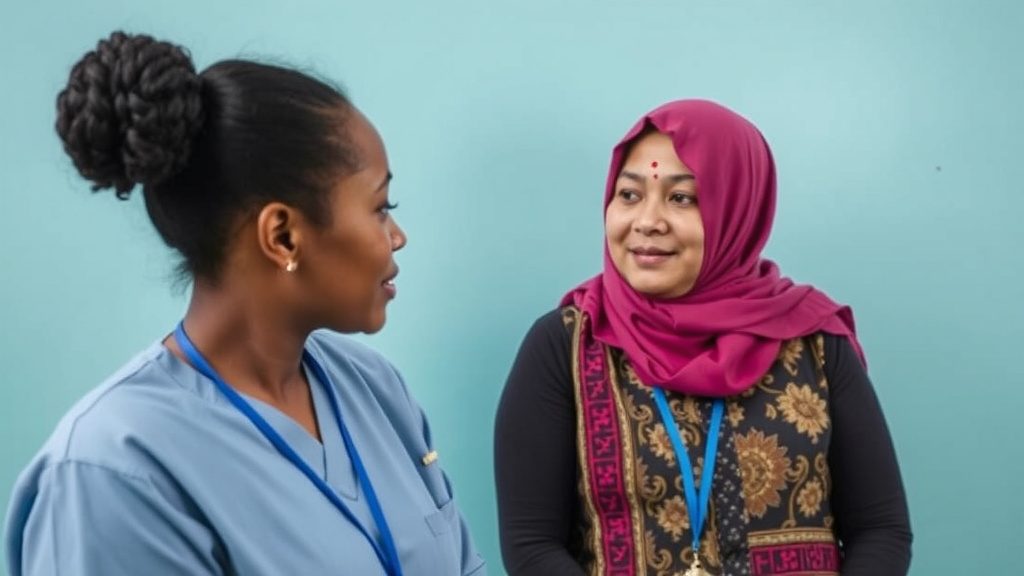
Across the Netherlands and far beyond it, millions of people quietly shoulder the daily work of caring for a family member with a mental illness. They administer medication, manage crises, comfort during psychotic episodes, and absorb the confusion and grief that psychiatric conditions bring into a household. For migrants, this already demanding role is compounded by a phenomenon researchers call the double adaptation burden: the stresses of caregiving interact with the challenges of navigating a new country, a new language, and a health system that was not designed around their cultural frameworks. A new realist evaluation published in the Community Mental Health Journal offers an unusually detailed account of how a peer education intervention in Rotterdam attempted to lighten that burden, and what conditions determined whether it actually worked.
The intervention, known by its Dutch wordplay name that translates roughly as “They Are Not Mental?!” (TANM), was designed to strengthen the resilience of informal caregivers with a migration background whose loved ones live with a suspected mental illness. It pursued three short-term goals: encouraging open conversations about mental health taboos, improving understanding of mental illnesses and available support, and fostering trust between migrant families and the healthcare sector. The program unfolded in three phases. First, four coordinating organizations recruited and trained voluntary “ambassadors”—peer educators who shared participants’ migration backgrounds and, in some cases, their caregiving experiences. Second, ambassadors facilitated three peer education sessions, delivered in the dominant language of each group, covering mental health and the role of culture, specific conditions such as schizophrenia and depression, and the role of family alongside formal support options. Third, caregivers identified during the sessions could be referred for tailored follow-up support, either in group training or one-on-one consultations with a Family-Experience-Expert, a professional who draws on personal lived experience of caring for someone with mental illness.
What makes the new study methodologically interesting is its realist evaluation design. Rather than simply asking whether TANM succeeded, the researchers, led by Malin H. L. Hollaar of Erasmus University Rotterdam, asked how, for whom, and under what circumstances it worked. Realist evaluation, developed by Pawson and Tilley, models outcomes as the product of Context-Mechanism-Outcome (CMO) configurations: specific contextual conditions activate specific mechanisms, which in turn generate outcomes. The team began with an Initial Program Theory built from twelve interviews and a focus group, then tested and refined it during the 2024–2025 implementation period using 27 semi-structured interviews with ambassadors, participants, and program staff, 10 observations of peer education sessions, and 76 anonymous post-session questionnaires. During this cycle, 11 ambassadors facilitated 11 groups attended by 138 participants, most of them women, with considerable variation in age, cultural background, and caregiving experience. Abductive and retroductive reasoning moved the analysis back and forth between the data, the initial theory, and concepts such as social learning, ultimately producing ten refined CMO-configurations validated in a focus group with the coordinating organizations.
The first cluster of findings concerns the taboo on mental illness itself. Nearly half of the participants—47.3 percent—reported experiencing a taboo around mental illness, with no significant differences between cultural groups, suggesting that shame and silence are not the property of any single community. Yet the degree to which groups became more open varied substantially, and the explanation lay in context. Groups whose ambassadors were already acquainted with participants, shared their language and cultural background, and remained available beyond the formal sessions were noticeably more open and engaged. In unfamiliar groups, conversations stayed reserved. Questionnaire analyses confirmed significant associations between prior acquaintance and the sharing of personal experiences, reinforcing that familiarity is not a soft nicety but a structural condition of disclosure.
The mechanisms behind this openness were fundamentally relational. Ambassadors worked as trusted peers, sharing reliable information while acknowledging alternative explanations for mental illness—including attributions to black magic, divine punishment, or the evil eye—rather than dismissing them. Trust emerged as the prerequisite for everything else, a point program staff emphasized by noting that shame and taboo exist in all cultures, and that the only way around them is building enough comfort for people to speak. Ambassadors deliberately engineered safety: setting explicit confidentiality rules, or encouraging indirect sharing. One ambassador described a participant who asked questions “on behalf of a friend” for two full sessions before revealing in the third that the friend was herself. Another described modeling vulnerability—sharing her own experiences or relatable anecdotes—which could trigger a domino effect of disclosures across the group, provided a basic level of trust was already in place.
The second cluster of findings addressed the bridge between informal family care networks and formal healthcare services. Ambassadors recruited participants through their peer role, enabled by their social capital and connections in both formal and informal networks. Recruitment strategies mattered enormously: ambassadors who drew on their own existing community groups or used one-to-one invitations generated many more referrals to the follow-up support phase than ambassadors who appeared as guest speakers in unfamiliar groups. Cultural alignment even shaped how the intervention was introduced. Some ambassadors framed the sessions as discussions about “taboos” rather than naming mental illness upfront, given the cautiousness such topics provoke. The researchers also found that TANM’s Dutch title lost its stigmatizing-ironic wordplay among non-native speakers—its primary target audience—an unexpected barrier to communication.
Clusters three and four traced the path to actual help-seeking and the unexpected role of social support. Before participants could seek help, many first had to recognize themselves as informal caregivers at all, since in many cultures caregiving is framed as a natural family duty rather than a distinct role, and seeking outside help can feel like failing that duty. Overcoming fear and distrust toward formal institutions—including fear that a child might be removed from the home, or wariness rooted in earlier negative encounters with providers—required trusted, independent-seeming guides such as ambassadors and the Family-Experience-Expert. Knowledge of the Dutch care system was transmitted through shared frames of reference, allowing ambassadors to contextualize advice in culturally recognizable terms; one ambassador explained how she could understand a participant consulting an imam or receiving ruqya, a form of spiritual healing involving Quranic recitation, and build on it rather than dismissing it. Strikingly, the researchers discovered that some participants joined primarily for social connection and emotional support rather than information, revealing a psychosocial spillover effect the intervention’s designers had not anticipated. In some cases, peer contact continued long after the formal sessions ended.
The study’s implications cut two ways. On one hand, the findings demonstrate that “being a peer” is not a fixed identity but a relational position constructed through shared culture, language, religion, or lived experience—which explains why the Family-Experience-Expert, whose similarity to participants was experiential rather than cultural, could build trust just as effectively. The ambassadors’ role modeling aligns closely with Bandura’s social learning theory: participants adopt behaviors when demonstrated by someone perceived as similar to themselves, and continued availability reinforces that change over time. On the other hand, this centrality exposed a structural vulnerability. Ambassadors described their roles as demanding, emotionally taxing, and extending well beyond the intervention period without supervision, structural support, or adequate compensation—a pattern documented previously among peer educators in HIV/AIDS prevention and workplace mental health. The researchers recommend structured support and fair compensation for ambassadors, mechanisms for transferring the Family-Experience-Expert’s experiential knowledge rather than concentrating it in a single person, and recruitment through ambassadors’ own groups or individual invitations rather than guest-speaking arrangements.
Perhaps the most sobering conclusion is that even a well-designed, culturally sensitive intervention cannot close the gap alone. Persistent structural barriers—language difficulties, jargon-heavy communication, culturally insensitive practices, and negative past experiences with care professionals—continued to shape participants’ trust and help-seeking, and these lie largely beyond the scope of any peer education program. The authors are explicit that interventions like TANM are a necessary but partial response, effective only when accompanied by system-level investment in culturally sensitive communication and care practices. Future evaluations, they argue, should track longer-term outcomes such as resilience and sustained help-seeking, and researchers working with underserved groups should ask whether the barriers lie within communities or within the research approaches themselves. For migrant caregivers navigating stigma, fear, and family expectations, the study suggests that the most powerful lever remains deceptively simple: someone like them, available over time, who understands both languages—the literal one and the cultural one.
Subject of Research: Realist evaluation of a peer education intervention supporting migrant informal caregivers of people with mental illness in Rotterdam.
Article Title: Navigating Stigma and Support: Realist Evaluation of Support for Migrant Informal Caregivers of Loved Ones with Mental Illness
Article References: Hollaar, M. H. L., Buis, P., Smedts, M., Uysal-Bozkir, Ö., Kocken, P. L., & Denktaş, S. (2026). Navigating Stigma and Support: Realist Evaluation of Support for Migrant Informal Caregivers of Loved Ones with Mental Illness. Community Mental Health Journal. https://doi.org/10.1007/s10597-026-01728-0
Image Credits: AI Generated
DOI: 10.1007/s10597-026-01728-0
Keywords: informal caregivers, migration background, mental illness, peer education, realist evaluation, stigma, trust, resilience, help-seeking, culturally sensitive care, social support, Rotterdam
Cite Scienmag News
Glenn Wilkins. (September 20, 2026). Peer Ambassadors Help Migrant Caregivers Break Mental Health Stigma. Scienmag. https://scienmag.com/peer-ambassadors-help-migrant-caregivers-break-mental-health-stigma/
Glenn Wilkins. "Peer Ambassadors Help Migrant Caregivers Break Mental Health Stigma." Scienmag, 20 September 2026, https://scienmag.com/peer-ambassadors-help-migrant-caregivers-break-mental-health-stigma/. Accessed 20 September 2026.
Glenn Wilkins. "Peer Ambassadors Help Migrant Caregivers Break Mental Health Stigma." Scienmag. September 20, 2026. https://scienmag.com/peer-ambassadors-help-migrant-caregivers-break-mental-health-stigma/


