


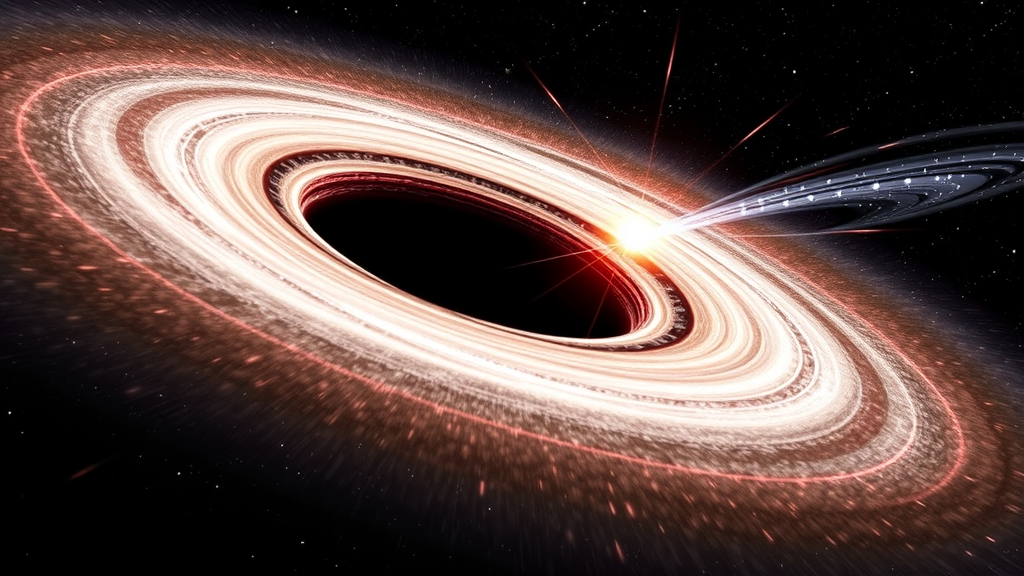
One of the most unsettling questions in modern cosmology is what happens to a black hole when the universe itself undergoes a catastrophic transformation. In the standard picture of a hot big bang, the cosmos emerges from a singularity, a point where the equations of general relativity break down entirely. But a growing number of theoretical physicists favor an alternative scenario: a cosmic bounce, in which a preceding contracting universe rebounds into an expanding one without ever passing through a true singularity. Now, a new theoretical study published in the journal General Relativity and Gravitation tackles a question that has lingered at the edge of this research program for years. If the universe once bounced, would black holes that formed before the bounce survive the transition, or would they be torn apart, erased, or fundamentally altered by the violent dynamics of the reversal?
The research, carried out by B. Yildirim and A. A. Coley of the Department of Mathematics and Statistics at Dalhousie University in Halifax, Canada, approaches the problem through the mathematics of scalar-tensor gravity. This class of theories extends Einstein’s general relativity by adding a scalar field that dynamically couples to the curvature of spacetime. Scalar-tensor gravity has long attracted attention in cosmology because it provides a natural mathematical setting in which nonsingular bouncing universes can be realized. In such models, the scalar field’s evolution can drive a contraction to a halt and trigger a rebound, replacing the dreaded big bang singularity with a smooth, finite transition. But while bouncing cosmologies have been studied extensively in homogeneous settings, the inclusion of localized objects such as black holes makes the field equations dramatically harder to solve.
To make progress, the authors adopted a perturbative strategy, treating the black hole as a small deviation from an otherwise perfectly uniform cosmos. At leading order in their perturbative scheme, controlled by a small parameter epsilon, the solution is a spatially flat Friedmann-Lemaître-Robertson-Walker, or FLRW, spacetime undergoing a bounce, sourced by a perfect fluid of radiation. This background captures the essence of a bouncing cosmology in the simplest possible form: the universe contracts, reaches a minimum size at a moment identified with a conformal time coordinate eta equal to zero, and then re-expands. This leading-order solution respects what the authors call the parabolic structure of the bounce, a smoothness condition on how the scale factor behaves at the turning point.
At the next order in the expansion, the team embedded a central inhomogeneity into the bouncing background using a generalized McVittie geometry. The original McVittie solution, constructed in 1933, is a celebrated exact solution of general relativity that describes a mass concentrated at the center of an expanding universe, providing a mathematically tractable bridge between black hole physics and cosmology. By generalizing this construction to the scalar-tensor setting and treating it perturbatively, Yildirim and Coley encoded the gravitational imprint of a localized compact object within the contracting and rebounding cosmos. The perturbations appear as first-order corrections to the metric and to the scalar field, and the coupled field equations were solved as a series expansion carried up to fourth order in the parameter eta near the bounce.
A central technical challenge arose from the nature of the matter content near the inhomogeneity. In the vicinity of a concentrated mass, the stress-energy generically becomes anisotropic, meaning that pressure differs along the radial direction compared with the tangential directions. The authors therefore first allowed an anisotropic fluid with separate radial and tangential pressures, whose diagonal components suffice to solve the diagonal components of the field equations. They then imposed the physically motivated condition that the stress-energy reduce to a perfect fluid, one with a single isotropic pressure, far from the center. The resulting perfect fluid solution contains three arbitrary functions, which are constrained by demanding that the spacetime smoothly asymptote to the homogeneous FLRW background as the radial coordinate tends to infinity, ensuring that the black hole’s influence fades with distance as it must.
With suitable initial conditions chosen to preserve the parabolic structure of the bounce, a remarkable simplification emerged. The solution’s integration constants consolidate into a single quantity, denoted d0, which the authors identify as the true perturbative parameter of the problem. When d0 is set to zero, every perturbation vanishes and the spacetime reverts exactly to the homogeneous bouncing FLRW universe. When d0 is small but nonzero, a localized inhomogeneity, and with it a small evolving horizon, appears in the geometry. This clean parametrization means the entire structure of the black hole embedding is controlled by one number, allowing the authors to track precisely how the compact object’s gravitational field responds to the cosmic contraction and rebound.
The key result of the analysis concerns the fate of that horizon. Yildirim and Coley find a small evolving horizon whose radius scales linearly with the perturbative parameter, roughly as d0, and which they interpret as the horizon of the central inhomogeneity. Crucially, this horizon persists through the bounce at eta equals zero, supporting the interpretation that a black hole present before the cosmological transition survives it and continues to exist in the expanding universe on the other side. Intriguingly, the evolution is not symmetric about the bounce: the horizon’s behavior on the contracting side differs from its behavior on the expanding side, suggesting that the cosmic reversal leaves a subtle imprint on the object even as it survives. In a cosmological context, such findings resonate with long-standing speculations about black holes from a previous cosmic epoch, sometimes discussed in connection with ideas about the origin of supermassive black holes and the possible relics of a pre-bounce universe.
The authors are careful about what their construction does and does not establish. The small horizon they track is a future outer trapping horizon, a locally defined surface characterized by the convergence properties of outgoing and ingoing light rays, and it behaves as such in a two-sided neighborhood of the bounce. Because the entire construction is local and perturbative, it does not demonstrate the existence of a global event horizon, the teleological boundary beyond which nothing can escape to infinity. The distinction matters in a dynamical spacetime, where global horizons are notoriously difficult to define and can depend on the entire future evolution of the cosmos. Still, the persistence of a local trapping horizon through a nonsingular bounce is a nontrivial and suggestive result, indicating that the mechanisms of black hole formation and survival may be more robust under extreme cosmological conditions than simpler arguments had implied.
The work also fits into a broader effort to understand how inhomogeneities behave in bouncing scenarios. Previous studies have explored whether structure formation is possible through a bounce, whether primordial black holes can survive ekpyrotic contractions, and how numerical simulations of nonsingular bouncing spacetimes handle black holes and their horizons. By providing an analytic, perturbative solution in scalar-tensor gravity, the Dalhousie team adds a complementary tool to this mostly numerical and heuristic literature. The mathematical framework, combining generalized McVittie geometries with a controlled expansion around a radiation-dominated bounce, offers a concrete laboratory in which questions about horizons, matter anisotropies, and scalar-field dynamics can be addressed with precision. While the analysis is idealized, assuming spherical symmetry, a radiation fluid, and a small perturbation strength, it demonstrates that black hole persistence through a bounce is a mathematically consistent possibility in a well-motivated class of gravitational theories, bringing the speculative picture of black holes bridging cosmic epochs one step closer to rigorous footing.
Subject of Research: Perturbative scalar-tensor cosmology modeling black hole survival through a nonsingular bouncing universe
Article Title: Black hole persistence in scalar-tensor theories
Article References: Yildirim, B., & Coley, A. A. (2026). Black hole persistence in scalar-tensor theories. General Relativity and Gravitation, 58(9), Article 111. https://doi.org/10.1007/s10714-026-03610-6
Image Credits: AI Generated
DOI: 10.1007/s10714-026-03610-6
Keywords: black holes, scalar-tensor gravity, bouncing cosmology, general relativity, McVittie metric, trapping horizon, FLRW spacetime, cosmic bounce, perturbation theory, theoretical cosmology, nonsingular cosmology, gravitational physics
Cite Scienmag News
Grant Pearson. (September 20, 2026). Black Holes Could Survive a Cosmic Bounce, New Study Suggests. Scienmag. https://scienmag.com/black-holes-could-survive-a-cosmic-bounce-new-study-suggests/
Grant Pearson. "Black Holes Could Survive a Cosmic Bounce, New Study Suggests." Scienmag, 20 September 2026, https://scienmag.com/black-holes-could-survive-a-cosmic-bounce-new-study-suggests/. Accessed 20 September 2026.
Grant Pearson. "Black Holes Could Survive a Cosmic Bounce, New Study Suggests." Scienmag. September 20, 2026. https://scienmag.com/black-holes-could-survive-a-cosmic-bounce-new-study-suggests/


