


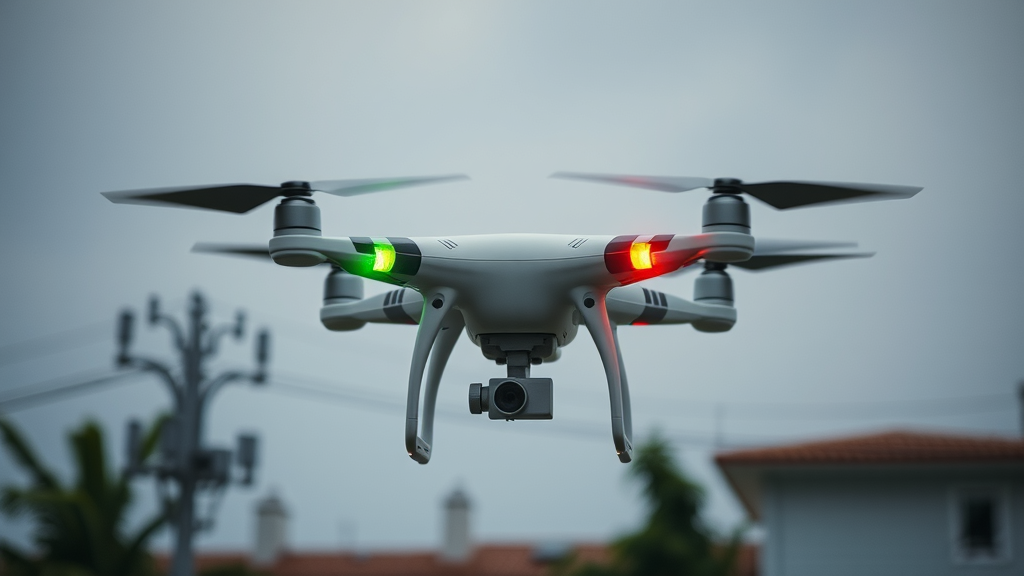
When a natural disaster tears through cellular infrastructure, the first units in the sky are often battery-powered drones configured as flying relay stations. Their Achilles’ heel is the same as that of every battery-operated device in a next-generation wireless network: energy. A new study published in Mobile Networks and Applications proposes a scheme called power scavenging, or PSV, that lets a drone acting as an aerial relay harvest radio-frequency energy from the very signals it forwards, extending the operational life of cooperative communication networks precisely when they matter most.
The research, led by Nikita Goel and Pankaj Kumar of Manipal Institute of Technology together with Vrinda Gupta of the National Institute of Technology Kurukshetra, tackles a scenario known as drone-assisted cooperative communication, or DACC. In such systems, a source node on the ground cannot reach the destination directly with sufficient quality, so a drone hovering between them receives the signal, strengthens it, and retransmits it. Because the drone is the linchpin of the link, draining its battery quickly collapses the entire connection, which is why the authors focused their energy-harvesting design on the relay itself.
What distinguishes this work from earlier energy-harvesting schemes is the way the drone decides how much of each received signal to divert into its battery. Conventional designs use a fixed power-splitting factor, dividing every incoming signal by a constant fraction regardless of conditions. The researchers instead introduce a statistical, height-dependent splitting factor. At any given altitude and set of environmental parameters, the drone computes the probability that a line-of-sight path exists between itself and the ground node, then sets its scavenging ratio accordingly. When the line-of-sight probability is high and received power is strong, the drone banks more energy; when the path is obstructed, it shifts the balance back toward information transmission.
The physics behind that decision rests on the air-to-ground channel model. Rather than assuming the idealized extremes used in much of the prior literature, the team modeled the link between the drone and ground users with Nakagami-m fading, a flexible statistical model that can capture mixtures of line-of-sight and non-line-of-sight propagation. The direct ground link between source and destination, assumed to be purely non-line-of-sight in the dense scenario they study, uses Rayleigh fading. Crucially, because the drone moves vertically, the channels in this hybrid environment are not independent: the correlation between the source-drone, drone-destination, and direct links varies with altitude, and the mathematical framework explicitly tracks this height-dependent correlation.
Within this correlated hybrid fading environment, the researchers derived closed expressions for two key performance metrics: outage probability, the chance that the link fails to deliver a target data rate, and achievable rate at the destination. The destination node combines the direct signal received in the first time slot with the relayed signal received in the second using maximum ratio combining, extracting the best of both paths. The drone can operate in either amplify-and-forward mode, which scales and retransmits the analog received signal, or decode-and-forward mode, which decodes, re-encodes, and retransmits it. Two algorithms were developed: one governing the scavenging and information-splitting decisions at the drone, and another computing rate and outage probability across the correlated channel environment, implemented in MATLAB simulations.
The simulation results reveal a nuanced trade-off. Outage probability rises with drone altitude in every scenario considered, an effect the authors attribute to the Nakagami-m shaping parameters being treated as height-independent, so that path loss eventually dominates any line-of-sight gain. When the drone transmits using only the power it has harvested, performance is worst, because the harvested energy fluctuates with channel conditions from one transmission session to the next. The best configuration lets the drone transmit at a fixed, relatively high power while simultaneously scavenging energy to sustain it, effectively replenishing the battery that would otherwise deplete steadily.
That sustained battery translates directly into longevity. Compared with a system in which the drone draws all relay power from its primary battery, the power-scavenging scheme completes significantly more communication cycles for the same initial charge, and substantially more packets arrive successfully at the destination. Although harvesting does slightly worsen outage performance in some regimes, because power siphoned into the battery is unavailable for retransmission, the authors show that this drawback is outweighed by the dramatic increase in total delivered data over the life of the network. In a crisis scenario, that difference is measured not in abstract metrics but in the number of messages that get through before the aerial relay falls silent.
Environment matters as well. The team compared outage behavior across dense urban, urban, and suburban settings, finding the worst results in dense urban terrain, where tall buildings suppress the probability of a line-of-sight connection and depress the received signal-to-noise ratio, while suburban environments, with clearer sightlines, performed best. The height-dependent splitting factor adapts across all of these contexts, adjusting scavenging intensity to the environment-specific line-of-sight probability in a way that a static design cannot.
The study also contributes a sharper account of channel correlation than most prior drone-relay analyses. At low altitudes, the source-drone and source-destination links, as well as the drone-destination and direct links, exhibit strong correlation because the geometry of the moving drone couples them; as the drone climbs, that coupling weakens and different link pairs take on the stronger relationship. Because most of the literature treats relay channels as fixed and independent, this height-driven correlation dynamic has been largely overlooked, even though it materially affects outage and rate predictions in real deployments.
The authors position the work within the march toward 5G and beyond-5G networks, where users demand higher throughput, better reliability, and lower energy consumption from battery-constrained devices, and where drones are increasingly folded into cooperative communication architectures. They note that the scheme applies to infrastructure-less wireless networks generally, and that extending it to multi-user scenarios and deriving closed-form performance expressions are the next research steps. For disaster response teams weighing how long an aerial relay can keep a shattered network breathing, the message is that the drone’s own下行 data stream can double as a fuel line, and that tuning how much of that stream to bottle up, altitude by altitude, can stretch mission endurance considerably.
Subject of Research: A height-dependent radio-frequency energy harvesting scheme for drone-assisted cooperative communication in correlated hybrid fading channels.
Article Title: Power Scavenging for Strengthening the Life Cycle of Cooperative Devices in Correlated Hybrid Fading Environment
Article References: Goel, N., Gupta, V., & Kumar, P. (2026). Power Scavenging for Strengthening the Life Cycle of Cooperative Devices in Correlated Hybrid Fading Environment. Mobile Networks and Applications. https://doi.org/10.1007/s11036-026-02526-4
Image Credits: AI Generated
DOI: 10.1007/s11036-026-02526-4
Keywords: drone relays, energy harvesting, cooperative communication, Nakagami-m fading, channel correlation, outage probability, power splitting, UAV communications, network lifetime, wireless networks, 5G, disaster response
Cite Scienmag News
Faith Mcneil. (September 20, 2026). Drones That Scavenge Power Could Keep Disaster Networks Alive Far Longer. Scienmag. https://scienmag.com/drones-that-scavenge-power-could-keep-disaster-networks-alive-far-longer/
Faith Mcneil. "Drones That Scavenge Power Could Keep Disaster Networks Alive Far Longer." Scienmag, 20 September 2026, https://scienmag.com/drones-that-scavenge-power-could-keep-disaster-networks-alive-far-longer/. Accessed 20 September 2026.
Faith Mcneil. "Drones That Scavenge Power Could Keep Disaster Networks Alive Far Longer." Scienmag. September 20, 2026. https://scienmag.com/drones-that-scavenge-power-could-keep-disaster-networks-alive-far-longer/


