


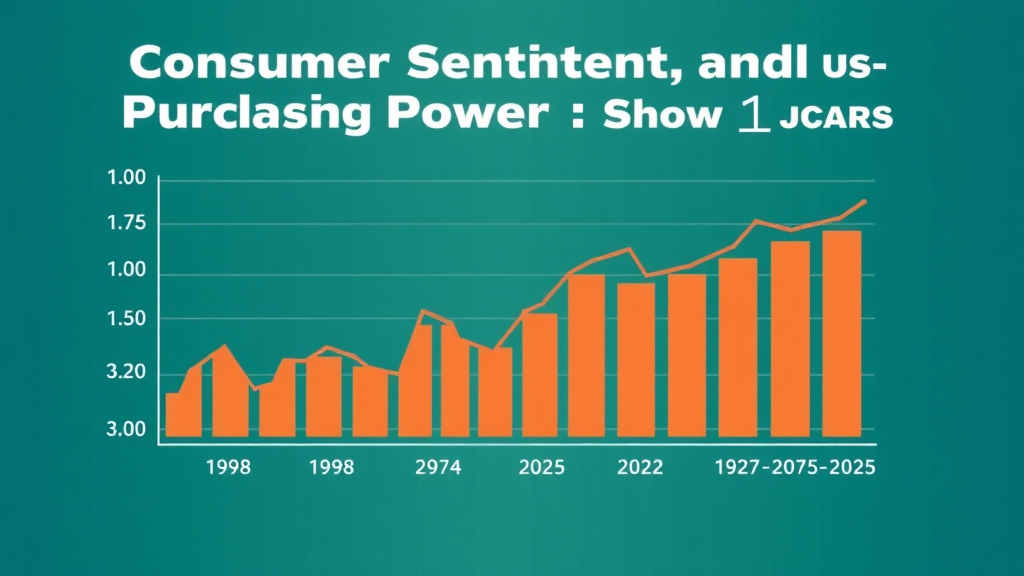
A new study of nearly five decades of American economic data has found that the way consumers feel about the economy and the real value of their money share a striking statistical property: both behave as if they carry a long memory, with shocks lingering far into the future rather than fading quickly. The research, published in the journal Discover Sustainability, analyzes monthly readings of the University of Michigan Index of Consumer Sentiment alongside the purchasing power of the consumer dollar from January 1978 through March 2025, offering one of the most detailed persistence profiles of these closely watched series ever assembled.
The team, led by Manuel Monge of Universidad Francisco de Vitoria and Universidad Europea de Valencia in Spain, together with Jorge Aracil Jordá of Universidad Pontificia de Comillas and Juan Infante of Universidad Villanueva, set out to resolve a long-standing ambiguity in applied economics. Although consumer expectations and price levels are among the most intensively tracked macroeconomic indicators in the world, the applied literature offers a bewildering range of descriptions of their time-series behavior. Different studies classify the same series as stationary, trending, or unit-root processes depending on the tests used and the sample chosen, leaving policymakers without a clear picture of how lasting an economic shock to confidence or purchasing power really is.
To cut through that ambiguity, the authors adopted what they describe as a unitary empirical strategy rather than a conventional multivariate one. Each series was examined on its own terms, with inflation and general consumer confidence indicators maintained as context series. The first step was a rigorous classification of the order of integration of each variable using augmented versions of the Dickey-Fuller and Kwiatkowski-Phillips-Schmidt-Shin procedures, two of the workhorse tools of time-series econometrics. By explicitly accounting for deterministic specifications such as intercepts and trends, these tests determine whether a series must be differenced once to become stable, or whether it already fluctuates around a fixed mean.
The results of that first stage were clear. The Index of Consumer Sentiment, the purchasing power of the consumer dollar, and the broader consumer confidence index all emerged as first-order integrated, meaning they are non-stationary in levels and only settle down after being differenced. Inflation, by contrast, proved to be level stationary, fluctuating around a stable long-run value without requiring differencing. The purchasing power series itself was constructed as the inverse of the Consumer Price Index for all items for urban consumers, so it directly measures how much real consumption a dollar can command at any point in time.
But the study did not stop at the binary distinction between stationary and non-stationary. The authors then estimated a fractional differencing parameter for each series, allowing the order of persistence to lie along a continuum rather than forcing each variable into one of two rigid categories. This fractional integration framework, which has gained traction in macroeconomics over recent decades, captures the idea that many economic processes are neither quickly mean-reverting nor permanently drifting, but something in between: they remember shocks for a very long time, with the effect of any disturbance decaying only slowly, often over years or decades.
The fractional estimates delivered the study’s most intriguing finding. For consumer sentiment, purchasing power, and consumer confidence, the estimated differencing parameters clustered slightly below or slightly above one, placing all three processes in the non-stationary region of the continuum while still implying a capacity for slow recovery toward their means. In practical terms, this means that a collapse in consumer confidence or an erosion of real purchasing power is not necessarily permanent: the series can, in principle, drift back toward their historical average levels, but only gradually, with the imprint of the shock visible in the data for a long time. The consumer price index itself, meanwhile, was not easily differentiated from a unit root, indicating that price levels behave as though shocks to them accumulate without a reliable tendency to reverse.
Perhaps the most counterintuitive result concerns purchasing power. Among the mean-reverting series in the study, purchasing power turned out to be the most mean-reverting of all, a finding the authors note runs contrary to most expectations, which hold that mean-reverting data should exhibit the longest memory. The implication is that the real value of the consumer dollar, despite being buffeted by oil shocks, financial crises, pandemic-era supply disruptions, and the sharp inflation surge of 2021 through 2023, retains a stronger tendency to return toward its long-run level than sentiment or confidence measures do. Each series was specifically characterized through the results, giving economists a persistence fingerprint for every variable examined.
The authors are careful to draw a boundary around what their findings do and do not mean. The study finds no relationship between the estimated sentiment levels and affordability conditions, nor does it assert one. In other words, the statistical memory properties of consumer sentiment and the memory properties of purchasing power are characterized separately, and the paper does not claim that one drives the other or that the degree of persistence in feelings about the economy can be read off from the degree of persistence in prices. That restraint matters, because the temptation to link confidence and affordability causally is strong in both public debate and policy discussions.
Even so, the findings carry real weight for how economists and policymakers interpret the American economic mood. If consumer sentiment behaves as a highly persistent, near-unit-root process, then campaigns or interventions designed to restore confidence after a downturn should not expect rapid normalization; the psychological scar of a recession may persist for years, shaping spending and investment decisions long after objective conditions improve. Conversely, the comparatively stronger mean reversion in purchasing power suggests that the erosion of real wages and savings, while painful, has historically tended to correct itself over time as inflation subsides and nominal incomes adjust, a pattern visible in the data following the inflationary episodes of the early 1980s and the post-pandemic period.
The study also demonstrates the value of fractional integration methods for macroeconomic monitoring more broadly. Traditional unit-root tests force a stark either-or choice that can mislead: a series with a differencing parameter of 0.95 and one with a parameter of 1.05 may both fail standard stationarity tests, yet their long-run behavior differs meaningfully, with the former eventually reverting and the latter drifting without bound. By estimating the differencing parameter directly and reporting it along a continuum, the Spanish research team has provided a more nuanced map of persistence in some of the most consequential numbers in American economic life, from the confidence consumers express in surveys each month to the quiet, cumulative erosion and recovery of the dollar in their pockets. As debates over inflation, affordability, and economic anxiety continue to dominate headlines, the message of this research is that both prices and perceptions move on long timescales, and understanding their memory may be essential to anticipating when, and whether, they will return to normal.
Subject of Research: Long memory and fractional integration in US consumer sentiment and purchasing power, 1978 to 2025
Article Title: Long memory in consumer sentiment and consumer dollar purchasing power in the United States from 1978 to 2025
Article References: Monge, M., Jordá, J. A., & Infante, J. (2026). Long memory in consumer sentiment and consumer dollar purchasing power in the United States from 1978 to 2025. Discover Sustainability. https://doi.org/10.1007/s43621-026-04367-3
Image Credits: AI Generated
DOI: 10.1007/s43621-026-04367-3
Keywords: consumer sentiment, purchasing power, fractional integration, long memory, unit root testing, inflation persistence, consumer confidence, University of Michigan Index of Consumer Sentiment, mean reversion, US macroeconomic time series, Discover Sustainability, time-series econometrics
Cite Scienmag News
Violet Maxwell. (September 13, 2026). Consumer Sentiment and Purchasing Power Show Long Memory in US Data From 1978 to 2025. Scienmag. https://scienmag.com/consumer-sentiment-and-purchasing-power-show-long-memory-in-us-data-from-1978-to-2025/
Violet Maxwell. "Consumer Sentiment and Purchasing Power Show Long Memory in US Data From 1978 to 2025." Scienmag, 13 September 2026, https://scienmag.com/consumer-sentiment-and-purchasing-power-show-long-memory-in-us-data-from-1978-to-2025/. Accessed 13 September 2026.
Violet Maxwell. "Consumer Sentiment and Purchasing Power Show Long Memory in US Data From 1978 to 2025." Scienmag. September 13, 2026. https://scienmag.com/consumer-sentiment-and-purchasing-power-show-long-memory-in-us-data-from-1978-to-2025/


