


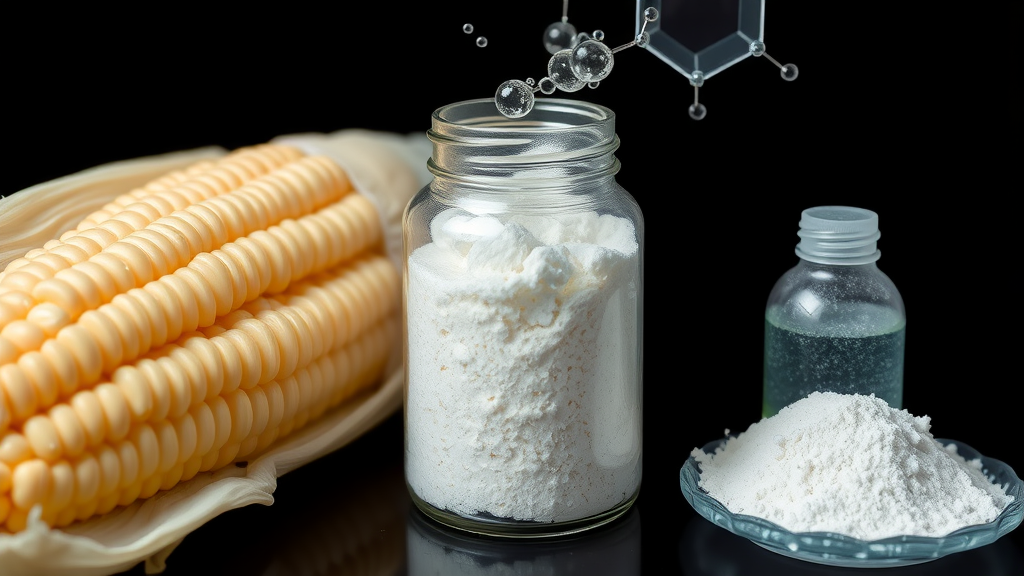
A team of researchers at Quaid-i-Azam University in Islamabad has shown that an ordinary kitchen staple, corn starch, can be transformed into a surprisingly capable solid electrolyte for lithium-ion batteries when it is combined with the right additives. In work published in Discover Electrochemistry, Muhammad Numan, Sajal Arwish, Khizar Hayat Khan, Syed Mujtaba Shah, and Hazrat Hussain report that blending lithium perchlorate salt into a biodegradable corn starch matrix, then further adding the triblock copolymer Pluronic as a plasticizer and tiny amounts of graphene oxide as a nanofiller, lifts the room-temperature ionic conductivity to 3.55 × 10⁻⁵ S cm⁻¹, nearly ten times higher than a starch-salt electrolyte on its own. Because the optimized film also delivers an ion transference number of 0.90 and remains thermally stable above 230 °C, the study offers a compelling case that renewable biopolymers can compete with synthetic polymer hosts in the race toward safer, greener energy storage.
The motivation stems from a well-known weakness of conventional lithium-ion batteries. Since their commercial debut in 1991, these devices have relied on flammable liquid organic carbonate electrolytes that permit uneven lithium flux and the growth of metallic dendrites, structures that can pierce the separator, trigger internal short circuits, thermal runaway, and in extreme cases fire or explosion. Solid-state electrolytes act as a physical barrier to dendrite growth and are widely regarded as the safest long-term solution. Inorganic ceramic conductors achieve superb conductivities between 10⁻³ and 10⁻² S cm⁻¹ but are brittle, hard to process at scale, and suffer from high interfacial impedance. Polymer electrolytes, by contrast, are flexible and electrode-compatible but typically conduct at a sluggish 10⁻⁷ S cm⁻¹, a gap the new work sets out to narrow using sustainable materials.
Composite polymer electrolytes, which disperse a secondary filler into a polymer host, have long been used to push conductivity upward. Fillers suppress polymer recrystallization, create amorphous regions and grain boundaries, and promote salt dissociation through Lewis acid-base interactions. Yet most polymer hosts studied to date, including polyethylene oxide, poly(methyl methacrylate), PVDF, polyacrylonitrile and poly(vinyl alcohol), derive from fossil feedstocks and are not biodegradable. Biopolymers offer a striking alternative: cellulose, chitosan, lignin and starch are abundant, renewable, nontoxic and richly decorated with polar hydroxyl and ether groups that can coordinate lithium ions and host high salt loadings. Corn starch in particular, composed of roughly 20 to 30 percent linear amylose and 70 to 80 percent branched amylopectin linked by alpha glycosidic bonds, is cheap, lightweight and compatible with ionic salts, making it an attractive host for solid electrolyte research.
The researchers fabricated their films by solution casting. Corn starch was dispersed in a dilute acetic acid solution at 80 °C, lithium perchlorate was added in concentrations from 20 to 50 weight percent, and the mixtures were stirred, cast onto Teflon dishes and dried under vacuum to yield free-standing membranes roughly 140 micrometers thick. Electrochemical impedance spectroscopy identified 40 weight percent salt as the optimum: below that limit, conductivity rose with charge carrier concentration, while above it undissociated salt accumulated and impeded ion motion. Building on that baseline, the team introduced Pluronic, a PEG-PPG-PEG triblock copolymer, at 10 to 30 weight percent, and finally dispersed graphene oxide, synthesized by the modified Hummers method, at loadings of 0.1 to 0.7 weight percent into the best plasticized formulation.
Fourier transform infrared spectroscopy revealed exactly what each additive does to the starch structure. The ratio of the crystalline band at 993 cm⁻¹ to the amorphous band at 1015 cm⁻¹, a standard order parameter, fell from 1.24 for neat starch to 0.98 with salt, then to 0.69 after Pluronic addition and to 0.65 once graphene oxide was incorporated. Peak shifts and broadening across the fingerprint region confirmed complexation between lithium ions and the starch oxygen atoms, while the gradual disappearance of the band at 1366 cm⁻¹ signaled progressive disruption of crystalline order. The result is a predominantly amorphous matrix in which polymer chain segments can move freely, a prerequisite for fast ion hopping through the electrolyte.
Perhaps the most elegant finding involves the perchlorate anion band near 623 cm⁻¹. By deconvoluting the overlapping peaks corresponding to free perchlorate and contact ion pairs, the authors quantified the fraction of dissociated salt in each film. That fraction climbed steadily as Pluronic and then graphene oxide were added, providing direct spectroscopic evidence that both additives actively break lithium-perchlorate ion pairs. Pluronic is no ordinary diluent: because its PEG and PPG segments contain ether oxygens that coordinate lithium ions, it participates directly in conduction pathways while also softening the film. Graphene oxide, with its dense surface population of hydroxyl and carboxyl groups, interacts with the salt through Lewis acid-base chemistry and creates low-energy percolation channels at the polymer-filler interface. Both effects multiply the population of mobile charge carriers.
The electrical measurements tell a consistent story. Room-temperature conductivity climbed from the salt-only baseline to 1.33 × 10⁻⁵ S cm⁻¹ at the optimal 20 weight percent Pluronic loading, and then to 3.55 × 10⁻⁵ S cm⁻¹ with 0.5 weight percent graphene oxide, roughly triple the plasticized value. Beyond 0.5 percent, graphene oxide sheets aggregate into insulating barriers that disrupt the conduction network, a phenomenon the group had documented previously in PVDF-HFP/Pluronic blend systems. Temperature-dependent impedance from 20 to 80 °C showed classic Arrhenius behavior, with conductivity reaching 6.45 × 10⁻⁴ S cm⁻¹ at 80 °C and the activation energy falling stepwise from 0.69 eV for the salt-only film to 0.67 eV with plasticizer and 0.59 eV with the nanofiller, confirming that the additives smooth the energetic landscape for lithium-ion hopping.
Direct-current polarization measurements using ion-blocking electrodes added a crucial safety metric. The ion transference number rose from 0.58 at 20 weight percent salt to 0.76 at 40 weight percent, then to 0.82 with Pluronic and finally to 0.90 in the fully optimized composite, indicating that ionic conduction overwhelmingly dominates over electronic leakage. Dielectric analysis reinforced the picture: both the dielectric constant and dielectric loss surged in the low-frequency regime as Pluronic and graphene oxide were added, a hallmark of increased free-ion density and enhanced electrode polarization. According to Bjerrum theory, the elevated dielectric constant also shortens the critical distance for ion-pair formation, further favoring salt dissociation, while the higher permittivity exponentially boosts charge carrier density. Electric modulus formalism, which suppresses electrode polarization, showed no relaxation peak within the measured frequency window, implying ion hopping times shorter than 1.6 × 10⁻⁷ seconds, fast dynamics for a biopolymer electrolyte.
Thermal data close the loop on practicality. Differential scanning calorimetry showed that the onset of chain fragmentation shifts downward as salt, plasticizer and filler are added, from 272 °C for the 20 weight percent salt film to about 253 °C for the optimized composite, but all samples remain comfortably above the operating temperatures of real batteries. The optimized conductivity is comparable to other reported systems such as starch/PEGMA (3.8 × 10⁻⁵ S cm⁻¹) and PEO/sepiolite nanoribbon composites (9.22 × 10⁻⁵ S cm⁻¹), though it trails ionic-liquid and chemically modified electrolytes in the 10⁻⁴ to 10⁻³ S cm⁻¹ range. The authors caution that their study was limited to structural characterization, impedance and dielectric analysis; validating the electrolyte in actual cells will require linear sweep and cyclic voltammetry to establish the electrochemical stability window, along with full-cell testing. If those trials succeed, tomorrow’s batteries could draw part of their backbone not from petrochemicals but from a crop grown on farms worldwide, a small but meaningful step toward truly sustainable energy storage.
Subject of Research: Biodegradable corn starch-based solid polymer electrolytes enhanced with lithium perchlorate, Pluronic plasticizer, and graphene oxide nanofiller for sustainable lithium-ion battery applications.
Article Title: Pluronic and graphene oxide influence the structural properties as well as the ionic conductivity and dielectric behavior of corn starch based solid electrolytes
Article References: Numan, M., Arwish, S., Khan, K. H., Shah, S. M., & Hussain, H. (2026). Pluronic and graphene oxide influence the structural properties as well as the ionic conductivity and dielectric behavior of corn starch based solid electrolytes. Discover Electrochemistry, 3(1), Article 69. https://doi.org/10.1007/s44373-026-00157-8
Image Credits: AI Generated
DOI: 10.1007/s44373-026-00157-8
Keywords: solid polymer electrolyte, corn starch, graphene oxide, Pluronic plasticizer, ionic conductivity, lithium perchlorate, dielectric behavior, biopolymer, lithium-ion batteries, FTIR spectroscopy, electrochemical impedance spectroscopy, sustainable energy storage
Cite Scienmag News
Neil Sanderson. (September 13, 2026). Corn Starch Electrolyte Boosted Tenfold with Plasticizer and Graphene Oxide. Scienmag. https://scienmag.com/corn-starch-electrolyte-boosted-tenfold-with-plasticizer-and-graphene-oxide/
Neil Sanderson. "Corn Starch Electrolyte Boosted Tenfold with Plasticizer and Graphene Oxide." Scienmag, 13 September 2026, https://scienmag.com/corn-starch-electrolyte-boosted-tenfold-with-plasticizer-and-graphene-oxide/. Accessed 13 September 2026.
Neil Sanderson. "Corn Starch Electrolyte Boosted Tenfold with Plasticizer and Graphene Oxide." Scienmag. September 13, 2026. https://scienmag.com/corn-starch-electrolyte-boosted-tenfold-with-plasticizer-and-graphene-oxide/


