


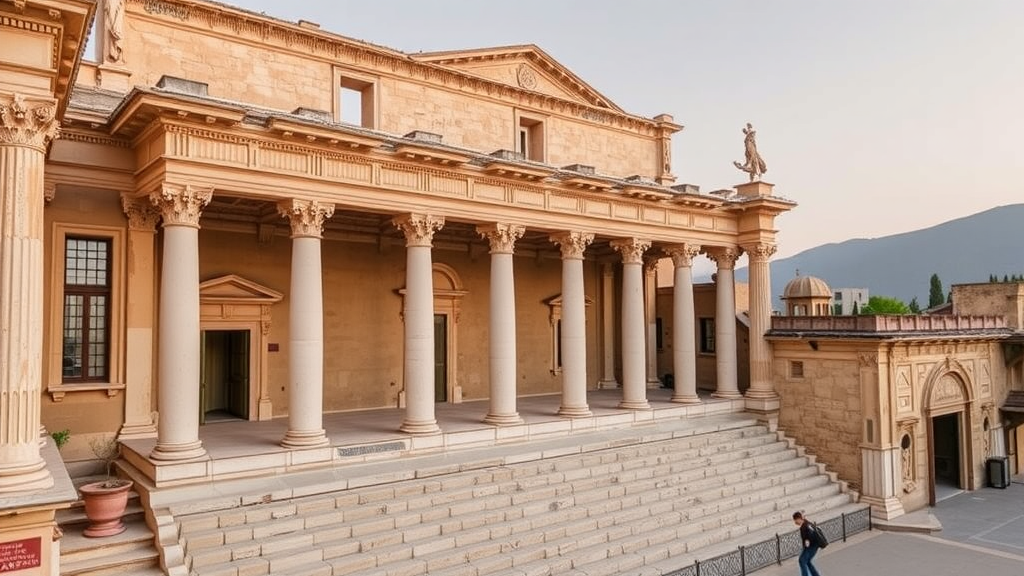
A comprehensive architectural monograph examining one of the best-preserved theatres of the ancient Greek world has received one of the most respected honors in Mediterranean studies. The Theatre at Messene: An Architectural Study, written by Associate Professor Ryuichi Yoshitake of Kumamoto University’s Faculty of Advanced Science and Technology, has been awarded the 2026 Herend Award by the Collegium Mediterranistarum, the Japan-based academic society devoted to Mediterranean culture. The recognition places Yoshitake’s volume among a select group of scholarly works that the society considers to have opened genuinely new paths of inquiry into the civilizations that ringed the Mediterranean Sea in antiquity.
The award was formally conferred on June 27, 2026, during a ceremony held at the 50th Annual Conference of the Collegium Mediterranistarum in Tokyo. The milestone anniversary lent particular weight to the occasion, as the society marked half a century of promoting interdisciplinary research on the Mediterranean region while simultaneously honoring a new generation of scholars. The Herend Award, established in 1995 with the support of the Herend Porcelain Manufactory and its Japan sole distributor Hoshi Shoji Co., Ltd., is granted annually to promising young researchers for exceptional books and scholarly contributions concerning Mediterranean culture. Recipients traditionally receive an exquisite Herend porcelain decorative plate bearing the Gardens of the Mediterranean motif, inscribed with the winner’s name in gold, a fitting emblem for a prize that celebrates the intersection of European craft tradition and rigorous academic achievement.
The honored publication itself appeared under the imprint of the German Archaeological Institute, the Deutsches Archäologisches Institut, one of the most authoritative publishing venues for classical archaeology. Its subject, the ancient theatre at Messene, stands in the southwestern Peloponnese of Greece, where the ruins of the Hellenistic city founded in 369 BCE survive with unusual completeness. Unlike many ancient theatres whose superstructures have vanished almost entirely, Messene’s theatre retains substantial remains of its cavea, or seating structure, along with architectural fragments scattered across the site. This preservation allowed Yoshitake to undertake something rarely achievable for monuments of this class: a full architectural study that reconstructs the building’s design, construction history, and transformation across centuries of use.
At the heart of the monograph is a methodological commitment to meticulous documentation combined with detailed architectural reconstruction. Architectural studies of ancient theatres depend on the patient recording of every surviving block, seat, stairway, and fragment of masonry, followed by the analytical work of fitting those pieces into a coherent three-dimensional understanding of the original structure. By applying this approach to Messene, Yoshitake has produced the first comprehensive study of the theatre’s remarkably well-preserved ruins and architectural fragments. The volume traces the monumental evolution of Greek into Roman theatre architecture on the Greek mainland, a transition that has long fascinated historians of building technology because it encapsulates broader cultural and political shifts accompanying Roman expansion into the Hellenistic East.
One of the study’s most significant contributions lies in its analysis of the reuse of Hellenistic building materials. Ancient builders frequently recycled stone blocks, seats, and structural elements from earlier phases of a monument when renovating or rebuilding it, and these reused components preserve valuable evidence of earlier construction techniques and dimensions. By carefully distinguishing original Hellenistic fabric from later Roman interventions, the study is able to read the theatre at Messene as a layered document, one whose stones record successive generations of design decisions. This stratigraphic reading of architecture allows scholars to follow not only how the building looked at any given moment but also how engineering practices, aesthetic preferences, and civic priorities changed as Greek civic culture adapted to Roman rule.
Equally innovative is the monograph’s attention to ephemeral elements of ancient theatrical infrastructure that rarely survive in the archaeological record. Yoshitake’s study explores mobile wooden stages, temporary structures erected for performances that left little direct trace, and mechanisms derived from siege technology, devices whose engineering principles were transferred from military engineering to the staging of spectacles. These reconstructions address a persistent problem in theatre studies: the visible stone shell of an ancient theatre represents only part of the performance environment, while the machinery that enabled scene changes, special effects, and actor movement was often made of perishable materials. By reasoning from structural evidence, parallels, and engineering principles, the study sheds new light on ancient engineering and design practices that conventional excavation alone cannot recover.
The significance of this work extends beyond the boundaries of a single monument. Theatres were among the most complex buildings produced by ancient societies, requiring sophisticated understanding of geometry, acoustics, load-bearing structures, drainage, and audience circulation. Tracing how a Greek theatre of the Hellenistic period was modified under Roman influence illuminates the transfer of building technologies across the Mediterranean world and the ways in which local craftsmen and imperial authorities negotiated architectural change. The theatre at Messene, with its unusually complete remains, offers an exceptional case study for this process, and Yoshitake’s comprehensive treatment makes it newly available as a reference point for comparative studies of theatres throughout Greece, Asia Minor, and the wider Roman world.
The monograph also stands as a vital contribution to the understanding of ancient construction processes and urban evolution. Theatres did not exist in isolation; they anchored the civic life of the cities that built them, hosting festivals, political assemblies, and public spectacles that defined urban identity. Reconstructing the building history of the theatre at Messene therefore contributes to a broader picture of how the city developed, how its public spaces were maintained and transformed, and how investment in monumental architecture reflected the shifting fortunes of the community. Studies of this kind demonstrate that architecture, read carefully, can serve as a historical archive in its own right, complementing texts and inscriptions with material testimony.
For the Collegium Mediterranistarum, the awarding of the Herend Award to this volume reflects the society’s enduring mission of encouraging pioneering academic inquiry across Mediterranean studies. Founded to bring together Japanese researchers working on the many cultures of the Mediterranean basin, the Collegium has used the Herend Award since 1995 to spotlight scholarly work by early- and mid-career researchers whose contributions promise to shape their fields for decades. Yoshitake’s recognition underscores the increasingly international character of classical archaeology, in which a scholar based at a Japanese university can produce a definitive study of a Greek monument published by a German research institute and honored by a Japanese Mediterranean studies society, a network of collaboration that mirrors the ancient connectivity of the region itself.
The full monograph is available through the iDAI.publications catalog of the German Archaeological Institute, where readers can access the complete architectural documentation, reconstructions, and analysis that earned the work its distinction. As research on ancient theatres continues to evolve, incorporating digital surveying, three-dimensional modeling, and new perspectives on performance culture, The Theatre at Messene: An Architectural Study provides a foundational baseline of carefully verified observation against which future interpretations can be tested. The 2026 Herend Award affirms that such patient, technically rigorous architectural scholarship remains central to understanding the ancient Mediterranean, and it signals to the field that the theatre of Messene, long admired by visitors to the Peloponnese, has now received the comprehensive scholarly treatment its exceptional preservation deserves.
Subject of Research: Comprehensive architectural study of the ancient Greek theatre at Messene and its evolution from Hellenistic to Roman design
Article Title: Prestigious Herend Award bestowed upon comprehensive architectural study of the theatre at Messene
Article References: Prestigious Herend Award bestowed upon comprehensive architectural study of the theatre at Messene. (n.d.). Original publication
Image Credits: AI Generated
DOI: Not provided
Keywords: Herend Award, Messene, ancient theatre, archaeology, Greek architecture, Roman architecture, Hellenistic, Kumamoto University, German Archaeological Institute, Collegium Mediterranistarum, architectural reconstruction, Mediterranean studies
Cite Scienmag News
Denise Maddox. (September 13, 2026). Herend Award Honors Landmark Architectural Study of Ancient Theatre at Messene. Scienmag. https://scienmag.com/herend-award-honors-landmark-architectural-study-of-ancient-theatre-at-messene/
Denise Maddox. "Herend Award Honors Landmark Architectural Study of Ancient Theatre at Messene." Scienmag, 13 September 2026, https://scienmag.com/herend-award-honors-landmark-architectural-study-of-ancient-theatre-at-messene/. Accessed 13 September 2026.
Denise Maddox. "Herend Award Honors Landmark Architectural Study of Ancient Theatre at Messene." Scienmag. September 13, 2026. https://scienmag.com/herend-award-honors-landmark-architectural-study-of-ancient-theatre-at-messene/


