


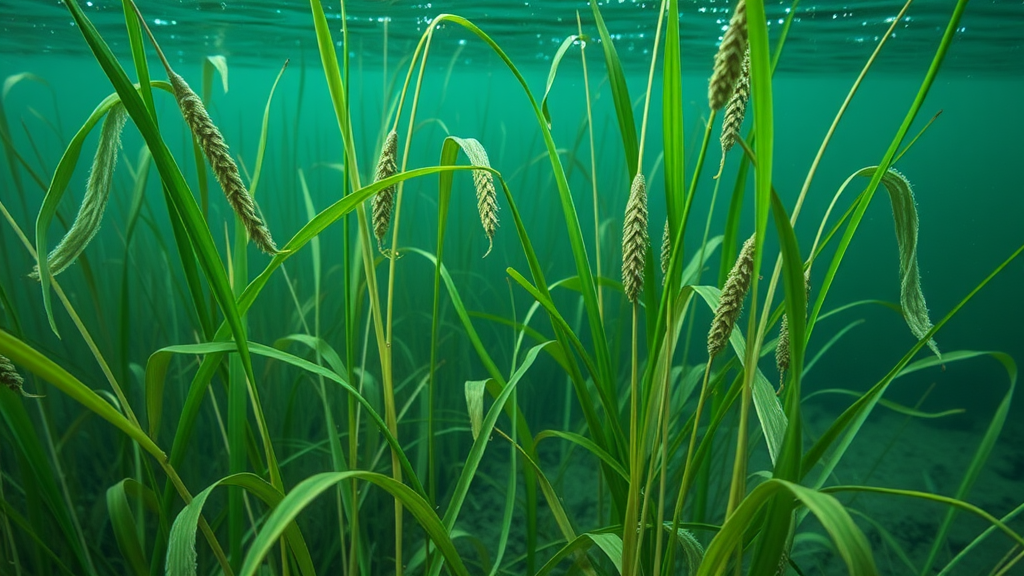
The Chesapeake Bay’s underwater grass meadows, long regarded as one of the most sensitive barometers of the estuary’s ecological condition, expanded by 7 percent in 2025, according to researchers at William & Mary’s VIMS & Batten School of Coastal & Marine Sciences. The annual Bay-wide aerial survey documented a total of 89,385 acres of submerged aquatic vegetation across the Chesapeake Bay and its tidal tributaries, an increase of 6,134 acres over the 2024 estimate. The figure marks the highest Bay-wide acreage recorded since 2018 and brings the estuary within striking distance of the Chesapeake Bay Watershed Agreement’s 2030 interim restoration goal of 90,000 acres. It also represents roughly 45 percent of the long-term restoration target of 196,600 acres, a benchmark rooted in historical reconstructions of how much grass the Bay once supported.
The new numbers capture both how far the ecosystem has come and how much work remains. When systematic monitoring began in 1984, underwater grass coverage had collapsed to approximately 39,000 acres, the residue of decades of nutrient pollution, sediment runoff and habitat degradation that pushed the Bay’s once-extensive meadows to historic lows in the 1980s. Abundance has since more than doubled, a trajectory researchers attribute in large part to nutrient reduction measures implemented throughout the 64,000-square-mile watershed. The 2025 results suggest those sustained investments continue to pay ecological dividends, even as climate change, shifting land-use pressures and localized environmental stressors introduce new complications for restoration planners.
Christopher J. Patrick, associate professor and director of the SAV Program at VIMS & the Batten School, said the survey reflects a recovery that is both encouraging and uneven. This year’s results, he noted, demonstrate that the Bay is moving in the right direction while also revealing considerable complexity in the composition and behavior of its underwater grass communities. Strong recovery continues in the main basin, particularly in the saltier portions of the Bay, while some localized freshwater areas have experienced setbacks. Patrick emphasized that the mainstem recoveries are especially meaningful because they indicate that watershed-level management actions are producing measurable positive outcomes at the scale of the entire estuary.
Much of the 2025 increase was driven by continued expansion in the Bay’s higher-salinity waters. The Polyhaline Zone, which encompasses the saltiest waters near the Bay’s mouth, grew from 25,266 acres in 2024 to an estimated 28,142 acres in 2025, setting a new record for the second consecutive year. The moderately salty Mesohaline Zone expanded nearly 15 percent, from 33,033 acres in 2024 to an estimated 37,879 acres in 2025. Researchers attribute much of this growth, including the record-setting expansion of eelgrass meadows, to sustained year-over-year improvements in water clarity in the lower Bay. Recent work has documented consistent water-quality gains throughout the Chesapeake Bay mainstem over the past several years, and the concurrent expansion of eelgrass, both in the size of existing beds and into deeper waters, is consistent with those improvements.
Similar processes appear to be driving the expansion of widgeon grass in the middle portion of the Bay, a species that is still rebounding from a dramatic crash triggered by exceptionally wet conditions in 2018. Heavy rainfall years deliver pulses of nutrients and sediment that cloud the water and suppress the light these plants need for photosynthesis, and the 2018 event demonstrated how vulnerable even recovering beds can be to climatic variability. The fact that widgeon grass has reestablished itself in the years since underscores the resilience of these communities when the underlying conditions that govern light availability begin to stabilize. Patrick described the pace of change in the lower Bay as remarkable, noting how rapidly seagrass can recover when conditions are right and expressing hope that the Bay’s ultimate seagrass restoration goals remain achievable.
Despite the Bay-wide gains, the survey revealed distinct declines in other portions of the estuary, a reminder that aggregate statistics can mask divergent regional trajectories. The Tidal Fresh Zone, a collection of spatially isolated upstream rivers and embayments, experienced a small decline, falling from 20,221 acres to an estimated 18,653 acres. Researchers observed particularly significant losses in several Virginia tributaries, including portions of the upper Rappahannock River. These declines were driven largely by reductions in Hydrilla verticillata, an invasive aquatic plant commonly known as water thyme that has expanded and contracted across multiple river systems in recent years. Because hydrilla can dominate freshwater beds, its fluctuations can swing regional totals even when native vegetation remains comparatively stable.
The slightly salty Oligohaline Zone, by contrast, remained relatively stable overall at just over 4,700 acres, with gains in several portions of the Bay helping to offset losses elsewhere. Patrick stressed that the Bay is not a single ecosystem but a collection of many distinct habitats, each responding differently to rainfall, water quality, salinity and other environmental factors and stressors. What emerged from this year’s survey, he said, is a reminder that Bay-wide trends are really the sum of many regional stories. Researchers say these contrasting patterns highlight the complexity of restoring underwater grasses across a watershed that spans parts of six states and the District of Columbia, where geography, land use, rainfall patterns, water clarity and local environmental conditions all shape how grass beds respond from one year to the next.
The ecological stakes of this recovery extend well beyond the meadows themselves. Underwater grasses provide essential habitat for fish, blue crabs, waterfowl and countless other species, functioning as nursery grounds, foraging areas and refuge from predators. They also perform a suite of ecosystem services that directly improve water quality: absorbing excess nutrients, stabilizing sediments, reducing shoreline erosion, sequestering carbon and producing oxygen through photosynthesis. Because submerged aquatic vegetation responds quickly to changes in environmental conditions, scientists consider it one of the most sensitive and informative indicators of overall Bay health, a living gauge that integrates the effects of upstream land management, wastewater treatment, atmospheric deposition and climate variability into a single measurable signal.
Historical evidence suggests the Chesapeake Bay once supported between 200,000 and 600,000 acres of underwater grasses, a range that dwarfs today’s totals and frames the scale of the restoration challenge. The 2025 acreage of 89,385 acres, while the highest since 2018, still leaves the Bay at less than half of the 196,600-acre long-term goal. Yet the trajectory of the past four decades offers what researchers describe as genuine grounds for optimism. Recovery has proven possible, Patrick said, and the gains documented since monitoring began reflect the benefits of cleaner water and sustained restoration effort. Continuing that progress, he cautioned, will require ongoing support for science, habitat conservation and water-quality improvements throughout the watershed. For the scientists who fly the aerial surveys each year and the managers who translate the results into policy, the 2025 findings serve as both a validation of past investments and a measure of the distance still to be traveled in restoring one of the world’s largest and most closely studied estuaries.
Subject of Research: Annual monitoring of submerged aquatic vegetation recovery in the Chesapeake Bay
Article Title: Chesapeake Bay underwater grasses increase 7%, buoyed by gains in salty waters
Article References: Chesapeake Bay underwater grasses increase 7%, buoyed by gains in salty waters. (n.d.). Original publication
Image Credits: AI Generated
DOI: Not provided
Keywords: Chesapeake Bay, submerged aquatic vegetation, eelgrass, widgeon grass, water quality, seagrass restoration, water clarity, VIMS, estuary health, nutrient reduction, Polyhaline Zone, habitat restoration
Cite Scienmag News
Violet Maxwell. (September 12, 2026). Underwater Grasses in Chesapeake Bay Rise 7 Percent as Salty Waters Lead Recovery. Scienmag. https://scienmag.com/underwater-grasses-in-chesapeake-bay-rise-7-percent-as-salty-waters-lead-recovery/
Violet Maxwell. "Underwater Grasses in Chesapeake Bay Rise 7 Percent as Salty Waters Lead Recovery." Scienmag, 12 September 2026, https://scienmag.com/underwater-grasses-in-chesapeake-bay-rise-7-percent-as-salty-waters-lead-recovery/. Accessed 12 September 2026.
Violet Maxwell. "Underwater Grasses in Chesapeake Bay Rise 7 Percent as Salty Waters Lead Recovery." Scienmag. September 12, 2026. https://scienmag.com/underwater-grasses-in-chesapeake-bay-rise-7-percent-as-salty-waters-lead-recovery/


